


WBJEE · Maths · Application of Derivatives
Consider the curve \(y=\) be \(^{-\frac{x}{ \text { a }}}\) where \(a\) and \(b\) are non-zero real numbers. Then
- A \(\frac{x}{a}+\frac{y}{b}=1\) is tangent to the curve at \((0,0)\)
- B \(\frac{x}{a}+\frac{y}{b}=1\) is tangent to the curve where the curve crosses the axis of \(y\)
- C \(\frac{x}{a}+\frac{Y}{b}=1\) is tangent to the curve at \((a, 0)\)
- D \(\frac{x}{a}+\frac{y}{b}=1\) is tangent to the curve at \((2 a, 0)\)
Answer & Solution
Correct Answer
(B) \(\frac{x}{a}+\frac{y}{b}=1\) is tangent to the curve where the curve crosses the axis of \(y\)
Step-by-step Solution
Detailed explanation
Hint: \(y-b=-\frac{b}{a}(x) \Rightarrow \frac{x}{a}+\frac{y}{b}=1\)
See the Complete Solution
Get step-by-step explanations for this and 2.5 Lakh+ more JEE, NEET & CET questions.
- Unlock all solutions
- Practice the full chapter
- Track accuracy across PYQs
4.8 rated on Google Play · 14,000+ reviews
More questions from Maths
- The Rolle's theorem is applicable in the interval \(-1 \leq \mathrm{x} \leq 1\) for the functionWBJEE 2009 Easy
- If the algebraic sum of the distances from the points \((2,0),(0,2)\) and \((1,1)\) to a variable straight line be zero, then the line passes through the fixed pointWBJEE 2022 Medium
- If \(f(x)\) and \(g(x)\) are two polynomials such that \(\phi(x)=f\left(x^3\right)+x g\left(x^3\right)\) is divisible by \(x^2+x+1\), thenWBJEE 2025 Hard
- \(f(x)=x+|x|\) is continuous forWBJEE 2009 Medium
- The domain of definition of \(f(x)=\sqrt{\frac{1-|x|}{2-|x|}}\) is Here \((a, b)=\{x: a < x < b\}\) and
\([a, b]=\{x: a \leq x \leq b\}\)WBJEE 2018 Medium - The number of solutions of the equation \(\log _{2}\left(x^{2}+2 x-1\right)=1\) isWBJEE 2012 Easy
More PYQs from WBJEE
- The \(I\) - \(V\) characteristics of a metal wire at two different temperatures \(\left(T_{1}\right.\) and \(T_{2}\) ) are given in the adjoining figure. Here, we can conclude that
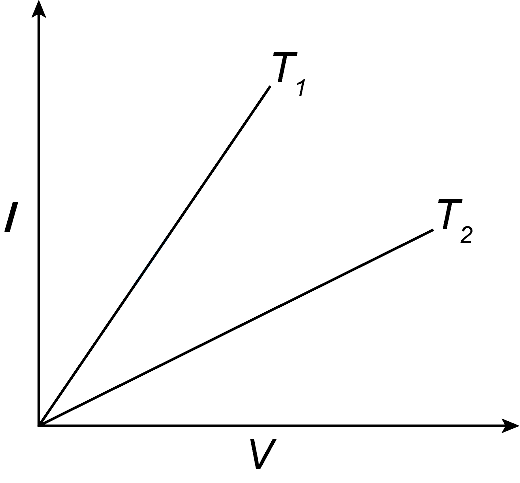 WBJEE 2012 Easy
 - Consider the equation \(y-y_1=m\left(x-x_1\right)\). If \(m\) and \(x_1\) are fixed and different lines are drawn for different values of \(y_1\), thenWBJEE 2022 Easy
- The number of unpaired electrons in Ni (atomic number \(=28\) ) areWBJEE 2018 Easy
- With origin as a foucs and x = 4 as corresponding directrix, a family of ellipse are drawn. Then the locus of an end of
minor axis isWBJEE 2024 Medium - If \(f(x)=\left\{\begin{array}{ll}x^2+3 x+a, & x \leq 1 \\ b x+2, & x\gt1\end{array}, x \in \mathbb{R}\right.\), is everywhere differentiable, thenWBJEE 2025 Medium
- The circles \(\mathrm{x}^2+\mathrm{y}^2-10 \mathrm{x}+16=0\) and \(\mathrm{x}^2+\mathrm{y}^2=\mathrm{a}^2\) intersect at two distinct points ifWBJEE 2009 Medium