


WBJEE · Maths · Straight Lines
A square with each side equal to 'a' above the \(x\)-axis and has one vertex at the origin. One of the sides passing through the origin makes an angle \(\alpha\left(0 \lt \alpha \lt \frac{\pi}{4}\right)\) with the positive direction of the axis. Equation of the diagonals of the square.
- A \(y(\cos \alpha-\sin \alpha)=x(\sin \alpha+\cos \alpha)\)
- B \(y(\cos \alpha+\sin \alpha)=x(\cos \alpha-\sin \alpha)\)
- C \(y(\sin \alpha+\cos \alpha)+x(\cos \alpha-\sin \alpha)=a\)
- D \(y(\cos \alpha-\sin \alpha)+x(\cos \alpha+\sin \alpha)=a\)
Answer & Solution
Correct Answer
(C) \(y(\sin \alpha+\cos \alpha)+x(\cos \alpha-\sin \alpha)=a\)
Step-by-step Solution
Detailed explanation
The parametric coordinate of one vertex of square is \((0+a \cos a, 0+a \sin a)\) Inclination of diagonal not passing through origin is \(135^{\circ}+\mathrm{a}\) \(\therefore\) equation of the diagonal which is not passing through origin is…
See the Complete Solution
Get step-by-step explanations for this and 2.5 Lakh+ more JEE, NEET & CET questions.
- Unlock all solutions
- Practice the full chapter
- Track accuracy across PYQs
4.8 rated on Google Play · 14,000+ reviews
More questions from Maths
- If the four points with position vectors \(-2\hat i+\hat j + \hat k, \hat i+\hat j+\hat k,\hat j- \hat k\) and \(\lambda \hat j + \hat k\) are coplanar, then \(\lambda\) is equal toWBJEE 2015 Easy
- The equation of auxiliary circle of the ellipse \(16 x^{2}+25 y^{2}+32 x-100 y=284\) isWBJEE 2016 Easy
- Let \(f\) be a non-constant continuous function for all \(x \geq 0\). Let \(f\) satisfy the relation \(f(x) f(a-x)=1\) for some \(a \in R^{+}\). Then, \(I=\int_{0}^{a} \frac{d x}{1+f(x)}\) is equal toWBJEE 2017 Medium
- Let \(Q=\left(\begin{array}{cc}\cos \frac{\pi}{4} & -\sin \frac{\pi}{4} \\ \sin \frac{\pi}{4} & \cos \frac{\pi}{4}\end{array}\right)\) and\(x=\left(\begin{array}{c}\frac{1}{\sqrt{2}} \\ \frac{1}{\sqrt{2}}\end{array}\right)\) then \(Q^{3} x\) is equal toWBJEE 2016 Medium
- The approximate value of \(\sqrt[5]{33}\) correct to 4 decimal places isWBJEE 2011 Medium
- The function \(f: \mathbb{R} \rightarrow \mathbb{R}\) defined by \(f(x)=e^x+e^{-x}\) isWBJEE 2024 Easy
More PYQs from WBJEE
- A glass slab consists of thin uniform layers of progressively decreasing refractive indices RI (see figure) such that the RI of any layer is \(\mu-m \Delta \mu\). Here, \(\mu\) and \(\Delta \mu\) denote the \(\mathrm{RI}\) of 0 th layer and the difference in RI between any two consecutive layers, respectively. The integer \(m=0,1,2,3, \ldots\) denotes the numbers of the successive layers. A ray of light from the oth layer enters the 1st layer at an angle of incidence of \(30^{\circ}\). After undergoing the mth refraction, the ray emerges parallel to the interface. If \(\mu=1.5\) and \(\Delta \mu=0.015,\) the value of \(m\) is
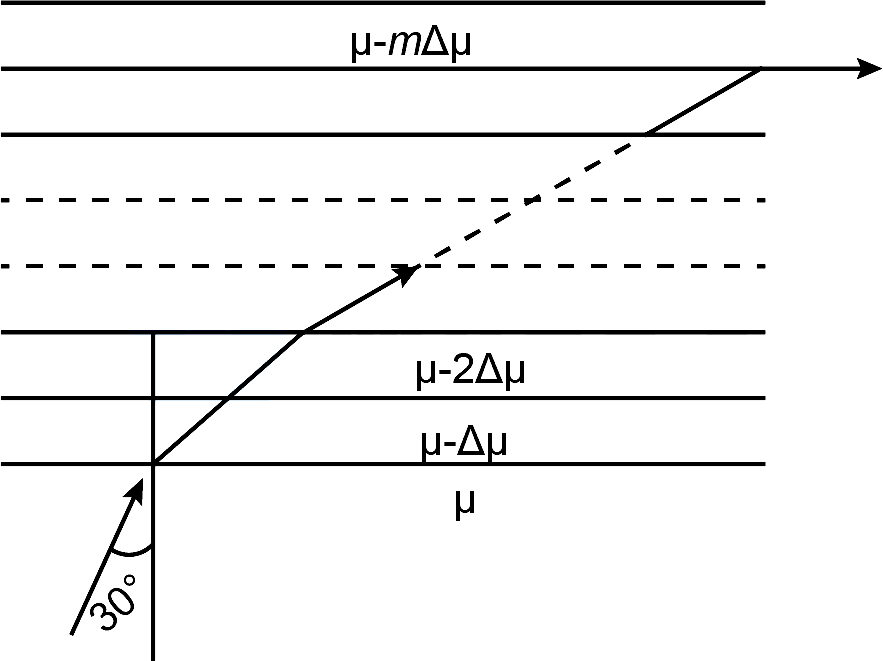 WBJEE 2014 Medium
 - An earth's satellite nejar the surface of the earth takes about 90 min per revolution. A satellite orbiting the moon also takes about 90 min per revolution. Then which of the following is true?WBJEE 2023 Hard
- Each of \(a\) and \(b\) can take values 1 or 2 with equal probability. The probability that the equation \(a x^{2}+b x+1=0\) has real roots, is equal toWBJEE 2013 Easy
- Six wires, each of resistance \(r\), are connected so as to form a tetrahedron. The equivalent resistance of the combination when current enters through one corner and leaves through some other corner isWBJEE 2017 Hard
- There are two coins, one unbiased with probaility \(\frac{1}{2}\) or getting heads and the other one is biased with probability \(\frac{3}{4}\) of getting heads. A coin is selected at random and tossed. It shows heads up. Then, the probability that the unbiased coin wa selected isWBJEE 2013 Easy
- If \(Z_{r}=\sin \frac{2 \pi}{11}-i \cos \frac{2 \pi}{11},\) then \(\sum_{r=0}^{10} Z_{r}\) is equal toWBJEE 2018 Easy