


TS EAMCET · Physics · Magnetic Effects of Current
Two infinitely long straight wires \(A\) and \(B\), each carrying current \(I\) are placed on \(x\) and \(y\)-axis, respectively. The current in wires \(A\) and \(B\) flow along \(-\hat{\mathbf{i}}\) and \(\hat{\mathbf{j}}\) directions respectively. The force on a charged particle having charge \(q\), moving from position, \(\mathbf{r}=d(\hat{\mathbf{i}}+\hat{\mathbf{j}})\) with velocity \(\mathbf{v}=\hat{v}\) is
- A \(\frac{\mu_0 f v^{\prime}}{2 \pi \sigma^{\prime}} \hat{\mathbf{j}}\)
- B \(\frac{\mu_0 f q v}{\pi \sigma^{\prime}} \hat{\mathbf{j}}\)
- C \(\frac{\mu_0 f Q v}{\sqrt{2} \pi \phi} \hat{\mathbf{k}}\)
- D 0
Answer & Solution
Correct Answer
(B) \(\frac{\mu_0 f q v}{\pi \sigma^{\prime}} \hat{\mathbf{j}}\)
Step-by-step Solution
Detailed explanation
The given situation for two current carrying wires are shown in the figures. Position vector of charge particle, \( \mathbf{r}=d(\hat{\mathbf{i}}+\hat{\mathbf{j}})=d \hat{\mathbf{i}}+d \hat{\mathbf{j}} \) The magnetic field intensity due to the wire along \(-\hat{\mathbf{i}}\)…
See the Complete Solution
Get step-by-step explanations for this and 2.5 Lakh+ more JEE, NEET & CET questions.
- Unlock all solutions
- Practice the full chapter
- Track accuracy across PYQs
4.8 rated on Google Play · 14,000+ reviews
More questions from Physics
- Which of the following principles is being used in Sonar Technology?TS EAMCET 2017 Easy
- The lengths of two wires made of the same material are in the ratio \(2: 3\) and their radii are in the ratio \(1: 2\). If the two wires are connected in parallel to a battery, then the ratio of the drift velocities of free electrons in the two wires isTS EAMCET 2025 Medium
- To excite the spectral line of wavelength of an atom, an excitation energy of is required. The ground state energy of the atom is . The energies of two levels involved in the emission of line are (Assume he , where is Planck's constant and is speed of light)TS EAMCET 2019 Easy
- An amplitude modulated wave is represented by \(c_m(t)= 10[1+0.6 \sin (1250 \mathrm{t})] \sin \left(10^8 \mathrm{t}\right)\). Then the modulation index isTS EAMCET 2023 Medium
- Two small spheres each having equal positive charge \(Q\) (Coulomb) on each are suspended by two insulating strings of equal length \(L\) (metre) from a rigid hook (shown in figure). The whole set up is taken into satellite where there is no gravity. The two balls are now held by electrostatic forces in horizontal position, the tension in each string is then
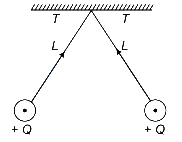 TS EAMCET 2012 Medium
 - The machine gun fires 240 bullets per minute. If the mass of each bullet is \(10 \mathrm{~g}\) and the velocity of the bullets is \(600 \mathrm{~ms}^{-1}\), the power (in kW) of the gun isTS EAMCET 2005 Medium
More PYQs from TS EAMCET
- A solid cylinder is released from rest from the top of an inclined plane of inclination \(30^{\circ}\) and length \(60 \mathrm{~cm}\). If the cylinder rolls without slipping, then the speed when it reaches the bottom isTS EAMCET 2020 Hard
- If a planet of mass \(6.4 \times 10^{23} \mathrm{~kg}\) can be compressed into a sphere such that the escape velocity from its surface is \(8 \times 10^4 \mathrm{~m} / \mathrm{s}\), then what showld be the radius of the sphere? (Gravitational constant, \(G=6.6 \times 10^{11} \mathrm{Nm}^2 \mathrm{~kg}^2\) )TS EAMCET 2019 Easy
- The displacement equations of sound waves produced by two sources are given by \(y_1=5 \sin 400 \pi t\) and \(y_2=\) \(8 \sin 408 \pi t\), where ' \(t\) ' is time in seconds. If the waves are produced simultaneously, the number of beats produced per minute isTS EAMCET 2024 Medium
- A given mass of a gas is compressed isothermally until its pressure is doubled. It is then allowed to expand adiabatically until its original volume is restored and its pressure is then found to be 0.75 of its initial pressure. The ratio of the specific heats of the gas is approximately :TS EAMCET 2006 Easy
- What is the dimension of \(\frac{1}{\mu_0 \varepsilon_0}\) ? \(\left(\mu_0=\right.\) magnetic permeability and \(\varepsilon_0=\) permittivity of free space)TS EAMCET 2020 Easy
- A magnetic dipole is under the influence of two orthogonal magnetic fields, \(B_1=0.5 \times 10^{-3} \mathrm{~T}\) and \(B_2=0.866 \times 10^{-3} \mathrm{~T}\). If the dipole comes to stable equilibrium at an angle \(\theta\) with respect to \(B_2\) field, then the value of \(\theta\) isTS EAMCET 2018 Easy