


TS EAMCET · Physics · Motion In Two Dimensions
Consider an object making uniform motion around a circle of radius \(5 \mathrm{~m}\) with tangential velocity \(2 \mathrm{~ms}^{-1}\). The time it takes to complete 2 revolution and the magnitude of acceleration respectively are
- A \(0.2 \pi \mathrm{s}\) and \(0.8 \mathrm{~ms}^{-2}\)
- B \(0.5 \pi \mathrm{s}\) and \(1 \mathrm{~ms}^{-2}\)
- C \(10 \pi \mathrm{s}\) and \(0.8 \mathrm{~ms}^{-2}\)
- D \(5 \pi \mathrm{s}\) and \(5 \mathrm{~ms}^{-2}\)
Answer & Solution
Correct Answer
(C) \(10 \pi \mathrm{s}\) and \(0.8 \mathrm{~ms}^{-2}\)
Step-by-step Solution
Detailed explanation
Given that, circle of radius \(=5 \mathrm{~m}\) tangential velocity \(=2 \mathrm{~m} / \mathrm{s}\) \( \text { Here, } 2 \text { revolutions complete by object. } \) \(\because\) We know that,…
See the Complete Solution
Get step-by-step explanations for this and 2.5 Lakh+ more JEE, NEET & CET questions.
- Unlock all solutions
- Practice the full chapter
- Track accuracy across PYQs
4.8 rated on Google Play · 14,000+ reviews
More questions from Physics
- Wavelength of light used in an optical instruments are \(\lambda_1=4000 Å\) and \(\lambda_2=5000 Å\), then the ratio of their respective resolving powers (corresponding to \(\lambda_1\) and \(\lambda_2\) ) isTS EAMCET 2020 Easy
- A soap bubble of initial radius \(R\) is to be blown up. The surface tension of the soap film is \(\mathrm{T}\). The surface energy needed to double the diameter of the bubble isTS EAMCET 2022 Easy
- If the terminal velocity of a metal sphere of mass 8 g falling through a liquid is \(3 \mathrm{cms}^{-1}\), then the terminal velocity of another sphere of mass 64 g made of the same metal falling through same liquid isTS EAMCET 2025 Medium
- The two surfaces of a biconvex lens has same radii of curvatures. This lens is made of glass of refractive index 1.5 and has a focal length \(10 \mathrm{~cm}\) in air. The lens is cut into two equal halves along a plane perpendicular to its principal axis to yield two plano-convex lenses. The two pieces are glued such that the convex surfaces touch each other. If this combination lens is immersed in water (refractive index \(=\) \(4 / 3\) ), its focal length (in \(\mathrm{cm}\) ) is :TS EAMCET 2006 Medium
- The electric resistance of a certain wire of iron is \(R\). If its length and radius are both doubled, thenTS EAMCET 2023 Easy
- In planetary motion the areal velocity of position vector of a planet depends on angular velocity \(\omega\) and the distance of the planet from sun \(r\). The correct relation for areal velocity isTS EAMCET 2003 Easy
More PYQs from TS EAMCET
- The velocity of an object of mass \(2 \mathrm{~kg}\) is given by \(\mathbf{v}=\left(8 t \hat{\mathbf{i}}+3 t^2 \hat{\mathbf{j}}\right) \mathrm{m} / \mathrm{s}\), where \(t\) is time in seconds. What will be the direction of net force on the object relative to the positive direction of \(X\)-axis, at the instant when its magnitude is \(20 \mathrm{~N} ?\)TS EAMCET 2020 Medium
- Two infinitely long thin wires are placed at \((1 \mathrm{~cm}, 0 \mathrm{~cm})\) and \((2 \mathrm{~cm}, 0 \mathrm{~cm})\) as shown in the figure.
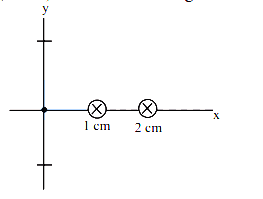
The same current \(i\) flows in both the wires in the same direction, say, into the page. Let the magnetic field at the origin due to these wires is \(\overrightarrow{\mathrm{B}}\). If \(\mathrm{B}_0\) is the magnitude of the magnetic field if only the wire at \((1 \mathrm{~cm}, 0 \mathrm{~cm})\) was present, then the value of \(\mathrm{B} / \mathrm{B}_0\) isTS EAMCET 2022 Easy - A rocket lifts off from the ground and accelerates upwards at . seconds after liftoff a piece breaks off from the bottom of the rocket. After breaking off, how much time it takes approximately to reach the ground? (Take )TS EAMCET 2021 Medium
- A body of mass 0.5 kg is supplied with a power ' P ' (in watt) which varies with time ' t ' (in second) as \(\mathrm{P}=3 \mathrm{t}^2+3\). If the velocity of the body at time \(\mathrm{t}=0\) is zero, then the velocity of the body at time \(t=3 \mathrm{~s}\) isTS EAMCET 2025 Medium
- The dimension of angular momentum in mass \((M)\), length \((L)\) and time \((T)\) isTS EAMCET 2020 Easy
- A particle moves from \((1,0,3)\) to the point \((-3,4,5)\), when a force \(\mathbf{F}=\hat{\mathbf{i}}+5 \hat{\mathbf{k}}\) acts on it. Amount of work done in joules isTS EAMCET 2016 Easy