


TS EAMCET · Physics · Motion In One Dimension
A ball is thrown straight upward from ground with a speed of \(20 \mathrm{~m} / \mathrm{s}\). The ball was caught on its way down at a point \(5 \mathrm{~m}\) above the ground. The time taken by the ball during entire trip is (assume, \(g=10 \mathrm{~m} / \mathrm{s}^2\) )
- A \(2+\sqrt{3} s\)
- B \(3-\sqrt{3} s\)
- C \(2+\sqrt{2} s\)
- D \(3.5 \mathrm{~s}\)
Answer & Solution
Correct Answer
(A) \(2+\sqrt{3} s\)
Step-by-step Solution
Detailed explanation
The given situation of entire motion of ball is shown in the following figure. Initial speed of ball, \(u=20 \mathrm{~m} / \mathrm{s}\) Total time taken by the ball to reach at highest point \(P\) is \(t_1\), then from equation of vertical motion…
See the Complete Solution
Get step-by-step explanations for this and 2.5 Lakh+ more JEE, NEET & CET questions.
- Unlock all solutions
- Practice the full chapter
- Track accuracy across PYQs
4.8 rated on Google Play · 14,000+ reviews
More questions from Physics
- The potential difference between the terminals of a cell is 20 V when a current of 2 A flows through the circuit. When the direction of current in the circuit is reversed, the potential difference between the terminals of the cell is 30 V. The internal resistance of the cell isTS EAMCET 2025 Medium
- The two lenses of an achromatic doublet should haveTS EAMCET 2009 Easy
- \(\alpha\)-decay of a parent nucleus \(\mathrm{X}\) results in a daughter nucleus Y. If \(m_x, m_y\) and \(m_a\) are the masses of the parent nucleus, the daughter nucleus and the \(\alpha\) - particle respectively, then the net kinetic.energy gained in the process isTS EAMCET 2023 Easy
- Two objects are located at height above the ground. At some point of time, the objects are thrown with initial velocity at an angle and with the positive -axis respectively. Assuming , the velocity vectors will be perpendicular to each other at time equal toTS EAMCET 2018 Medium
- Three bodies, a ring, a solid disc and a solid sphere roll down the same inclined plane without slipping. The radii of the bodies are Identical and they start from rest. If \(V_S, V_R\) and \(V_D\) are the speeds of the sphere, ring and disc, respectively when they reach the bottom, then the correct option isTS EAMCET 2019 Easy
- What will be the energy released in joule, in the process of fission by \(1 \mathrm{mg}\) of \({ }_{92}^{240} \mathrm{U}\). Assume energy release per fission is \(200 \mathrm{MeV}\). [useAvogadro's number as \(6 \times 10^{23}\) and \(1 \mathrm{eV}=1.6 \times 10^{-19} \mathrm{~J}\) ]TS EAMCET 2022 Hard
More PYQs from TS EAMCET
- An object of mass \(15 \mathrm{~kg}\) is attached to the end of a metal wire of unstretched length \(1.0 \mathrm{~m}\). The object is then whirled in a vertical circle with an angular velocity of 4 \(\mathrm{rad} / \mathrm{s}\) at the bottom of the circle. If the cross sectional area of the wire is \(0.05 \mathrm{~cm}^2\) and Young's modulus of metal is \(2 \times 10^{11} \mathrm{~N} / \mathrm{m}^2\), then the elongation of the wire when the mass is at the lowest point of its path (Take \(\mathrm{g}=10 \mathrm{~m} / \mathrm{s}^2\) )TS EAMCET 2022 Easy
- An initially charged undriven \(L C R\) circuit having inductance \(L\), capacitance \(C\) and resistance \(R\) will beTS EAMCET 2018 Hard
- If a proton is accelerated through a potential difference of \(1000 \mathrm{~V}\), then its de-Broglie wavelength is (given, \(m_p=1.67 \times 10^{-27} \mathrm{~kg}\), \(\left.h=6.63 \times 10^{-34} \mathrm{~J}-\mathrm{s}\right)\)TS EAMCET 2018 Easy
- During the disintegration of a radioactive nucleus of mass number 208 at rest, two alpha particles each with kinetic energy E are emitted. The total kinetic energy of the emitted alpha particles and the daughter nucleus after the disintegration isTS EAMCET 2025 Medium
- Figure shows a ray of light entering and passing through a dense glass slab and emerging from the other side. If the angle \(i=60^{\circ}\), slab thickness \(b=0.04 \mathrm{~m}\) and the refractive index of glass \(=\sqrt{3}\), the parallel shift \(d\) between the emerging and entering rays in \(\mathrm{mm}\) is
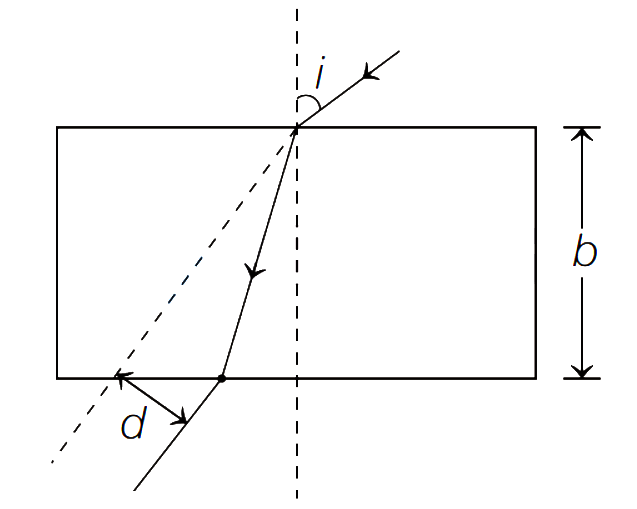 TS EAMCET 2018 Easy
 - A body of mass \(1 \mathrm{~g}\) and carrying a charge \(10^{-8} \mathrm{C}\) passes from two points \(P\) and \(Q . P\) and \(Q\) are at electric potentials. \(600 \mathrm{~V}\) and \(0 \mathrm{~V}\), respectively. The velocity of the body at \(Q\) is \(20 \mathrm{cms}^{-1}\). It velocity in \(\mathrm{ms}^{-1}\) at \(P\) isTS EAMCET 2002 Medium