


TS EAMCET · Maths · Three Dimensional Geometry
The sum of the squares of the perpendicular distances of a point \((\mathrm{x}, \mathrm{y}, \mathrm{z})\) from the coordinate axes is \(\mathrm{k}\) times the square of the distance of the point from the origin. Then \(\mathrm{k}=\)
- A \(2\)
- B \(3\)
- C \(1\)
- D \(4\)
Answer & Solution
Correct Answer
(A) \(2\)
Step-by-step Solution
Detailed explanation
Distance of \((x, y, z)\) (a) From \(x\) axis i.e. \((x, 0,0)\) \(d=\sqrt{y^2+z^2}\) (b) From \(y\) axis i.e. \((0, y, 0)\) \(d_2=\sqrt{x^2+z^2}\) (c) From \(z\) axis i.e. \((0,0, z)\) \(d_3=\sqrt{x^2+y^2}\) Distance of \((x, y, z)\) from origin \(d=\sqrt{x^2+y^2+z^2}\)…
See the Complete Solution
Get step-by-step explanations for this and 2.5 Lakh+ more JEE, NEET & CET questions.
- Unlock all solutions
- Practice the full chapter
- Track accuracy across PYQs
4.8 rated on Google Play · 14,000+ reviews
More questions from Maths
- The shortest distance between the skew-lines \(\frac{x-3}{-1}=\frac{y-4}{2}=\frac{z+2}{1}, \frac{x-1}{1}=\frac{y+7}{3}=\frac{z+2}{2}\) isTS EAMCET 2015 Hard
- The equation of the circle passing through the points of intersection of the two orthogonal circles \(\begin{aligned} & S_1=x^2+y^2+k x-4 y-1=0, \ & S_2=3 x^2+3 y^2-14 x+23 y-15=0 \text { and passing } \end{aligned}\) through the point \((-1,-1)\) isTS EAMCET 2020 Medium
- If \(\cos ^{-1}\left(\frac{y}{b}\right)=2 \log \left(\frac{x}{2}\right)\), where \(x>0\), then \(x^2 \frac{d^2 y}{d x^2}+x \frac{d y}{d x}\) is equal toTS EAMCET 2013 Medium
- \(1+\frac{1+2}{2 !}+\frac{1+2+2^2}{3 !}+\ldots\) is equal toTS EAMCET 2002 Medium
- If \(\int \frac{2 x^{12}+5 x^9}{\left(1+x^3+x^5\right)^3} d x=\frac{x^m}{l\left(1+x^3+x^5\right)^r}+C\) then \(\frac{m-l}{r}=\)TS EAMCET 2020 Easy
- \(\begin{aligned} & 2 \sin ^{-1} x+\sin ^{-1}\left(2 x \sqrt{1-x^2}\right)+3 \cos ^{-1} x \\ & -\cos ^{-1}\left(4 x^3-3 x\right) \text { is equal to }\end{aligned}\)TS EAMCET 2021 Easy
More PYQs from TS EAMCET
- The radius of the circle passing through the points \((-1,1),(2,-1)\) and \((1,0)\) isTS EAMCET 2022 Medium
- Magnetite can be reduced with \(\mathrm{CO}\) to yield iron metal and carbon dioxide. Calculate the mass of magnetite (in \(\mathrm{kg}\) ) needed to obtain \(4 \mathrm{~kg}\) of iron if the process is \(80 \%\) efficient. [Atomic weight of \(\mathrm{Fe}\) and \(\mathrm{O}\) are \(56 \mathrm{~g}\) and \(16 \mathrm{~g}\), respectively]TS EAMCET 2022 Medium
- Match the differential equations in List I to their integrating factors in List II.
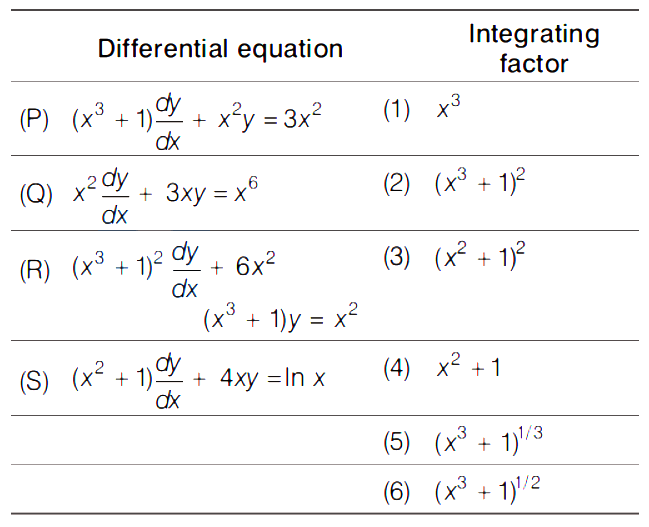
The correct match isTS EAMCET 2015 Easy - Wires \(A\) and \(B\) have resistivities \(\rho_A\) and \(\rho_B\), \(\left(\rho_B=2 \rho_A\right)\) and have lengths \(l_A\) and \(l_B\). If the diameter of the wire \(B\) is twice that of \(A\) and the two wires have same resistance, then \(\frac{l_B}{l_A}\) isTS EAMCET 2014 Easy
- If \(\Delta\) is the area of the triangle formed by the positive \(x\)-axis and the normal and tangent to the circle \(x^2+y^2=4\) at \((1, \sqrt{3})\), then \(\Delta\) is equal toTS EAMCET 2012 Hard
- If \(Z=r(\cos \theta+i \sin \theta),(\theta \neq-\pi / 2)\) is a solution of \(x^3=i\), then \(r^9(\cos \theta+i \sin \theta)^9=\)TS EAMCET 2025 Medium