


TS EAMCET · Maths · Differential Equations
The general solution of the differential equation \((3 x-4 y)\) \((d x-3 d y)+(6 d x-4 d y)=0\) is
- A \(x-2 y+\log |3 x-4 y+6|=c\)
- B \(5 \mathrm{x}-15 \mathrm{y}-4 \log |15 \mathrm{x}-20 \mathrm{y}-12|=\mathrm{c}\)
- C \(5 \mathrm{x}-15 \mathrm{y}+14 \log |15 \mathrm{x}-20 \mathrm{y}-12|=\mathrm{c}\)
- D \(8 y-4 x+\log |9 x-12 y+4|=c\)
Answer & Solution
Correct Answer
(C) \(5 \mathrm{x}-15 \mathrm{y}+14 \log |15 \mathrm{x}-20 \mathrm{y}-12|=\mathrm{c}\)
Step-by-step Solution
Detailed explanation
\[ \begin{aligned} & \text { }(3 x-4 y)(d x-3 d y)+(6 d x-4 d y)=0 \\ & \Rightarrow \frac{d y}{d x}=\frac{(3 x-4 y)+6}{3(3 x-4 y)+4} \end{aligned} \] Let \(3 x-4 y=t \Rightarrow 3-4 \frac{d y}{d x}=\frac{d t}{d x}\)…
See the Complete Solution
Get step-by-step explanations for this and 2.5 Lakh+ more JEE, NEET & CET questions.
- Unlock all solutions
- Practice the full chapter
- Track accuracy across PYQs
4.8 rated on Google Play · 14,000+ reviews
More questions from Maths
- If three unit vectors \(\overrightarrow{\mathbf{a}}, \overrightarrow{\mathbf{b}}, \overrightarrow{\mathbf{c}} \quad\) satisfy \(\overrightarrow{\mathbf{a}}+\overrightarrow{\mathbf{b}}+\overrightarrow{\mathbf{c}}=\overrightarrow{\mathbf{0}}\), then the angle between \(\overrightarrow{\mathbf{a}}\) and \(\overrightarrow{\mathbf{b}}\) isTS EAMCET 2010 Easy
- If two equal sides of an isosceles triangle are given by the equations \(7 x-y+3=0\) and \(x+y-3=0\), then the equation of its third side passing through the point \((2,-5)\) isTS EAMCET 2020 Medium
- The general solution of the differential equation \(\left(6 x^2-2 x y-18 x+3 y\right) d x-\left(x^2-3 x\right) d y=0\) isTS EAMCET 2024 Medium
- If \((-1,-1)\) is the radical centre of the circles \(x^2+y^2+\) \(2 g x-4 y+4=0, x^2+y^2+6 x+2 f y+12=0\) and \(x^2+y^2\) \(+10 y+20=0\) then \(g-f=\)TS EAMCET 2022 Medium
- If is a line passing through the point and parallel to the common line of the pairs of lines and , then the equation of pair of lines joining the origin to the points of intersection of the curve and the line isTS EAMCET 2022 Hard
- If \(z=\frac{(2-i)(1+i)^3}{(1-i)^2}\), then \(\operatorname{Arg}(z)=\)TS EAMCET 2024 Medium
More PYQs from TS EAMCET
- What is \(Z\) in the following reaction sequence?
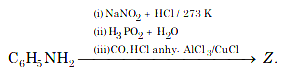 TS EAMCET 2014 Hard
 - Currents flowing in each of the following circuits \(A\) and \(B\) respectively are
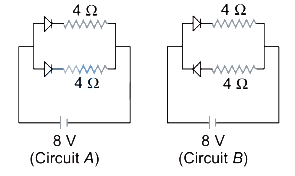 TS EAMCET 2009 Easy
 - Electric charges \(+q\) and \(-q\) are placed at points \(A\) and \(B\) respectively which are at a distance of \(2 L\) apart. If \(C\) is the midpoint between \(A\) and \(B\), then the work done in moving a charge \(+Q\) along the semi-circle \(C R D\) is
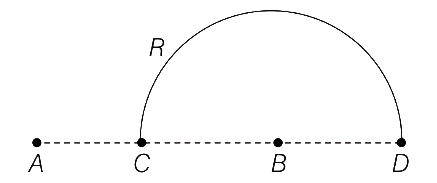 TS EAMCET 2020 Easy
 - 37 g of ice at \(0^{\circ} \mathrm{C}\) temperature is mixed with 74 g of water at \(70^{\circ} \mathrm{C}\) temperature. The resultant temperature is (Specific heat capacity of water \(=1 \mathrm{cal} \mathrm{g}^{-1}{ }^{\circ} \mathrm{C}^{-1}\) and latent heat of fusion of ice \(=80 \mathrm{cal} \mathrm{g}^{-1}\) )TS EAMCET 2024 Easy
- Two adjacent sides of a triangle are represented by the vectors \(2 \bar{i}+\bar{j}-2 \bar{k}\) and \(2 \sqrt{3} \bar{i}-2 \sqrt{3} \bar{j}+\sqrt{3} \bar{k}\). Then the least angle of the triangle and perimeter of the triangle are respectivelyTS EAMCET 2025 Medium
- The term independent of \(x\) in the expansion of \(\left(x-\frac{2}{\sqrt{x}}\right)^{21}\) isTS EAMCET 2021 Easy