


TS EAMCET · Maths · Area Under Curves
The area (in sq. units) bounded by the parabola \(y=x^2+3\), the tangent to the parabola at \((3,12)\) and the coordinate axes and lying in the first quadrant is
- A 6
- B 30
- C 18
- D 24
Answer & Solution
Correct Answer
(A) 6
Step-by-step Solution
Detailed explanation
Given parabola, \(y=x^2+3\) Tangent of parabola at \((3,12)\) is \(\frac{Y+12}{2}=3 x+3 \Rightarrow Y=6 x-6\)…
See the Complete Solution
Get step-by-step explanations for this and 2.5 Lakh+ more JEE, NEET & CET questions.
- Unlock all solutions
- Practice the full chapter
- Track accuracy across PYQs
4.8 rated on Google Play · 14,000+ reviews
More questions from Maths
- If the number of all possible permutations of the letters of the word in which the repeated letters are not together is , thenTS EAMCET 2020 Easy
- The distribution of a random variable \(X\) is given below
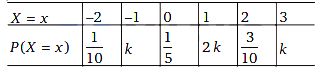
The value of \(k\) isTS EAMCET 2008 Medium - If \(\tan 20^{\circ}=\lambda\), then \[ \frac{\tan 160^{\circ}-\tan 110^{\circ}}{1+\left(\tan 160^{\circ}\right)\left(\tan 110^{\circ}\right)}= \]TS EAMCET 2017 Easy
- Let \(K\) be the number of rational terms in the expansion of \((\sqrt{2}+\sqrt[3]{3})^{6144}\). If the coefficient of \(x^{\mathrm{P}} \quad(\mathrm{P} \in \mathrm{N})\) in the expansion of \(\frac{1}{(1+x)\left(1+x^2\right)\left(1+x^4\right)\left(1+x^8\right)\left(1+x^{16}\right)}\) is \(\alpha_{\mathrm{P}}\), then \(\alpha_{\mathrm{K}}-\alpha_{\mathrm{K}+1}-\alpha_{\mathrm{K}-1}=\)TS EAMCET 2025 Hard
- In the space the equation by \(+c z+d=0\) represents a plane perpendicular to theTS EAMCET 2002 Easy
- If where denotes the greatest integer less than or equal to thenTS EAMCET 2021 Easy
More PYQs from TS EAMCET
- The vertex and the focus of the parabola respectively, areTS EAMCET 2022 Easy
- In a triangle \(A B C\), if \(\cos A \cos B+\sin A \sin B \sin C=1\), then \(a: b: c=\)TS EAMCET 2020 Hard
- At \(\mathrm{T}(\mathrm{K}), \mathrm{K}_{\mathrm{p}}\) value for the reaction, \(2 \mathrm{AO}_2(g)+\mathrm{O}_2(g) \rightleftharpoons 2 \mathrm{AO}_3(g)\) is \(4 \times 10^{10}\). What is the \(\mathrm{K}_{\mathrm{p}}^{\prime}\) value for \(3 \mathrm{AO}_2(g)+\frac{3}{2} \mathrm{O}_2(g) \rightleftharpoons 3 \mathrm{AO}_3(g)\) at \(\mathrm{T}(\mathrm{K})\) ?TS EAMCET 2025 Medium
- An object of mass \(2 \mathrm{~kg}\) is hanging from a rope that is wrapped around a pulley of radius \(25 \mathrm{~cm}\). The mass of pulley is \(2 \mathrm{~kg}\). Find the acceleration of the object. (Assume, pulley to be a solid disk \(g=10 \mathrm{~m} / \mathrm{s}^2\) )
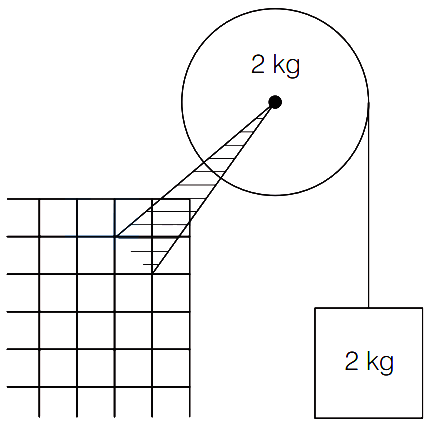 TS EAMCET 2020 Hard
 - \(\mathrm{A}(2,0), \mathrm{B}(0,2), \mathrm{C}(-2,0)\) are three points. Let \(\mathrm{a}, \mathrm{b}, \mathrm{c}\) be the perpendicular distances from a variable point P on to the lines \(\mathrm{AB}, \mathrm{BC}\) and CA respectively. If \(\mathrm{a}, \mathrm{b}, \mathrm{c}\) are in arithmetic progression, then the locus of P isTS EAMCET 2025 Hard
- \(\int_0^{\pi / 4} \frac{1}{5 \cos ^2 x+16 \sin ^2 x+8 \sin x \cos x} d x=\)TS EAMCET 2025 Medium