


TS EAMCET · Maths · Sequences and Series
\(\sum_{n=1}^{\infty} \frac{2 n^2+n+1}{n !}\) is equal to
- A \(2 e-1\)
- B \(2 e+1\)
- C \(6 e-1\)
- D \(6 e+1\)
Answer & Solution
Correct Answer
(C) \(6 e-1\)
Step-by-step Solution
Detailed explanation
\begin{aligned} & \text { Let } S=\sum_{n=1}^{-} \frac{2 n^2+n+1}{n !} \\ & =\bar{\sum}_{n=1}\left(\frac{2 n}{(n-1) !}+\frac{1}{(n-1) !}+\frac{1}{n !}\right) \\ & =\bar{\sum}_{n=1}\left(\frac{2}{(n-2) !}+\frac{3}{(n-1) !}+\frac{1}{n !}\right) \\ & =2\left(1+\frac{1}{1…
See the Complete Solution
Get step-by-step explanations for this and 2.5 Lakh+ more JEE, NEET & CET questions.
- Unlock all solutions
- Practice the full chapter
- Track accuracy across PYQs
4.8 rated on Google Play · 14,000+ reviews
More questions from Maths
- If \(\int \frac{a \cos x-2 \sin x}{b \sin x+5 \cos x} d x=\frac{7}{41} x+\frac{22}{7} \log\) \(|b \sin x+5 \cos x|+C,(a>0, b>0)\), then \(\int \frac{d x}{b+a \cos x}=\)TS EAMCET 2020 Hard
- A line \(l\) meets the circle \(x^2+y^2=61\) in \(A, B\) and \(P(-5,6)\) is such that \(P A=P B=10\). Then, the equation of \(l\) isTS EAMCET 2004 Easy
- The domain of the function \(f(x)=\sin ^{-1}\left[\log _4\left(\frac{x}{4}\right)\right]+\sqrt{17 x-x^2-16}\) isTS EAMCET 2019 Easy
- If the real valued function \(f(x)=\left\{\begin{array}{cl}\frac{\cos 3 x-\cos x}{x \sin x} & \text { if } x < 0 \\ \mathrm{p} & \text { if } x=0 \\ \frac{\log (1+\mathrm{q} \sin x)}{x} & \text { if } x>0\end{array}\right.\) is continuous at \(x=0\) then \(\mathrm{p}+\mathrm{q}=\)TS EAMCET 2025 Medium
- If the roots of the equation \(z^2-i=0\) are \(\alpha\) and \(\beta\), then \(|\operatorname{Arg} \beta-\operatorname{Arg} \alpha|=\)TS EAMCET 2023 Easy
- If \(f(x)=(\cos x)(\cos 2 x) \ldots(\cos n x)\) then \(f^{\prime}(x)+\sum_{r=1}^n(r \tan r x) f(x)\) is equal toTS EAMCET 2010 Hard
More PYQs from TS EAMCET
- Let \(\vec{a}\) and \(\vec{b}\) be non-collinear vectors. If the vectors \((\lambda-1) \vec{a}+2 \vec{b}\) and \(3 \vec{a}+\lambda \vec{b}\) are collinear, then the set of all possible values of \(\lambda\) isTS EAMCET 2023 Medium
- Identify the values of A, B, C, D and E for the following unbalanced reaction \(\mathrm{KNO}_3+5 \mathrm{C}_{12} \mathrm{H}_{22} \mathrm{O}_{11} \longrightarrow \mathrm{b} \mathrm{N_{2 }}+\mathrm{c} \mathrm{CO}_2+\mathrm{d} \mathrm{H}_2 \mathrm{O}+\mathrm{e} \mathrm{K}_2 \mathrm{CO}_3\)TS EAMCET 2022 Hard
- The vector \(\mathbf{c} .(\mathbf{b}+\mathbf{c}) \times(\mathbf{a}+\mathbf{b}+\mathbf{c})\) is equal toTS EAMCET 2004 Easy
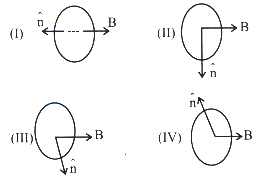
- A current carrying loop is placed in a uniform magnetic field 'B' in different orientations I, II, III and IV as shown in the figure. The correct order of decreasing potential energy is ( \(\hat{\mathrm{n}}\)-unit vector normal to the plane of the loop)
 TS EAMCET 2023 Easy
 - If the angle between the pair of tangents drawn to the circle \(x^2+y^2-2 x+4 y+3=0\) from the point \((6,-5)\) is \(\theta\), then \(\cot \theta=\)TS EAMCET 2023 Easy
- If \(\overrightarrow{\mathbf{a}}=\hat{\mathbf{i}}-\hat{\mathbf{j}}-\hat{\mathbf{k}}\) and \(\overrightarrow{\mathbf{b}}=+\lambda \hat{\mathbf{i}}-3 \hat{\mathbf{j}}+\hat{\mathbf{k}}\) and the orthogonal projection of \(\overrightarrow{\mathbf{b}}\) on \(\overrightarrow{\mathbf{a}}\) is \(\frac{4}{3}(\hat{\mathbf{i}}-\hat{\mathbf{j}}-\hat{\mathbf{k}})\), then \(\lambda\) is equal toTS EAMCET 2007 Easy