


TS EAMCET · Maths · Quadratic Equation
Let the roots of the equation \(E_1 \equiv x^3+x^2+l x+n=0\) be \(x_i,(i=1,2,3)\) and the roots of \(E_2 \equiv x^3+a x^2+b x+c=0\) be \(\frac{x_i-1}{2}\). If the equation \(E_2=0\) is a equation of class one, then the roots of these two equations excluding the common roots are
- A \(2,3, \frac{1}{2}, 1\)
- B \(\sqrt{2},-\sqrt{2}, \frac{-1+\sqrt{2}}{2}, \frac{-1-\sqrt{2}}{2}\)
- C \(\sqrt{3} i,-\sqrt{3} i, \frac{-1+\sqrt{3} i}{2}, \frac{-1-\sqrt{3} i}{2}\)
- D \(\sqrt{3} i,-\sqrt{3} i, 1+2 \sqrt{3} i, 1-2 \sqrt{3} i\)
Answer & Solution
Correct Answer
(C) \(\sqrt{3} i,-\sqrt{3} i, \frac{-1+\sqrt{3} i}{2}, \frac{-1-\sqrt{3} i}{2}\)
Step-by-step Solution
Detailed explanation
Given \(n_1, n_2, n_3\) are roots of the equation \(E_1: x^3+x^2+l x+n=0\) \(\ldots(\mathrm{i})\) \(\therefore \text { Sum of roots } x_1+x_2+x_3=-1\) \(\ldots(\mathrm{ii})\) Now, \(E_2: x^3+a x^2+b x+c=0\) is reciprocal equation of class one \(\Rightarrow c=1\) and \(a=b\)…
See the Complete Solution
Get step-by-step explanations for this and 2.5 Lakh+ more JEE, NEET & CET questions.
- Unlock all solutions
- Practice the full chapter
- Track accuracy across PYQs
4.8 rated on Google Play · 14,000+ reviews
More questions from Maths
- The mean of four observations is 3 . If the sum of the squares of these observations is 48 , then their standard deviation isTS EAMCET 2014 Medium
- Suppose \(\alpha, \beta, \gamma \quad\) are roots of \(x^3+x^2+2 x+3=0\). If \(f(x)=0\) is a cubic polynomial equation whose roots are \(\alpha+\beta, \beta+\gamma, \gamma+\alpha\), then \(f(x)\) is equal toTS EAMCET 2016 Hard
- If a circle with its centre at the focus of the parabola \(y^2=2 p x\) is such that it touches the directrix of the parabola, then a point of intersection of the circle and the parabola isTS EAMCET 2020 Medium
- If \(\omega\) is a complex cube root of unity and \(x=\omega^2-\omega+2\) thenTS EAMCET 2025 Medium
- Let \(\overrightarrow{\mathbf{a}}=a_1 \hat{\mathbf{i}}+a_2 \hat{\mathbf{j}}+a_3 \hat{\mathbf{k}}\) Assertion (A) : The identity \(|\overrightarrow{\mathbf{a}} \times \hat{\mathbf{i}}|^2+|\overrightarrow{\mathbf{a}} \times \hat{\mathbf{j}}|^2+|\overrightarrow{\mathbf{a}} \times \hat{\mathbf{k}}|^2=2|\overrightarrow{\mathbf{a}}|^2\) holds for \(\vec{a}\). Reason (R) : \(\overrightarrow{\mathbf{a}} \times \hat{\mathbf{i}}=a_3 \hat{\mathbf{j}}-a_2 \hat{\mathbf{k}}\), \(\overrightarrow{\mathbf{a}} \times \hat{\mathbf{j}}=a_1 \hat{\mathbf{k}}-a_3 \hat{\mathbf{i}}, \overrightarrow{\mathbf{a}} \times \hat{\mathbf{k}}=a_2 \hat{\mathbf{i}}-a_1 \hat{\mathbf{j}}\) Which of the following is correct?TS EAMCET 2007 Medium
- If \(y=\tan ^{-1}\left(\frac{\sqrt{1+a^2 x^2}-1}{a x}\right)\), then \(\left(1+a^2 x^2\right){y^{\prime}}^{\prime}+2 a^2 x y^{\prime}\) is equal toTS EAMCET 2014 Hard
More PYQs from TS EAMCET
- If the amplitude of \(z-2-3 i\) is \(\pi / 4\), then the locus of \(z=x+i y\) isTS EAMCET 2020 Easy
- Consider the following electrode processes of a cell, \[ \mathrm{Cl}^{-} \rightarrow \frac{1}{2} \mathrm{Cl}_2+e^{-} \quad\left[\mathrm{MCl}+e^{-} \rightarrow M+\mathrm{Cl}^{-}\right] \] If EMF of this cell is \(-1.140 \mathrm{~V}\) and \(E^{\circ}\) value of the cell is \(-0.55 \mathrm{~V}\) at \(298 \mathrm{~K}\), the value of the equilibrium constant of the sparingly soluble salt \(M \mathrm{Cl}\) is in the order ofTS EAMCET 2017 Hard
- Two cars \(A\) and \(B\) are moving with speeds \(v_A=120 \mathrm{~km} / \mathrm{h}\) and \(v_B=50 \mathrm{~km} / \mathrm{h}\) respectively in the directions as indicated by the arrow in the figure below. What is the relative speed of the car \(B\) with respect to car \(A\) ?
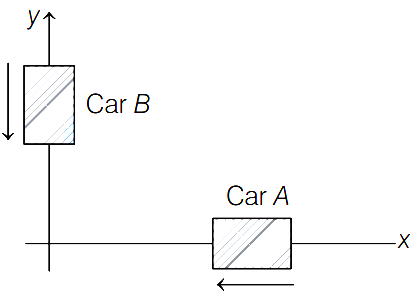 TS EAMCET 2020 Easy
 - Number of solutions of the equation in isTS EAMCET 2018 Medium
- For reaction \(2 \mathrm{~A}+\mathrm{B} \longrightarrow \mathrm{D}+\mathrm{E}\), following mechanism has been proposed \(\mathrm{A}+\mathrm{B} \longrightarrow \mathrm{C}+\mathrm{D}\) (Is slow) and \(\mathrm{A}+\mathrm{C} \rightarrow \mathrm{E}\) (Is fast).TS EAMCET 2023 Easy
- The area of the region bounded by the curves \(x=y^2-2\) and \(x=y\) isTS EAMCET 2017 Medium