


TS EAMCET · Maths · Straight Lines
Let \(P\) be the point of intersection of the lines \(L_1 \equiv x-y-7=0\) and \(L_2 \equiv x+y-5=0\). \(A\left(x_1, y_1\right)\) and \(B\left(x_2, y_2\right)\) are points on the lines \(L_1=0\) and \(L_2=0\) respectively such that \(P A=3 \sqrt{2}, P B=\sqrt{2}, x_1, y_1 \geq 0, x_2, y_2 \geq 0\), then the angle made by the line segment \(A B\) at the origin is
- A \(\frac{\pi}{4}\)
- B \(\frac{\pi}{2}\)
- C \(\cos ^{-1}\left(\frac{3}{4}\right)\)
- D \(\cos ^{-1}\left(\frac{9}{\sqrt{85}}\right)\)
Answer & Solution
Correct Answer
(D) \(\cos ^{-1}\left(\frac{9}{\sqrt{85}}\right)\)
Step-by-step Solution
Detailed explanation
The point of intersection of lines \(L_1=x-y-7=0\) and \(L_2 \equiv x+y-5=0\) is \((6,-1)\) Now, for point \(A\left(x_1, y_1\right)\) such that \(P A=3 \sqrt{2}\), take the equation of line \(L_1\) in symmetric form…
See the Complete Solution
Get step-by-step explanations for this and 2.5 Lakh+ more JEE, NEET & CET questions.
- Unlock all solutions
- Practice the full chapter
- Track accuracy across PYQs
4.8 rated on Google Play · 14,000+ reviews
More questions from Maths
- Two particles \(P\) and \(Q\) located at the points with coordinates \(P\left(t, t^3-16 t-3\right)\), \(Q\left(t+1, t^3-6 t-6\right)\) are moving in a plane. The minimum distance between them in their motion isTS EAMCET 2015 Easy
- The locus of the mid-points of the chords of the circle \(x^2+y^2=16\) which are tangents to the hyperbola \(9 x^2-16 y^2=144\) isTS EAMCET 2018 Medium
- Consider the lines If the line intersects the lines and at the points and respectively, then the combined equation of and isTS EAMCET 2021 Medium
- If the eccentricity of a hyperbola is \(\sqrt{3}\); then the eccentricity of its conjugate hyperbola is :TS EAMCET 2006 Easy
- If \(\left|\begin{array}{cc}2+3 i & i \ 1-2 i & -i\end{array}\right|=x+i y\), then \(x+y=\)TS EAMCET 2022 Easy
- Suppose the new axes \(X, Y\) are generated by rotating the coordinate axes \(x, y\) about the origin through an angle of \(30^{\circ}\) in the anti-clockmise direction. Then, the transformed equation of \(x^2+2 \sqrt{3} x y-y^2=2 a^2\) with respect to new axes \(X, Y\) isTS EAMCET 2019 Hard
More PYQs from TS EAMCET
- Let \(x \in \mathbf{R}\) be so small that the powers of \(x\) beyond two are insignificant and negligibly small. For such \(x\), if \((1-x)^3(2+x)^6\) is approximated by \(a+b x+c x^2\), then \(a+b+c=\)TS EAMCET 2020 Medium
- If the normal drawn at the point P on the curve \(y^2=x^3-x+1\) makes equal intercepts on the coordinate axes, then the equation of the tangent drawn to the curve at P isTS EAMCET 2025 Medium
- If \(f(x)=\frac{2 x}{4+3|x|}, x \in R\), then \(f^{\prime}(0)=\)TS EAMCET 2018 Medium
- Find out the bond order in and , respectivelyTS EAMCET 2020 Easy
- A tank of height \(15 \mathrm{~m}\) and cross-section area \(10 \mathrm{~m}^2\) is filled with water. There is a small hole of cross-section area \(a\) which is much smaller than the container, located at a height of \(12 \mathrm{~m}\) from the base of the container. How much force should be applied with a piston at the top level, so that the water coming out of the hole hits the ground at a distance of \(16 \mathrm{~m}\) ? (Take, density of water \(=1000 \mathrm{~kg} \mathrm{~m}^{-3}\) )
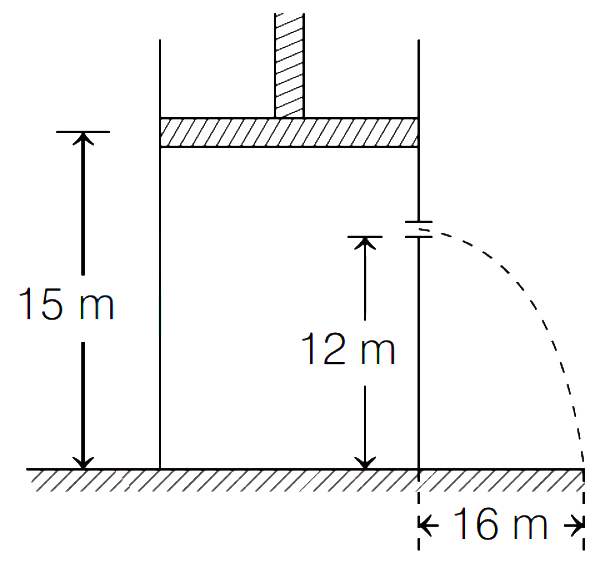 TS EAMCET 2018 Medium
 - A circular disc of radius \(R\) is removed from a bigger circular disc of radius \(2 R\) such that the circumferences of the discs touch. The centre of mass of the new disc is at a distance \(\alpha R\) from the centre of the bigger disc. The value of \(\alpha\) isTS EAMCET 2011 Hard