


TS EAMCET · Maths · Limits
Let \(f(x)\) be a differentiable function such that \(f(0)=0\) and \(f^{\prime}(0)=20\). For \(x \in\left(0, \frac{\pi}{2}\right]\), if \(A(x)=2 f(x) \operatorname{cosec} 4 x+\) \(4 f(x)\left(\cos ^2 x+1\right)-4 \cos ^2 x\) then \(\lim _{x \rightarrow 0} A(x)=\)
- A 0
- B 4
- C 6
- D 8
Answer & Solution
Correct Answer
(C) 6
Step-by-step Solution
Detailed explanation
(c) Given \(\mathrm{f}(\mathrm{x})\) is differentiable function. Take, \(\lim _{x \rightarrow 0} A(x)=\lim _{x \rightarrow 0}\left[\begin{array}{l}2 f(x) \operatorname{cosec} 4 x+ \\ 4 f(x)\left(\cos ^2 x+1\right)-4 \cos ^2 x\end{array}\right]\)…
See the Complete Solution
Get step-by-step explanations for this and 2.5 Lakh+ more JEE, NEET & CET questions.
- Unlock all solutions
- Practice the full chapter
- Track accuracy across PYQs
4.8 rated on Google Play · 14,000+ reviews
More questions from Maths
- The point of intersection of two tangents drawn to the hyperbola \(\frac{x^2}{a^2}-\frac{y^2}{4}=1\) lie on the circle \(x^2+y^2=5\). If these tangents are perpendicular to each other, then \(a=\)TS EAMCET 2024 Medium
- Assertion (A) a, b, c, d are position vectors of 4 points such that \(2 \mathbf{a}-3 \mathbf{b}+7 \mathbf{c}-6 \mathbf{d}=0 \Rightarrow\) \(\mathbf{a}, \mathbf{b}, \mathbf{c}, \mathbf{d}\) are coplanar. Reason (R) Vector equation of the plane passing through three points whose position vectors are \(\mathbf{a}, \mathbf{b}, \mathbf{c}\) is \(\mathbf{r}=(1-x-y) \mathbf{a}+x \mathbf{b}+y \mathbf{c}\). Which of the following is true?TS EAMCET 2018 Medium
- If is a complex cube root of unity, thenTS EAMCET 2020 Easy
- If the mean and variance of a Binomial variable \(X\) are \(\frac{5}{2}\) and \(\frac{5}{4}\) respectively, then \(P(X>1)=\)TS EAMCET 2018 Easy
- If \(\int e^x\left(\frac{x^2-8 x+19}{(x-1)^5}\right) d x=\frac{e^x(l x+m)}{(x-1)^4}+C\), then \(4 l+m=\)TS EAMCET 2020 Medium
- Let \(A, B, C\) be three points on \(\overline{O X}, \overline{O Y}, \overline{O Z}\) respectively at the distances 3, 6, 9 from origin. Let \(Q\) be the point \((2,5,8)\) and \(P\) be the point equidistant from \(O, A, B, C\). Then, the coordinates of the point \(R\) which divides \(P Q\) in the ratio \(3: 2\) isTS EAMCET 2018 Medium
More PYQs from TS EAMCET
- The line and a pair of lines both passing through origin forms an isosceles triangle. If this pair of lines are perpendicular, then the equation of the pair of straight lines isTS EAMCET 2021 Easy
- \(\operatorname{Sin}^{-1}(-\cos 2)+\operatorname{Cos}^{-1}(\sin 3)+\operatorname{Tan}^{-1}(\cot 5)=\)TS EAMCET 2025 Medium
- \(12 \mathrm{~cm}^3\) of \(\mathrm{SO}_2(g)\) diffused through a porous membrane in 1 minute. Under similar conditions \(120 \mathrm{~cm}^3\) of another gas diffused in 5 minutes. The molar mass of the gas in \(\mathrm{g} \mathrm{mol}^{-1}\) isTS EAMCET 2018 Hard
- If the straight line \(y=m x+c\) is parallel to the axis of the parabola \(y^2=l x\) and intersects the parabola at \(\left(\frac{c^2}{8}, c\right)\), then the length of the latusrectum isTS EAMCET 2011 Easy
- The effective capacitance between points \(A\) and \(B\) shown in the figure is
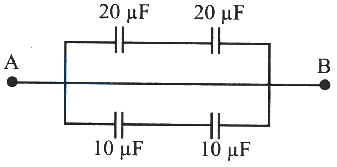 TS EAMCET 2023 Easy
 - The ratio of the highest to the lowest wavelength of Lyman series isTS EAMCET 2021 Medium