


TS EAMCET · Maths · Trigonometric Ratios & Identities
If \(x=\tan 15^{\circ}, y=\operatorname{cosec} 75^{\circ}\) and \(z=4 \sin 18^{\circ}\), then :
- A \(x < y < z\)
- B \(y < z < x\)
- C \(z < x < y\)
- D \(x < z < y\)
Answer & Solution
Correct Answer
(A) \(x < y < z\)
Step-by-step Solution
Detailed explanation
\(\because \quad x=\tan 15^{\circ}=\tan\left(45^{\circ}-30^{\circ}\right)\) \(=\frac{\tan 45^{\circ}-\tan 30^{\circ}}{1+\tan 45^{\circ} \tan 30^{\circ}}=\frac{1-\frac{1}{\sqrt{3}}}{1+\frac{1}{\sqrt{3}}}\) \(=\frac{\sqrt{3}-1}{\sqrt{3}+1}=\frac{(\sqrt{3}-1)^2}{3-1}\)…
See the Complete Solution
Get step-by-step explanations for this and 2.5 Lakh+ more JEE, NEET & CET questions.
- Unlock all solutions
- Practice the full chapter
- Track accuracy across PYQs
4.8 rated on Google Play · 14,000+ reviews
More questions from Maths
- If \(L\) is the line of intersection of two planes \(x+2 y+2 z=15\) and \(x-y+z=4\) and the direction ratios of the line \(L\) are \((a, b, c)\), then \(\frac{a^2+b^2+c^2}{b^2}=\)TS EAMCET 2024 Easy
- Consider the differential equation \(\frac{d y}{d x}=\frac{1}{a x+4 y+7}\) and the following statements A. The given differential equation is linear in \(x\). \(B\). The given differential equation is not linear in \(y\). C. The given differential equation is linear in \(y\). D. \(e^{a x}\) is the integrating factor of the given differential equation. Which one of the following options is true?TS EAMCET 2020 Easy
- If \(\int(1-\cos x) \operatorname{cosec}^2 x d x=f(x)+c\), then \(f(x)\) is equal toTS EAMCET 2010 Medium
- The product of all the values of \((\sqrt{3}-i)^{\frac{3}{7}}\) isTS EAMCET 2025 Medium
- \(\int_0^{\frac{\pi}{4}} \frac{\cos ^2 x}{\cos ^2 x+4 \sin ^2 x} d x=\)TS EAMCET 2019 Easy
- The mean deviation about the mean for the following data is \begin{array}{|c|c|c|c|c|c|}\hline Class interval & 0-2 & 2-4 & 4-6 & 6-8 & 8-10 \\hline Frequency & 1 & 3 & 5 & 3 & 1 \\hline\end{array}TS EAMCET 2024 Easy
More PYQs from TS EAMCET
- The combined equation of the straight lines passing through the point \((4,3)\) and each line making intercepts on the coordinate axes whose sum is -1 , isTS EAMCET 2015 Medium
- If \(\left[\begin{array}{ccc}0 & 2 & a \\ b & 0 & 4 \\ -3 & c & 0\end{array}\right]\) is a skew-symmetric matrix, then
\(\left[\begin{array}{ll}
a & b \\
b & a
\end{array}\right]\left[\begin{array}{ll}
b & c \\
c & b
\end{array}\right]=\)TS EAMCET 2022 Hard - \(\alpha, \beta, \gamma\) are the roots of the equation \(x^3-10 x^2+7 x+8=0\). Match the following and choose the correct answer.
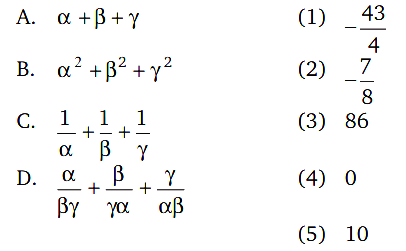 TS EAMCET 2004 Hard
 - If \(5 \cos x+12 \cos y=13\), then the maximum value of \(5 \sin x+12 \sin y\) is :TS EAMCET 2006 Medium
- The equation \(16 x^4+16 x^3-4 x-1=0\) has a multiple root. If \(\alpha, \beta, \gamma, \delta\) are the roots of this equation, then \(\frac{1}{\alpha^4}+\frac{1}{\beta^4}+\frac{1}{\gamma^4}+\frac{1}{\delta^4}=\)TS EAMCET 2024 Hard
- The sum of the maximum and minimum values of the function \(f(x)=\frac{x^2-x+1}{x^2+x+1}\) isTS EAMCET 2024 Easy