


TS EAMCET · Maths · Determinants
If the system of homogeneous equations
\(\begin{aligned} & t x+(t+1) y+(t-1) z=0 \\ & (t+1) x+t y+(t+2) z=0 \\ & (t-1) x+(t+2) y+t z=0\end{aligned}\)
in \(x, y, z\) has a non-trivial solution, then \(t\) is a root of the equation
- A \(3 t^2-4 t+1=0\)
- B \(2 t^2-3 t+1=0\)
- C \(2 t^2+3 t+1=0\)
- D \(3 t^2+4 t+1=0\)
Answer & Solution
Correct Answer
(C) \(2 t^2+3 t+1=0\)
Step-by-step Solution
Detailed explanation
The given system of homogeneous equations \(\begin{aligned} & t x+(t+1) y+(t-1) z=0 \\ & (t+1) x+t y+(t+2) z=0, \text { and } \\ & (t-1) x+(t+2) y+t z=0 \text { in } x, y, z \text { has a non-trivial }\end{aligned}\) solutions, then…
See the Complete Solution
Get step-by-step explanations for this and 2.5 Lakh+ more JEE, NEET & CET questions.
- Unlock all solutions
- Practice the full chapter
- Track accuracy across PYQs
4.8 rated on Google Play · 14,000+ reviews
More questions from Maths
- The coefficient of \(x^n\) in the expansion of \(\frac{1}{x^2-5 x+6}\) for \(|x| < 1\) isTS EAMCET 2015 Easy
- If \(z=x+i y\) is a complex number satisfying \(\left|z+\frac{i}{2}\right|^2=\left|z-\frac{i}{2}\right|^2\), then the locus of \(z\) isTS EAMCET 2002 Medium
- The equation of the circle passing through the points of intersection of the two orthogonal circles \(\begin{aligned} & S_1=x^2+y^2+k x-4 y-1=0, \ & S_2=3 x^2+3 y^2-14 x+23 y-15=0 \text { and passing } \end{aligned}\) through the point \((-1,-1)\) isTS EAMCET 2020 Medium
- A bag contains four balls. Two balls are drawn randomly and found them to be white. The probability that all the balls in the bag are white isTS EAMCET 2023 Easy
- Bag 'P' contains 3 white, 2 red, 5 blue balls and bag 'Q' contains 2 white, 3 red, 5 blue balls. A ball is chosen at random from ' P ' and is placed in ' Q '. If a ball is chosen from bag ' \(Q\) ' at random, then the probability that it is a red ball isTS EAMCET 2024 Easy
- The value that should be assigned to \(f(0)\) so that the function \(f(x)=(x+1)^{\cot x}\) is continuous at \(x=0\), isTS EAMCET 2015 Easy
More PYQs from TS EAMCET
- are non-coplanar vectors. If the position vector of the point of intersection of the line and the plane is thenTS EAMCET 2021 Medium
- Match the items given in List A with those of the items of List B
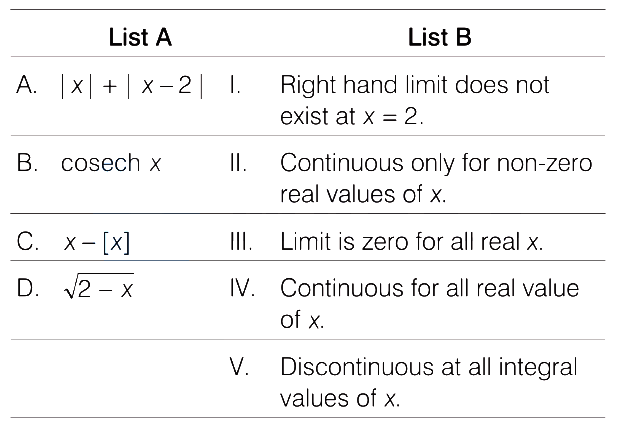
The correct match is \(\begin{array}{llll}A & B & C & D\end{array}\)TS EAMCET 2021 Medium - A box contains red, white and blue balls. If balls are drawn from the box at random one after the other without replacement, then the probability that they are red balls and white ball isTS EAMCET 2021 Medium
- Ellingham diagram is the plot of \(\mathrm{X} v s \mathrm{Y}\). what are \(\mathrm{X}\) and \(\mathrm{Y}\) ?TS EAMCET 2023 Easy
- In the preparation of chlorine by the electrolysis of brine, the reaction taking place at the anode isTS EAMCET 2019 Medium
- \(\lim _{x \rightarrow 0} \frac{\sqrt{1+x^2}-\sqrt{1-x+x^2}}{3^x-1}\) is equal toTS EAMCET 2014 Medium