


TS EAMCET · Maths · Trigonometric Ratios & Identities
If the period of the function \(f(x)=2 \cos (3 x+4)-3 \tan (2 x-3)+5 \sin (5 x)-7\) is \(k\), then
- A \(\sin \frac{k}{8}=\frac{1}{2}\)
- B \(\cos \frac{k}{6}=\frac{1}{\sqrt{2}}\)
- C \(\tan \frac{k}{3}=-\sqrt{3}\)
- D \(\sec \frac{k}{2}=2\)
Answer & Solution
Correct Answer
(C) \(\tan \frac{k}{3}=-\sqrt{3}\)
Step-by-step Solution
Detailed explanation
Period of \(\cos (3 x+4)\) is \(\frac{2 x}{3}\) Period of \(\tan (2 x-3)\) is \(\frac{\pi}{2}\) Period of \(\sin 5 x\) is \(\frac{2 \pi}{5}\) Period of \(f(x)\) is L.C.M. of \(\frac{2 \pi}{3}, \frac{\pi}{2}, \frac{2 \pi}{5} \Rightarrow k=2 \pi\)…
See the Complete Solution
Get step-by-step explanations for this and 2.5 Lakh+ more JEE, NEET & CET questions.
- Unlock all solutions
- Practice the full chapter
- Track accuracy across PYQs
4.8 rated on Google Play · 14,000+ reviews
More questions from Maths
- The function \(f(x)=2 x^3-9 a x^2+12 a^2 x+1\) where \(\mathrm{a}>0\) attains its local maximum and local minimum at \(p\) and \(q\) respectively. If \(p^2=q\) then \(a=\)TS EAMCET 2025 Medium
- If the line \(a x+b y=1\) is a tangent to the circle \(s_r \equiv x^2+y^2-r^2=0\), then which one of the following is true?TS EAMCET 2019 Easy
- If \(\alpha\) and \(\beta\) are the roots of \(x^2+2 x-3=0\) and \(\gamma, \delta\) are the roots of \(y^2-y-4=0\), then the equation of the circle having \((\alpha, \gamma)\) and \((\beta, \delta)\) as ends of a diameter isTS EAMCET 2021 Easy
- Let be three points. If is a point satisfying the condition , then a point that lies on the locus of isTS EAMCET 2022 Easy
- If \(\alpha, \beta, \gamma\) are the roots of the equation \(x^3-4 x^2-9 x-36\) \(=0\) such that \(\alpha+\beta=0\), then \(\alpha^2+2 \beta^2+3 \gamma^2=\)TS EAMCET 2022 Medium
- If \(\alpha, \beta, \gamma\) are the roots of the equation \(2 x^3+x^2-13 x+6\) \(=0\), then \(\alpha^3+\beta^3+\gamma^3=\)TS EAMCET 2023 Easy
More PYQs from TS EAMCET
- If \(f(x)=x^2-2 x+4\), then the set of values of \(x\) satisfying \(f(x-1)=f(x+1)\) isTS EAMCET 2016 Easy
- No bond resonance (hyperconjugation) depends on number of \(\alpha-\mathrm{H}\).
\(\mathrm{CH}_3-\mathrm{CH}_2-\mathrm{CH}=\mathrm{CH}_2\)
But-1-ene contains \(\alpha\)-H. Therefore, it gives 2 no bond resonating structures.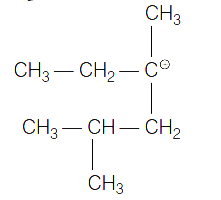
\(3^{\circ}\) carbocation has \(7 \alpha-\mathrm{H}\).
Thus, it forms 7 no bond resonating structures.
Hence, option (3) is correct.TS EAMCET 2019 Easy - \(\lim _{x \rightarrow 0}\left[\tan \left(x+\frac{\pi}{4}\right)\right]^{1 / x}\) is equal toTS EAMCET 2015 Easy
- The product of the distinct \((2 n)\) th roots of \(1+i \sqrt{3}\) is equal to :TS EAMCET 2006 Hard
- In a triangle \(\mathrm{ABC},\left(r_2+r_3\right) \operatorname{cosec}^2\left(\frac{\mathrm{~A}}{2}\right)=\)TS EAMCET 2025 Medium
- The efficiency of an engine is given by \(\eta=\frac{\alpha \beta}{\sin \theta} \cdot \log _{\mathrm{e}} \frac{\beta \mathrm{x}}{\mathrm{kT}}\), where \(\alpha\) and \(\beta\) are constants. If \(T\) is the absolute temperature, \(k\) - Boltzmann constant, \(\theta\)-angular displacement and \(\mathbf{x}\) is distance, then the incorrect statement isTS EAMCET 2023 Medium