


TS EAMCET · Maths · Continuity and Differentiability
If \(\operatorname{Lt}_{h \rightarrow 0} \frac{f(x+h)-f(x)}{h}=e^x(x+1)\) and \(f(0)=0\), then \(\frac{d}{d x}\left(f(x) e^{-x}\right)+\frac{d}{d x}\left(\frac{f(x)}{x}\right)=\)
- A \(e^x+1\)
- B \(x^2 e^x+x\)
- C \(x e^x+1\)
- D \(x^2 e^x\)
Answer & Solution
Correct Answer
(A) \(e^x+1\)
Step-by-step Solution
Detailed explanation
Given, \(\lim _{h \rightarrow 0} \frac{f(x+h)-f(x)}{h}=e^x(x+1)\) \(\Rightarrow f^{\prime}(x)=e^x(x+1) \Rightarrow f(x)=x e^x+c \Rightarrow f(0)=0\)…
See the Complete Solution
Get step-by-step explanations for this and 2.5 Lakh+ more JEE, NEET & CET questions.
- Unlock all solutions
- Practice the full chapter
- Track accuracy across PYQs
4.8 rated on Google Play · 14,000+ reviews
More questions from Maths
- 5 boys and 5 girls have to sit around a table. The number of ways in which all of them can sit so that no two boys and no two girls are together isTS EAMCET 2025 Medium
- If \(\cos x+\cos y=\frac{2}{3}\) and \(\sin x-\sin y=\frac{3}{4}\) then \(\sin (x-y)+\cos (x-y)=\)TS EAMCET 2024 Hard
- If \(f: R \rightarrow R^2\) and \(g: R^{+} \rightarrow R\) are such that \(g\{f(x)\}=|\sin x| \quad\) and \(\quad f\{g(x)\}=(\sin \sqrt{x})^2\), then a possible choice for \(f\) and \(g\) isTS EAMCET 2012 Medium
- In a triangle \(\mathrm{ABC}\), if \(\frac{r}{r_1}=\frac{1}{2}\), then 4 \[ \tan \frac{\mathrm{A}}{2}\left(\tan \frac{\mathrm{B}}{2}+\tan \frac{\mathrm{C}}{2}\right)= \]TS EAMCET 2022 Hard
- The number of ways in which four letters can be put in four addressed envelops so that no letter goes into envelope meant for it isTS EAMCET 2018 Easy
- The following system of equations hasTS EAMCET 2018 Easy
More PYQs from TS EAMCET
- Which one of the following of 2,3-butane diol is enantiomeric?TS EAMCET 2010 Medium
- Temperature of cold junction in a thermocouple is \(10^{\circ} \mathrm{C}\) and neutral temperature is \(270^{\circ} \mathrm{C}\), then the temperature of inversion isTS EAMCET 2007 Easy
- Match Column A (layers in the ionosphere for skywave propagation) with Column B (their height range)
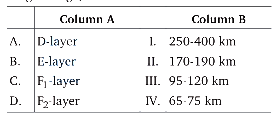
\(\begin{array}{llll}\mathrm{A} & \mathrm{B} & \mathrm{C} & \mathrm{D}\end{array}\)TS EAMCET 2012 Easy - Let be an matrix defined by . If trace of and then the value of isTS EAMCET 2022 Medium
- If is the equation of a parabola with focus and directrix then representsTS EAMCET 2021 Easy
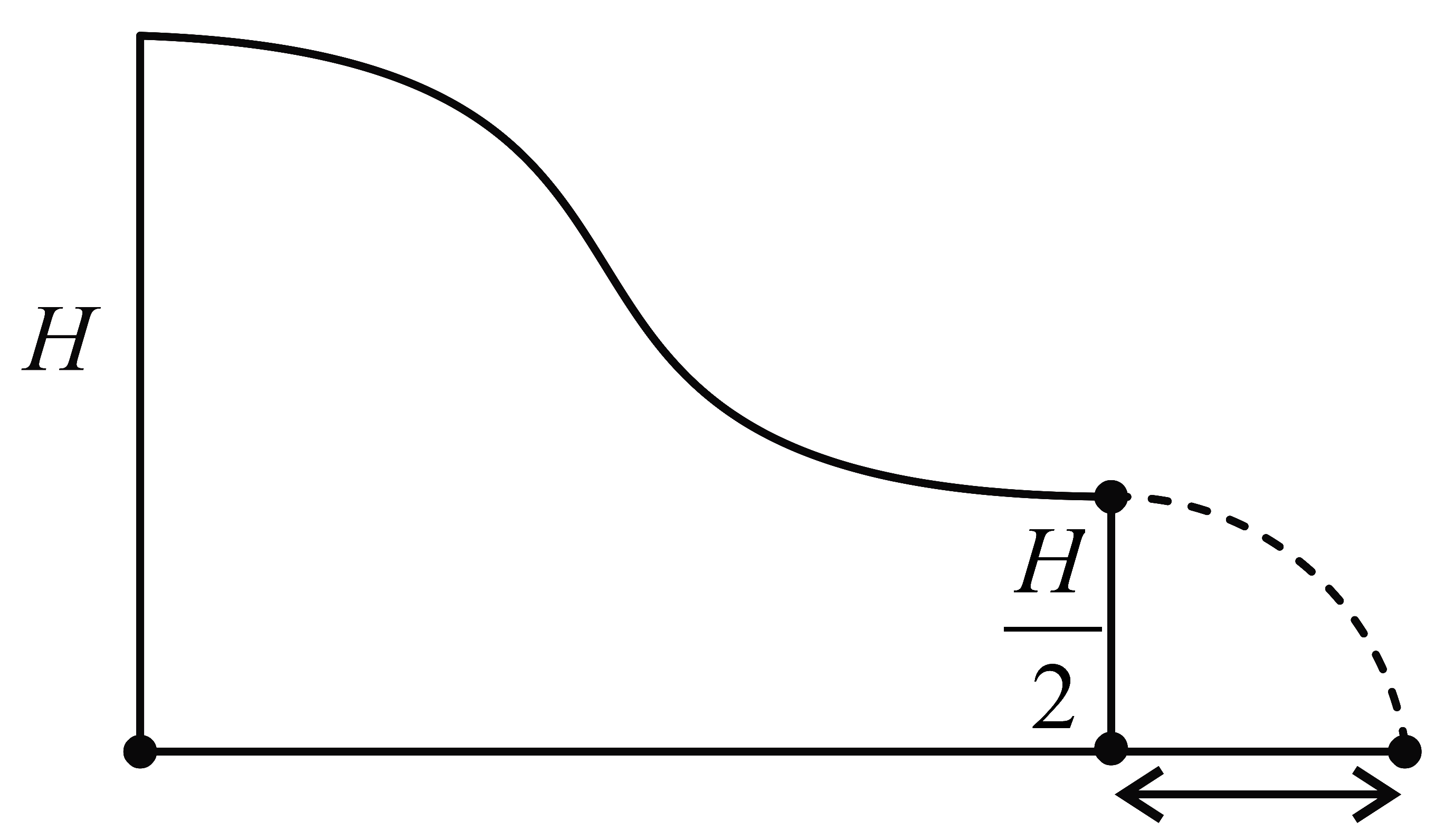
- A small object slides down with initial velocity equal to zero from the top of a smooth hill of height . The other end of the hill is horizontal and is at height as shown in the figure. The horizontal distance covered by the object from the end of the hill to the ground is
 TS EAMCET 2022 Easy