


TS EAMCET · Maths · Differentiation
If \(\mathrm{e}^{\mathrm{x}}=\mathrm{y}+\sqrt{y^2-1}\), then \(\frac{d y}{d x}=\)
- A \(\sinh x\)
- B \(\cosh x\)
- C \(\tanh x\)
- D \(-\sinh x\)
Answer & Solution
Correct Answer
(A) \(\sinh x\)
Step-by-step Solution
Detailed explanation
\[ \begin{aligned} & e^x=y+\sqrt{y^2-1} \\ \Rightarrow & e^x-y=\sqrt{y^2-1} \Rightarrow\left(e^x-y\right)^2=y^2-1 \\ \Rightarrow & e^{2 x}+y^2-2 y e^x=y^2-1 \\ \Rightarrow & e^{2 x}-2 e^x \cdot y=-1\left(\because y=\frac{e^{2 x}+1}{2 e^x}=\cos h x\right) \end{aligned} \]…
See the Complete Solution
Get step-by-step explanations for this and 2.5 Lakh+ more JEE, NEET & CET questions.
- Unlock all solutions
- Practice the full chapter
- Track accuracy across PYQs
4.8 rated on Google Play · 14,000+ reviews
More questions from Maths
- \(\sqrt{12-\sqrt{68+48 \sqrt{2}}}\) is equal to :TS EAMCET 2006 Easy
- A fair coin is tossed times. The probability that the tail will appear atleast thrice isTS EAMCET 2021 Easy
- If \(5 \sin \theta+3 \cos \left(\theta+\frac{\pi}{3}\right)+3\) lies between \(\alpha\) and \(\beta\) (including \(\alpha, \beta\) also), then \((\alpha-\beta)(\alpha+\beta-6)=\)TS EAMCET 2025 Hard
- ( \(a, b\) ) are the new coordinates of the point \((2,3)\) after shifting the origin to the point \((3,2)\) by translation of axes. If \((c, d)\) are the new coordinates of the point \((a, b)\) after rotating the axes through an angle \(\frac{\pi}{4}\) about the origin in the anti-clockwise direction, then \(d-c=\)TS EAMCET 2025 Medium
- If \(f\) is differentiable, \(f(x+y)=f(x) f(y)\) for all \(x, y \in \mathbb{R}, f(3)=3, f^{\prime}(0)=11\), then \(f^{\prime}(3)=\)TS EAMCET 2017 Easy
- The vertices of a triangle are \(A(1,7), B(-5,-1)\) and \(C(-1,2)\). Then, the equation of a bisector of the \(\angle A B C\) isTS EAMCET 2018 Hard
More PYQs from TS EAMCET
- If \(\overrightarrow{\mathbf{a}}=\hat{\mathbf{i}}-\hat{\mathbf{j}}-\hat{\mathbf{k}}\) and \(\overrightarrow{\mathbf{b}}=+\lambda \hat{\mathbf{i}}-3 \hat{\mathbf{j}}+\hat{\mathbf{k}}\) and the orthogonal projection of \(\overrightarrow{\mathbf{b}}\) on \(\overrightarrow{\mathbf{a}}\) is \(\frac{4}{3}(\hat{\mathbf{i}}-\hat{\mathbf{j}}-\hat{\mathbf{k}})\), then \(\lambda\) is equal toTS EAMCET 2007 Easy
- For a crystal, the angle of diffraction \((2 \theta)\) is \(90^{\circ}\) and the second order line has a \(d\) value of \(2.28 Å\). The wavelength (in \(Å\) ) of X-rays used for Bragg's diffraction isTS EAMCET 2008 Easy
- A body of mass \(2 \mathrm{~kg}\) starts from rest and moves with uniform acceleration. It acquires a velocity \(20 \mathrm{~ms}^{-1}\) in \(4 \mathrm{~s}\). The power exerted on the body in \(2 \mathrm{~s}\) in watts isTS EAMCET 2002 Easy
- What are the shapes of ethyne and methane?TS EAMCET 2014 Easy
- What are the suitable conditions for the following transformation?
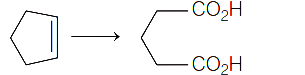 TS EAMCET 2019 Easy
 - If \(\int \frac{(2 x+3)}{x(x+1)(x+2)(x+3)+1} d x\) \(=-\frac{1}{p x^2+q x+r}+c\), then \(\frac{3 p-q}{r}=\)TS EAMCET 2019 Medium