


TS EAMCET · Maths · Matrices
If \(\left[\begin{array}{ccc}2 & 1 & 1 \\ 0 & 3 & -1 \\ 1 & -1 & 1\end{array}\right]\left[\begin{array}{l}x \\ y \\ z\end{array}\right]=\left[\begin{array}{l}1 \\ 1 \\ 0\end{array}\right]\), then \(\left[\begin{array}{l}x \\ y \\ z\end{array}\right]=\)
- A \(\left[\begin{array}{l}1 \\ 1 \\ 0\end{array}\right]+K\left[\begin{array}{c}3 \\ 1 \\ -2\end{array}\right], K \in \mathrm{R}\)
- B \(\left[\begin{array}{l}1 \\ 1 \\ 0\end{array}\right]+K\left[\begin{array}{c}1 \\ -2 \\ 3\end{array}\right], K \in \mathrm{R}\)
- C \(\left[\begin{array}{l}1 \\ 1 \\ 0\end{array}\right]+K\left[\begin{array}{c}-2 \\ 1 \\ 3\end{array}\right], K \in \mathrm{R}\)
- D \(\left[\begin{array}{c}1 \\ 0 \\ -1\end{array}\right]+K\left[\begin{array}{c}-2 \\ 1 \\ 3\end{array}\right], K \in \mathrm{R}\)
Answer & Solution
Correct Answer
(D) \(\left[\begin{array}{c}1 \\ 0 \\ -1\end{array}\right]+K\left[\begin{array}{c}-2 \\ 1 \\ 3\end{array}\right], K \in \mathrm{R}\)
Step-by-step Solution
Detailed explanation
It is given that, \(\left[\begin{array}{ccc}2 & 1 & 1 \\0 & 3 & -1 \\1 & -1 & 1\end{array}\right]\left[\begin{array}{l}x \\y \\z\end{array}\right]=\left[\begin{array}{l}1 \\1 \\0\end{array}\right]\) \(\Rightarrow \quad 2 x+y+z=1\) \(\ldots(\mathrm{i})\) \(3 y-z=1\)…
See the Complete Solution
Get step-by-step explanations for this and 2.5 Lakh+ more JEE, NEET & CET questions.
- Unlock all solutions
- Practice the full chapter
- Track accuracy across PYQs
4.8 rated on Google Play · 14,000+ reviews
More questions from Maths
- For all values of \(\theta\), the values of \(3-\cos \theta+\cos \left(\theta+\frac{\pi}{3}\right)\) lie in the interval :TS EAMCET 2006 Easy
- If \(n\) is an integer with \(0 \leq n \leq 11\), then the minimum value of \(n !(11-1)\) ! is attained when a value of \(n\) equals toTS EAMCET 2014 Medium
- If the equation of a line having a slope passing through and making an angle of with the line is thenTS EAMCET 2021 Easy
- In the random experiment of tossing two unbiased dice let \(E\) be the event of getting the sum 8 and \(F\) be the event of getting even numbers on both the dice. Then : I. \(P(E)=\frac{7}{36}\) II. \(P(F)=\frac{1}{3}\) Which of the following is a correct statement?TS EAMCET 2006 Hard
- \(\begin{aligned} & A(\alpha, \beta)=\left[\begin{array}{ccc}\cos \alpha & \sin \alpha & 0 \\ -\sin \alpha & \cos \alpha & 0 \\ 0 & 0 & e^\beta\end{array}\right] \\ & \Rightarrow[A(\alpha, \beta)]^{-1}=\end{aligned}\)TS EAMCET 2011 Medium
- If \(\tan \beta=\frac{n \sin \alpha \cos \alpha}{1-n \cos ^2 \alpha}\), then \(\tan (\alpha+\beta) \cdot \cot \alpha=\)TS EAMCET 2023 Easy
More PYQs from TS EAMCET
- Calculate the wavelength of the \(k_a\) line for \(z=31\), when \(a=5 \times 10^7 \mathrm{~Hz}^{1 / 2}\) for a characteristic X-ray spectrum.TS EAMCET 2011 Medium
- The number of common tangents to the circles \(x^2+y^2+4 x=0\) and \(x^2+y^2-2 x=0\) isTS EAMCET 2018 Easy
- An alcohol \(\mathrm{X}\left(\mathrm{C}_5 \mathrm{H}_{12} \mathrm{O}\right)\) when reacted with conc. HCl and anhydrous \(\mathrm{ZnCl}_2\) produces turbidity instantly. The alcohol X can be prepared from which of the following reactions?TS EAMCET 2024 Hard
- A molecule \((X)\) has (i) four sigma bonds formed by the overlap of \(s p^2\) and \(s\) orbitals (ii) one sigma bond formed by \(s p^2\) and \(s p^2\) orbitals and (iii) one \(\pi\) bond formed by \(p_x\) and \(p_z\) orbitals. Which of the following is \(X\) ?TS EAMCET 2006 Easy
- A current of \(2 \mathrm{~A}\) flows in an electric circuit as shown in figure. The potential difference \(\left(V_R-V_S\right)\), in volts \(\left(V_R\right.\) and \(V_S\) are potentials at \(R\) and \(S\) respectively) is
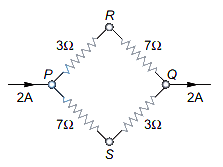 TS EAMCET 2008 Easy
 - If \(\int x(1+x) \log \left(1+x^2\right) d x=F(x)\) \(\log \left(1+x^2\right)-\frac{2}{3} \tan ^{-1} x-\frac{2 x^3}{9}-\frac{x^2}{2}+\frac{2 x}{3}+c\), then \(F(x)=\)TS EAMCET 2018 Hard