


TS EAMCET · Maths · Quadratic Equation
If \(\alpha, \beta\) are the roots of the equation \(x^2+3 x+\mathrm{k}=0\) and \(\alpha+\frac{1}{\alpha}, \beta+\frac{1}{\beta}\) are the roots of the equation \(4 x^2+p x+18=0\) then k satisfies the equation
- A \(2 x^2-13 x+20=0\)
- B \(x^2-5 x+6=0\)
- C \(2 x^2-7 x+3=0\)
- D \(x^2-8 x+15=0\)
Answer & Solution
Correct Answer
(A) \(2 x^2-13 x+20=0\)
Step-by-step Solution
Detailed explanation
Given: \(x^2+3x+k=0 \Rightarrow \alpha+\beta=-3, \alpha\beta=k\) Given: \(4x^2+px+18=0\) roots are \(\alpha+\frac{1}{\alpha}, \beta+\frac{1}{\beta}\) Product of roots: \(\left(\alpha+\frac{1}{\alpha}\right)\left(\beta+\frac{1}{\beta}\right) = \frac{18}{4} = \frac{9}{2}\)…
See the Complete Solution
Get step-by-step explanations for this and 2.5 Lakh+ more JEE, NEET & CET questions.
- Unlock all solutions
- Practice the full chapter
- Track accuracy across PYQs
4.8 rated on Google Play · 14,000+ reviews
More questions from Maths
- Let \(a, b, c, d \in \mathbf{R}\) be such that \(a d-b c \neq 0\) and \(e\) be a positive number other than 1 . If \(x^a y^b=e^m, x^c y^d=e^n, \Delta_1=\left|\begin{array}{ll}m & b \\ n & d\end{array}\right|, \Delta_2=\left|\begin{array}{ll}a & m \\ c & n\end{array}\right|\) and \(\Delta_3=\left|\begin{array}{ll}a & b \\ c & d\end{array}\right|\), then the values of \(x\) and \(y\) are respectively.TS EAMCET 2020 Hard
- If a straight line perpendicular to \(2 x-3 y+7=0\) forms a triangle with the co-ordinate axes whose area is 3 sq. units, then the equation of the straight line is :TS EAMCET 2002 Hard
-
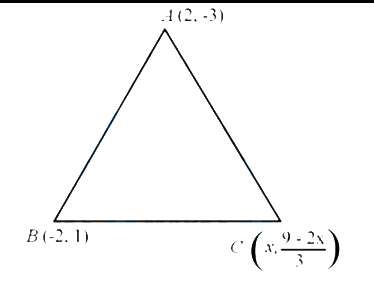
If \(A(2,-3)\) and \(B(-2,1)\) are two vertices of a triangle and third vertex moves on the line \(2 x+3 y=9\), then the locus of the centroid of the triangle isTS EAMCET 2023 Easy - If \(5 x-12 y+10=0\) and \(12 y-5 x+16=0\) are two tangents to a circle, then the radius of the circle isTS EAMCET 2003 Easy
- If a function \(f\) is defined by \(f(x)=\frac{\cot ^3 x-\tan x}{\cos (x+\pi / 4)}(x \neq \pi / 4)\), then \(\lim _{x \rightarrow \frac{\pi}{4}} f(x)=\)TS EAMCET 2023 Easy
- For the approximate value of isTS EAMCET 2019 Medium
More PYQs from TS EAMCET
- Consider the following
Assertion (A): phosphorus can form both phosphorus (III) and phosphorus (V) chlorides but nitrogen cannot form nitrogen(V) chloride.
Reason (R): The electronegativity of nitrogen is more than that of phosphorus
The correct answer isTS EAMCET 2025 Medium - Which one of the following molecules contain both ionic and covalent bonds?TS EAMCET 2002 Easy
- If \(\mathrm{P}(\mathrm{X}=\mathrm{x})=c\left(\frac{2}{3}\right)^x ; \mathrm{x}=1,2,3,4, \ldots\) is a probability distribution function of a random variable \(\mathrm{X}\), then the value of \(c\) isTS EAMCET 2023 Medium
- If and denote energies at time and respectively, and and distance from some point at and respectively, then which of the following equations can be declared to be incorrect on dimensional grounds (A) (B) (C) (D)TS EAMCET 2022 Easy
- The correct order of rates of addition of water to the following alkenes is [A] [B] [C] [D]TS EAMCET 2022 Hard
- A body is projected from the earth at angle \(30^{\circ}\) with the horizontal with some initial velocity. If its range is \(20 \mathrm{~m}\), the maximum height reached by it is : (in metres)TS EAMCET 2006 Easy