


TS EAMCET · Maths · Differential Equations
If A and B are arbitrary constants, then the differential equation having \(\mathrm{y}=\mathrm{Ae}^{\mathrm{x}}+\mathrm{B} \sin 2 \mathrm{x}\) as its general solution is
- A \(\begin{aligned} &(\cos 2 x-\sin 2 x) \frac{d^2 y}{d x^2}+(4 \sin 2 x) \frac{d y}{d x}-4(\sin 2 x \ &+\cos 2 x) y=0\end{aligned}\)
- B \(\begin{aligned} &(\cos 2 x+\sin 2 x) \frac{d^2 y}{d x^2}+(4 \sin 2 x) \frac{d y}{d x}-4(\sin \ &2 x-\cos 2 x) y=0\end{aligned}\)
- C \(\begin{aligned}(\cos 2 x-\sin 2 x) \frac{d^2 y}{d x^2}+(4 \sin 2 x) \frac{d y}{d x} & +4(\sin 2 x \ & +\cos 2 x) y=0\end{aligned}\)
- D \(\begin{array}{r}(\sin 2 x-\cos 2 x) \frac{d^2 y}{d x^2}-(4 \sin 2 x) \frac{d y}{d x}-4(\sin 2 x \ +\cos 2 x) y=0\end{array}\)
Answer & Solution
Correct Answer
(A) \(\begin{aligned} &(\cos 2 x-\sin 2 x) \frac{d^2 y}{d x^2}+(4 \sin 2 x) \frac{d y}{d x}-4(\sin 2 x \ &+\cos 2 x) y=0\end{aligned}\)
Step-by-step Solution
Detailed explanation
\(y=A e^x+B \sin 2 x \Rightarrow \frac{d y}{d x}=A e^x+2 B \cos 2 x\) \(\frac{d^2 y}{d x^2}=A e^x-4 B \sin 2 x\) \(\therefore \quad(\cos 2 x-\sin 2 x) \frac{d^2 y}{d x^2}=(\cos 2 x-\sin 2 x)\) \(\times\left(A e^x-4 B \sin 2 x\right)\) ...(1)…
See the Complete Solution
Get step-by-step explanations for this and 2.5 Lakh+ more JEE, NEET & CET questions.
- Unlock all solutions
- Practice the full chapter
- Track accuracy across PYQs
4.8 rated on Google Play · 14,000+ reviews
More questions from Maths
- The height (in cm) of a cylinder of the greatest volume that can be inscribed in a sphere of radius , isTS EAMCET 2018 Easy
- The value of \(k(>0)\), such that the angle between the lines \(4 x-y+7=0\) and \(k x-5 y-9=0\) is \(45^{\circ}\), isTS EAMCET 2015 Medium
- A circle passes through the point \((3,4)\) and cuts the circle \(x^2+y^2=a^2\) orthogonally; the locus of its centre is a straight line. If the distance of this straight line from the origin is 25 , then \(a^2\) is equal toTS EAMCET 2012 Medium
- Match the items of List-I to the items of List-II
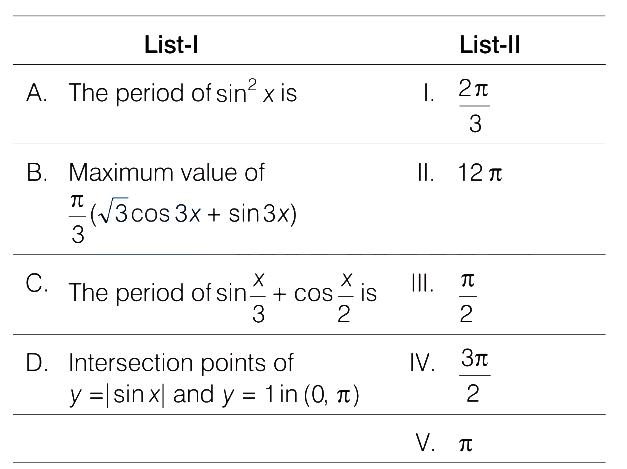
The correct match is \(\begin{array}{llll}A & B & C & D\end{array}\)TS EAMCET 2020 Medium - The length of the latusrectum of the conic \(25\left[(x-2)^2+(y-3)^2\right]=(3 x-4 y+7)^2\) isTS EAMCET 2021 Medium
- In a \(\triangle A B C\), if \(\frac{\cos A}{a}=\frac{\cos B}{b}=\frac{\cos C}{c}\), then \(\triangle A B C\) isTS EAMCET 2011 Medium
More PYQs from TS EAMCET
- Nuclear fission and fusion can be explained on the basis ofTS EAMCET 2023 Easy
- Which one of the following methods can be used to find out the percentage composition of halogen present in an organic compound?TS EAMCET 2019 Easy
- At \(T(\mathrm{~K})\), the ratio of kinetic energies of \(4 \mathrm{~g}\) of \(\mathrm{H}_2(g)\) and \(8 \mathrm{~g}\) of \(\mathrm{O}_2(g)\) isTS EAMCET 2013 Easy
- The solution of the differential equation \(\frac{d y}{d x}+\frac{x}{y} \cdot \frac{x^2+y^2-1}{2\left(x^2+y^2\right)+1}=0\) isTS EAMCET 2019 Hard
- The cubic equation whose roots are thrice to each of the roots of \(x^3+2 x^2-4 x+1=0\) isTS EAMCET 2008 Medium
- If \(x=\frac{9 t^2}{1+t^4}\) and \(y=\frac{16 t^2}{1-t^4}\) then \(\frac{d y}{d x}=\)TS EAMCET 2024 Easy