


TS EAMCET · Maths · Quadratic Equation
If \(2+\sqrt{3}\) is a root of the equation \(f(x)=x^4+2 x^3-16 x^2-22 x+7=0\), then which one of the following is not a root of \(f(x)=0 ?\)
- A \(3-\sqrt{2}\)
- B \(2-\sqrt{3}\)
- C \(-3+\sqrt{2}\)
- D \(-3-\sqrt{2}\)
Answer & Solution
Correct Answer
(A) \(3-\sqrt{2}\)
Step-by-step Solution
Detailed explanation
\(2+\sqrt{3}\) is a root of \(x^4+2 x^3-16 x^2-22 x+7=0\) \(\therefore 2-\sqrt{3}\) is also a root of \(\begin{aligned} x^4+2 x^3-16 x^2-22 x+7 & =0 \\ \because \quad x=2+\sqrt{3} & \\ (x-2)^2 & =(\sqrt{3})^2 \Rightarrow x^2-4 x+4-3=0 \\ x^2-4 x+1 & =0 \end{aligned}\)When…
See the Complete Solution
Get step-by-step explanations for this and 2.5 Lakh+ more JEE, NEET & CET questions.
- Unlock all solutions
- Practice the full chapter
- Track accuracy across PYQs
4.8 rated on Google Play · 14,000+ reviews
More questions from Maths
- If \(A=\left[\begin{array}{ll}1 & 1 \\ 0 & 1\end{array}\right]\) and \(I=\left[\begin{array}{ll}1 & 0 \\ 0 & 1\end{array}\right]\), then for all \(n \in N\)TS EAMCET 2018 Easy
- A random variable \(\mathrm{X}\) takes the values 0,1 and 2. If \(P(X=1)=P(X=2)\) and \(P(X=0)=0.4\), then the mean of the random variable \(\mathrm{X}\) isTS EAMCET 2002 Medium
- If \(m_1, m_2\) are the slopes of the tangents drawn through the point \((-1,-2)\) to the circle \((x-3)^2+(y-4)^2=4\), then \(\sqrt{3}\left|m_1-m_2\right|=\)TS EAMCET 2025 Medium
- Assume that are the roots of For , if are roots of thenTS EAMCET 2019 Hard
- If \(\alpha, \beta, 2 \beta\) are the real roots of the equation \(x^3-9 x^2+k=0\) and \(k \in \mathbb{R}-\{0\}\), then \(14 \beta=\)TS EAMCET 2022 Medium
- \((\sqrt{3}+i)^{10}+(\sqrt{3}-i)^{10}=\)TS EAMCET 2025 Medium
More PYQs from TS EAMCET
- What is the \(\%\) of carbon in the product ' \(Z\) ' formed in the reaction?
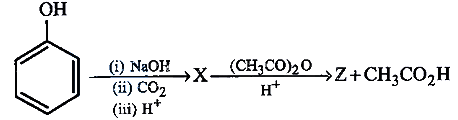 TS EAMCET 2024 Hard
 - Two vessels separately contain two ideal gases and at the same temperature. The pressure of gas is three times the pressure of gas . Under these conditions, the density of gas is found to be two times the density of . The ratio of molecular weights of gas and i.e. isTS EAMCET 2020 Hard
- TS EAMCET 2021 Easy
- Find the ratio of the length of a steel rod and a copper rod if the steel rod is longer than the copper rod at any temperature.
[The coefficient of linear expansion for steel and copper are and respectively]TS EAMCET 2022 Medium - If \(\bar{a}\) and \(\bar{b}\) are two vectors such that \(|\bar{a}|=|\bar{b}|=\sqrt{6}\) and \(\bar{a} \cdot \bar{b}=-1\) then \(|\bar{a} \times \bar{b}| \sin (\bar{a}, \bar{b})=\)TS EAMCET 2025 Medium
- Dehydration of an organic acid X with concentrated \(\mathrm{H}_2 \mathrm{SO}_4\) at 373 K gives \(\mathrm{H}_2 \mathrm{O}\) and gas Y. The hybridisation of the carbon in Y and nature of Y are respectivelyTS EAMCET 2025 Medium