


TS EAMCET · Maths · Probability
\(E_1\) and \(E_2\) are two independent events of a random experiment with \(P\left(E_1\right)=\frac{1}{2}\) and \(P\left(E_1 \cup E_2\right)=\frac{2}{3}\). Then match the items of List-1 with those of List-II. 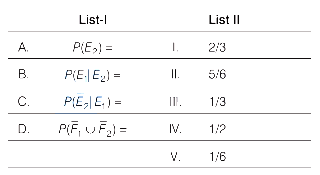
The correct match is \(\begin{array}{lllllllll}A & \text { B } & \text { C } & \text { D } & \text { A } & \text { B } & \text { C } & \text { D }\end{array}\)
- A \(\begin{array}{llll}\text { III } & \text { II } & \text { I } & \text { IV }\end{array}\)
- B III IV I II
- C \(\begin{array}{llll} & \text { III } & \text { II } & \text { I }\end{array}\)
- D \(\begin{array}{llll}\text { IV } & \text { III } & \text { I } & \text { II }\end{array}\)
Answer & Solution
Correct Answer
(B) III IV I II
Step-by-step Solution
Detailed explanation
We have, \(P\left(E_1\right)=\frac{1}{2}\) and \(P\left(E_1 \cup E_2\right)=\frac{2}{3}\). Since, \(E_1\) and \(E_2\) are independent events \(\therefore \quad P\left(E_1 \cap E_2\right)=P\left(E_1\right) \times P\left(E_2\right)\) Let \(P\left(E_2\right)\) be \(x\). Then,…
See the Complete Solution
Get step-by-step explanations for this and 2.5 Lakh+ more JEE, NEET & CET questions.
- Unlock all solutions
- Practice the full chapter
- Track accuracy across PYQs
4.8 rated on Google Play · 14,000+ reviews
More questions from Maths
- If \(\frac{6 x^4+13 x^3+2 x^2-x+3}{2 x^2+3 x-2}=f(x)+\frac{A}{a x-1}+\frac{B}{x+b}\) then \(f(1)+a \cdot B+b \cdot A=\)TS EAMCET 2023 Medium
- If \(n\) is a positive integer, then the coefficient of \(x^6\) in the expansion of \(\left(1-2 x+3 x^2-4 x^3+\ldots\right)^{-n}\) isTS EAMCET 2018 Medium
- Let \(f(0)=1, f(0.5)=\frac{5}{4}, f(1)=2, f(1.5)=\frac{13}{4}\) and \(f(2)=5\). Using Simpson's rule, \(\int_0^2 f(x) d x\) is equal toTS EAMCET 2011 Hard
- If \(f(x)=\frac{2 x}{4+3|x|}, x \in R\), then \(f^{\prime}(0)=\)TS EAMCET 2018 Medium
- If \(A=\left[\begin{array}{cc}-1 & 0 \\ 0 & 2\end{array}\right]\), then \(A^3-A^2\) is equal toTS EAMCET 2005 Medium
- The general solution of the differential equation \(\frac{d y}{d x}=\) \(\sin (x-y)+\cos (x-y)\) isTS EAMCET 2023 Hard
More PYQs from TS EAMCET
- If the normal drawn from the origin to the straight line \(2 x+7 y+6=0\) makes an angle 0 with the positive \(X\)-axis, then \(0=\)TS EAMCET 2019 Medium
- \(\alpha\) is the maximum value of \(1-2 x-5 x^2\) and \(\beta\) is the minimum value of \(x^2-2 x+r\). If \(5 \alpha x^2+\beta x+6>0\) for all real values \(x\), then the interval in which \(r\) lies isTS EAMCET 2020 Easy
- The solution set of the inequation isTS EAMCET 2019 Easy
- Which one of the following is the mineral for tin?TS EAMCET 2010 Easy
- Statement (A) \(\mathrm{CO}_2\) has no dipole moment, whereas \(\mathrm{SO}_2\) and \(\mathrm{H}_2 \mathrm{O}\) have dipole moment. Statement (B) \(\mathrm{SnCl}_2\) is ionic, whereas \(\mathrm{SnCl}_4\) is covalent. Which of the following is correct?TS EAMCET 2018 Easy
- \(\int \frac{\sin x+8 \cos x}{4 \sin x+6 \cos x} d x\) is equal toTS EAMCET 2007 Medium