


TS EAMCET · Maths · Functions
Assertion (A) If \(a_1, a_2, \ldots, a_n\) are the \(n\) distinct roots of the equation \(x^n-2=0\), then \(1+\left(1-a_1\right)\left(1-a_2\right) \ldots\left(1-a_{n-1}\right)\left(1-a_n\right)=0\) Reason (R) If \(\alpha_1, \alpha_2, \ldots, \alpha_n\) are the roots of \(f(x) \equiv p_0 x^n+p_1 x^{n-1}+p_2 x^{n-2}+\ldots+p_n=0\), then the roots of \(f(g(x))=0 \operatorname{are~}^{-1}\left(\alpha_i\right), i=1,2,3, \ldots, n\) The correct option among the following is
- A (A) is true, (R) is true and (R) is the correct explanation for (A).
- B (A) is true, (R) is true but (R) is not the correct explanation for (A).
- C (A) is true but (R) is false .
- D (A) is false but (R) is true.
Answer & Solution
Correct Answer
(A) (A) is true, (R) is true and (R) is the correct explanation for (A).
Step-by-step Solution
Detailed explanation
Given, \(a_1, a_2, a_3, \ldots, a_n\) are \(n\) distinct roots of…
See the Complete Solution
Get step-by-step explanations for this and 2.5 Lakh+ more JEE, NEET & CET questions.
- Unlock all solutions
- Practice the full chapter
- Track accuracy across PYQs
4.8 rated on Google Play · 14,000+ reviews
More questions from Maths
- The straight lines \(x+3 y-9=0\), \(4 x+5 y-1=0, p x+q y+10=0\) are concurrent, if the line \(5 x+6 y+10=0\) passes through the pointTS EAMCET 2020 Easy
- If \(\vec{a}=\hat{i}-\hat{j}+3 \hat{k}, \hat{c}=-\hat{k}\) are position vectors of two points and \(\vec{b}=2 \hat{i}-\hat{j}+\lambda \hat{k}, \hat{d}=\hat{i}+2 \hat{j}-\hat{k}\) are two vectors, then the lines \(\vec{r}=\vec{a}+t \vec{b}, \vec{r}=\vec{c}+s \vec{d}\) areTS EAMCET 2024 Medium
- If \(A\) and \(B\) are independent events of a random experiment such that \(P(A \cap B)=\frac{1}{6}\) and \(P(\bar{A} \cap \bar{B})=\frac{1}{3}\), then \(P(A)\) is equal to (Here, \(\overrightarrow{\mathbf{E}}\) is the complement of the event \(E\) )TS EAMCET 2008 Medium
- Let and , then the domain of isTS EAMCET 2021 Easy
- \(\sin 20^{\circ}\left(4+\sec 20^{\circ}\right)=\)TS EAMCET 2024 Medium
- Let the angles \(\mathrm{A}, \mathrm{B}, \mathrm{C}\) of a triangle ABC be in arithmetic progression. If the exradii \(r_1, r_2, r_3\) of triangle ABC satisfy the condition \(r_3^2=r_1 r_2+r_2 r_3+r_3 r_1\), then \(b=\)TS EAMCET 2025 Hard
More PYQs from TS EAMCET
- A block of mass M moving on a frictionless horizontal surface collides with a spring of spring constant K, as shown in the figure. If the spring compresses by a length \(\mathrm{L}\), then the maximum momentum of the block after the collision is.
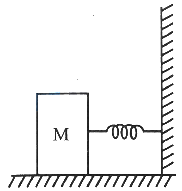 TS EAMCET 2023 Medium
 - The perimeter of a sector is a constant. If its area is to be maximum, the sectorial angle is :TS EAMCET 2006 Medium
- If \(f: \mathbb{R} \rightarrow \mathbb{R}\) is defined by \(f(\mathrm{x})=2 \mathrm{x}+\sin \mathrm{x}, \mathrm{x} \in \mathrm{R}\), then \(f\) isTS EAMCET 2023 Medium
- A parallel-plate capacitor with circular plates is being discharged. The radius of the circular plate is \(10 \mathrm{~cm}\). A circular loop of radius \(20 \mathrm{~cm}\) is concentric with the capacitor and located halfway between the plates. If the electric field between the plates is charging at the rate \(3.6 \times 10^{12} \mathrm{~V} /(\mathrm{ms})\), then the displacement current through the loop is (Assume \(\frac{1}{4 \pi \varepsilon_0}=9 \times 10^9 \mathrm{Nm}^2 / \mathrm{C}^2\) )TS EAMCET 2020 Medium
- Let be any point on the circle and be its centre. Let be the chord of contact of with respect to the circle . Then the locus of the circumcentre of the triangle isTS EAMCET 2022 Medium
- What is the correct order of bond lengths in the following molecules? \(\begin{array}{llll} \text { I. } \mathrm{O}_2 & \text { II. } \mathrm{O}_2^{+} & \text {III. } \mathrm{O}_2^{-} & \text {IV. } \mathrm{O}_2^{2-} \end{array}\)TS EAMCET 2020 Medium