


TS EAMCET · Maths · Probability
\(\mathrm{A}, \mathrm{B}_1, \mathrm{~B}_2, \mathrm{~B}_3\) are the events in a random experiment. If \(\mathrm{P}\left(\mathrm{B}_1\right)=0.25, \mathrm{P}\left(\mathrm{B}_2\right)=0.30\), \(\mathrm{P}\left(\mathrm{B}_3\right)=0.45, \mathrm{P}\left(\frac{\mathrm{A}}{\mathrm{B}_1}\right)=0.05, \mathrm{P}\left(\frac{\mathrm{A}}{\mathrm{B}_2}\right)=0.04, \mathrm{P}\left(\frac{\mathrm{A}}{\mathrm{B}_3}\right)=0.03\), then \(\mathrm{P}\left(\frac{\mathrm{B}_2}{\mathrm{~A}}\right)=\)
- A \(\frac{6}{19}\)
- B \(\frac{8}{19}\)
- C \(\frac{12}{19}\)
- D \(\frac{5}{19}\)
Answer & Solution
Correct Answer
(A) \(\frac{6}{19}\)
Step-by-step Solution
Detailed explanation
\(\mathrm{P}(\mathrm{A}) = \mathrm{P}(\mathrm{A}|\mathrm{B}_1)\mathrm{P}(\mathrm{B}_1) + \mathrm{P}(\mathrm{A}|\mathrm{B}_2)\mathrm{P}(\mathrm{B}_2) + \mathrm{P}(\mathrm{A}|\mathrm{B}_3)\mathrm{P}(\mathrm{B}_3)\)…
See the Complete Solution
Get step-by-step explanations for this and 2.5 Lakh+ more JEE, NEET & CET questions.
- Unlock all solutions
- Practice the full chapter
- Track accuracy across PYQs
4.8 rated on Google Play · 14,000+ reviews
More questions from Maths
- TS EAMCET 2019 Medium
- If the line \(2 x+b y+5=0\) forms an equilateral triangle with \(a x^2-96 b x y+k y^2=0\), then \(a+3 k=\)TS EAMCET 2024 Easy
- Consider the following system of equations in matrix form . Then which one of the following statements is true?TS EAMCET 2019 Medium
- The circle \(S=0\) cuts the circles \(C_1=x^2+y^2-8 x-2 y+16=0\) and \(C_2=x^2+y^2-4 x-4 y-1=0\) orthogonally. If the common chord of \(S=0\) and \(C_1=0\) is \(2 x+13 y-15=0\), then the centre of \(S=0\) isTS EAMCET 2020 Hard
- If the mean and variance of a binomial variable \(X\) are 2 and 1 respectively, then \(P(X \geq 1)\) is equal toTS EAMCET 2010 Easy
- The maximum value of the function \(f(x)=3 \sin ^{12} x+\) \(4 \cos ^{16} x\) isTS EAMCET 2024 Medium
More PYQs from TS EAMCET
- A particle leaves the origin with initial velocity and a constant acceleration . The position vector of particle, when it reaches its maximum -coordinate, isTS EAMCET 2021 Hard
- The rate of chemical reaction doubles with every rise in temperature. If the reaction is carried out in the vicinity of , the activation energy of the reaction is (Given and )TS EAMCET 2020 Medium
- Match the following.
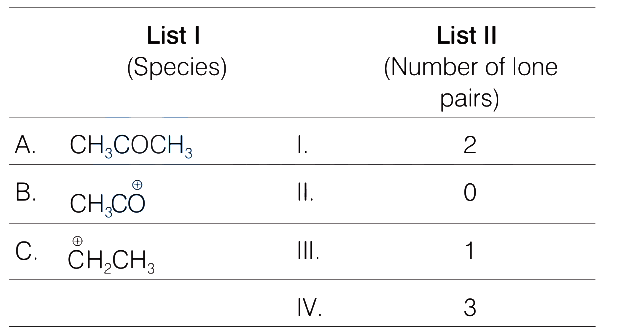
The correct match is \(\text { A } \quad B \quad \text { C }\)TS EAMCET 2021 Easy - Which one of the following sets correctly represents the increase in the paramagnetic property of the ions?TS EAMCET 2009 Easy
- In atomic scale the weakest force in nature isTS EAMCET 2020 Easy
- If \(\ell, \mathrm{m}, \mathrm{n}\) and \(\mathrm{a}, \mathrm{b}, \mathrm{c}\) are direction cosines of two lines thenTS EAMCET 2023 Easy