


TS EAMCET · Maths · Probability
A and \({B}\) are two independent events. \({P}({A})=\frac{2}{5}, {P}({B})=\frac{1}{3}\). Match the following.
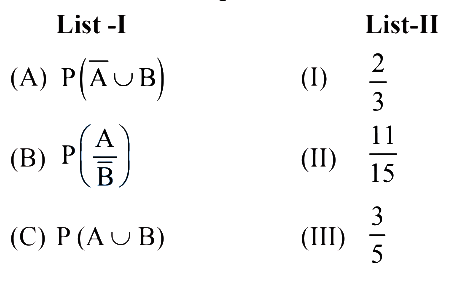
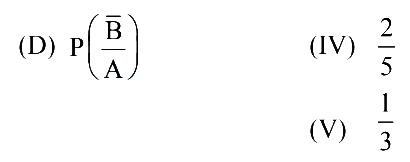
The correct answer is \( \begin{array}{llll} \mathbf{A} & \mathbf{B} & \mathbf{C} & \mathbf{D} \end{array} \)
- A \(\begin{array}{llll}\text { I } & \text { III } & \text { IV } & \text { II }\end{array}\)
- B \(\begin{array}{llll}\text { II } & \text { IV } & \text { V } & \text { I }\end{array}\)
- C \(\begin{array}{llll}\text { II } & \text { IV } & \text { III } & \text { V }\end{array}\)
- D \(\begin{array}{llll}\text { II } & \text { IV } & \text { III } & \text { I }\end{array}\)
Answer & Solution
Correct Answer
(D) \(\begin{array}{llll}\text { II } & \text { IV } & \text { III } & \text { I }\end{array}\)
Step-by-step Solution
Detailed explanation
Given \({P}({A})=\frac{2}{5}, {P}({B})=\frac{1}{3}\) are independent events. \( \Rightarrow {P}({A} \cap {B})={P}({A}) \times {P}({B})=\frac{2}{15} \) From the Venn diagram, you can see (A)…
See the Complete Solution
Get step-by-step explanations for this and 2.5 Lakh+ more JEE, NEET & CET questions.
- Unlock all solutions
- Practice the full chapter
- Track accuracy across PYQs
4.8 rated on Google Play · 14,000+ reviews
More questions from Maths
- The equation of the normal drawn to the curve \(y=\sin 3 x\) at \(x=\frac{\pi}{4}\) isTS EAMCET 2021 Easy
- If \(\tan \left(\frac{\pi}{4}+\frac{\alpha}{2}\right)=\tan ^3\left(\frac{\pi}{4}+\frac{\beta}{2}\right)\), then \(\frac{3+\sin ^2 \beta}{1+3 \sin ^2 \beta}=\)TS EAMCET 2025 Hard
- If \(\sqrt{1-x^2}+\sqrt{1-y^2}=a(x-y)\), then \(\left[\left(1-x^2\right)^2 \frac{d^2 y}{d x^2}+y\left(1-x^2\right)\right] \frac{d y}{d x}=\)TS EAMCET 2020 Hard
- For the circle \(C\) with the equation \(x^2+y^2-16 x-12 y+64=0\) match the List I with the List II given below.
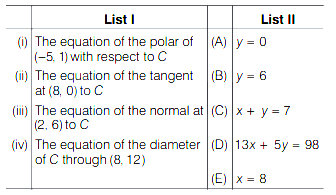
The correct match is \(\begin{array}{llll}(\mathrm{i}) & (\mathrm{ii}) & (\mathrm{iii}) & (\mathrm{iv})\end{array}\)TS EAMCET 2013 Medium - Let \(\mathbf{a}=\sin ^2 x \hat{\mathbf{i}}+\cos ^2 x \hat{\mathbf{j}}+\hat{\mathbf{k}},(x \in R)\). If the pairs of vectors \(\mathbf{a}, \hat{\mathbf{i}} ; \mathbf{a}, \hat{\mathbf{j}}\) and \(\mathbf{a}, \hat{\mathbf{k}}\) are adjacent sides of 3 distinct parallelograms and \(A\) is the sum of the squares of areas of these parallelograms, then \(A\) lies in the intervalTS EAMCET 2018 Medium
- If \(n=(210)^2(360)(143)\), then the total number of non trivial factors of \(n\) isTS EAMCET 2019 Easy
More PYQs from TS EAMCET
- The velocity of de Broglie wave is given byTS EAMCET 2022 Medium
- If is continuous everywhere, thenTS EAMCET 2021 Easy
- A thin uniform square lamina of side \(a\) is placed in the \(x y\)-plane with its sides parallel to \(X\) and \(Y\)-axes and with its centre coinciding with origin. Its moment of inertia about an axis passing through a point on the \(Y\)-axis at a distance \(Y=2 a\) and parallel to \(X\)-axis is equal to its moment of inertia about an axis passing through a point on the \(X\)-axis at a distance \(x=d\) and perpendicular to \(x y\)-plane. Then value of \(d\) isTS EAMCET 2004 Hard
- \(\cos \alpha \sin (\beta-\gamma)+\cos \beta \sin (\gamma-\alpha)\) \(+\cos \gamma \sin (\alpha-\beta)\) is equal toTS EAMCET 2003 Medium
- \(f:[1,3] \rightarrow R\) is a function defined as \(f(x)=x^3+a x^2+b x\). If \(f(\mathrm{l})-f(3)=0\) and \(f^{\prime}\left(\frac{2 \sqrt{3}+1}{\sqrt{3}}\right)=0\). Then, \(a-b\) is equal toTS EAMCET 2021 Medium
- The point of concurrence of all the chords of the curve \(3 x^2-y^2-2 x+4 y=0\) which subtend a right angle at the origin isTS EAMCET 2023 Easy