


TS EAMCET · Chemistry · d and f Block Elements
Which one of the following lanthanide ions does not exhibit paramagnetism?
- A \(\mathrm{Lu}^{3+}\)
- B \(\mathrm{Ce}^{3+}\)
- C \(\mathrm{Eu}^{3+}\)
- D \(\mathrm{Yb}^{3+}\)
Answer & Solution
Correct Answer
(A) \(\mathrm{Lu}^{3+}\)
Step-by-step Solution
Detailed explanation
Generally, paramagnetism is shown by lanthanoid ions. The paramagnetism arises due to presence of unpaired electrons in \(f\)-orbital. \(\mathrm{Lu}^{3+}\left(4 f^{14}\right)\) does not have unpaired electrons. Hence, it does not exhibit paramagnetism.
See the Complete Solution
Get step-by-step explanations for this and 2.5 Lakh+ more JEE, NEET & CET questions.
- Unlock all solutions
- Practice the full chapter
- Track accuracy across PYQs
4.8 rated on Google Play · 14,000+ reviews
More questions from Chemistry
- Phosphine is prepared by the reaction of \(\mathrm{P}_4\) with which of the following?TS EAMCET 2020 Medium
- How many protons will be consumed when dichromate ion oxidises \(\mathrm{Fe}^{2+}\) ions in aqueous acidic medium?TS EAMCET 2019 Medium
- The number of \(p \pi-d \pi\) 'pi' bonds present in \(\mathrm{XeO}_3\) and \(\mathrm{XeO}_4\) molecules, respectively areTS EAMCET 2009 Easy
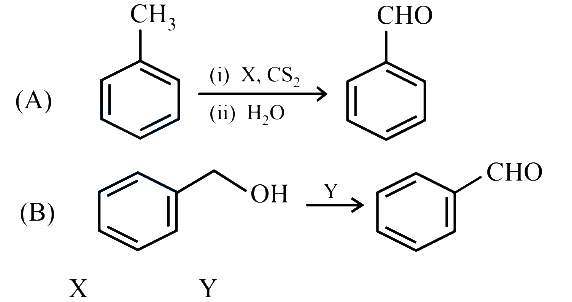
- Identify X and Y in the reactions, given below
 TS EAMCET 2022 Medium
 - Which of the following is the incorrect statement about maltose?TS EAMCET 2023 Medium
- Which of the following is a linear molecule?TS EAMCET 2005 Easy
More PYQs from TS EAMCET
- If \(\mathrm{p}_1, \mathrm{p}_2, \mathrm{p}_3\) are the altitudes and \(a=4, b=5, c=6\) are the sides of a triangle ABC, then \(\frac{1}{\mathrm{p}_1{ }^2}+\frac{1}{\mathrm{p}_2{ }^2}+\frac{1}{\mathrm{p}_3{ }^2}=\)TS EAMCET 2025 Medium
- The sum of oxidation state and co-ordination number of central metal atom is maximum with respect to which of the following complex?TS EAMCET 2023 Medium
- If the parabola \(x^2=4 a y,(a>0)\) makes an intercept of length \(\sqrt{40}\) units on the line \(y=1+2 x\) then \(4 a=\)TS EAMCET 2020 Medium
- In the reactions \(\mathrm{I}\) and \(\mathrm{II}\) the covalencies of \(\mathrm{Be}\) and \(\mathrm{Al}\) in \(\mathrm{X}\) and \(\mathrm{Y}\) are respectively I \(\mathrm{Be}(\mathrm{OH})_2+\underset{\text { (excess) }}{\mathrm{NaOH}} \rightarrow \mathrm{X}\) (excess) II \(\mathrm{Al}(\mathrm{OH})_3+\underset{\text { (excess) }}{\mathrm{NaOH}} \rightarrow \mathrm{Y}\)TS EAMCET 2023 Medium
- Three bodies a ring, a solid cylinder and a solid sphere roll down an inclined plane without slipping. They start from rest. Which of the bodies reaches bottom of plane with minimum velocity?TS EAMCET 2021 Easy
- Identify the logic gate from the following with the same truth table characteristics of the logic circuit below.TS EAMCET 2022 Easy