


TS EAMCET · Chemistry · Chemical Kinetics
Which of the following graphs represents a zero order reaction? (a = initial concentration of reactant, \(x=\) concentration of reactant consumed, \(t=\) time) 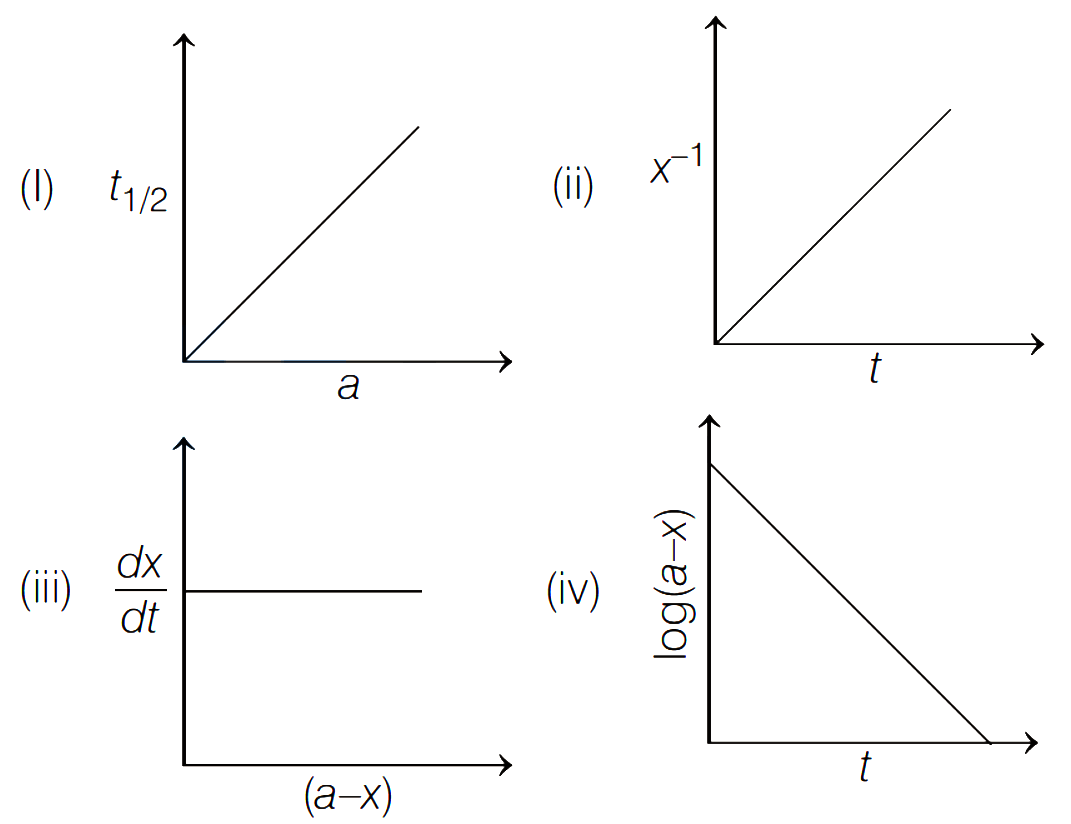
- A i, iii, iv
- B i, iii
- C ii, iii, iv
- D \(i_1\) iv
Answer & Solution
Correct Answer
(B) i, iii
Step-by-step Solution
Detailed explanation
For, zero order reaction \(t_{1 / 2}=\frac{a}{2 K}\) and for zero order reaction, concentration is independent from sate. So, \(\frac{d x}{d t}\) is constant.
See the Complete Solution
Get step-by-step explanations for this and 2.5 Lakh+ more JEE, NEET & CET questions.
- Unlock all solutions
- Practice the full chapter
- Track accuracy across PYQs
4.8 rated on Google Play · 14,000+ reviews
More questions from Chemistry
- The osmotic pressure of \(0.1 \mathrm{M}\) monobasic acid of \(\mathrm{pH} 3\) at \(27^{\circ} \mathrm{C}\) isTS EAMCET 2020 Hard
- Which of the following has \(\mathrm{S}-\mathrm{S}\) bond?TS EAMCET 2004 Medium
- The correct order of reducing ability of the following hydrides isTS EAMCET 2021 Medium
- \[ \mathrm{C}_2 \mathrm{H}_6 \stackrel{4500^{\circ} \mathrm{C}}{\longrightarrow} \mathrm{C}_2 \mathrm{H}_4+\mathrm{H}_2 \] Above reaction is called asTS EAMCET 2013 Easy
- Observe the following data ( \(\Delta_i \mathrm{H}_1, \Delta_i \mathrm{H}_2\) and \(\Delta_{\text {eg }} \mathrm{H}\) represent the first, second ionisation enthalpies and electron gain enthalpy respectively).
Element \(\begin{gathered}\Delta_i \mathrm{H}_1 \\ \left(\mathrm{~kJ}\mathrm{~mol}^{-1}\right)\end{gathered}\) \(\begin{gathered}\Delta_i \mathrm{H}_2 \\ \left(\mathrm{~kJ}\mathrm{~mol}^{-1}\right)\end{gathered}\) \(\begin{gathered}\Delta_{\text{eg}}\mathrm{H}\\ \left(\mathrm{kJ}\mathrm{mol}^{-1}\right)\end{gathered}\) I \(520\) \(7300\) \(-60\) II \(490\) \(3051\) \(-48\) III \(1681\) \(3374\) \(-328\) IV \(2372\) \(5251\) \(+48\)
Using the data identify the most reactive metal.TS EAMCET 2025 Medium - The structure of PCC isTS EAMCET 2013 Hard
More PYQs from TS EAMCET
- An aircraft is flying at a height of ' \(H\) ' above the ground and at a speed of ' \(V\) '. The maximum angle subtended at a ground observation point by the aircraft after time \(T\) isTS EAMCET 2022 Medium
- For the parabola \(y=x^2-3 x+2\), match the items in list-1 to that of the items in list-2. S is a focus, Z is intersection of axis and directrix, P is one end point of latus rectum, Q is the point on the parabola at which tangent is parallel to X -axis
List-1 List-2 A P I \((2,0)\) B Q II \(\left(\frac{3}{2},-\frac{1}{4}\right)\) C S III \(\left(\frac{3}{2}, 0\right)\) D Z IV \(\left(\frac{3}{2},-\frac{1}{2}\right)\) V \(\left(0, \frac{3}{2}\right)\) TS EAMCET 2025 Medium - The focal length of an equi-convex lens is greater than the radius of curvature of any of the surfaces. Then the refractive index of the material of the lens isTS EAMCET 2005 Medium
- Two charges \(2 \mathrm{C}\) and \(6 \mathrm{C}\) are separated by a finite distance. If a charge of \(-4 \mathrm{C}\) is added to each of them, the initial force of \(12 \times 10^3 \mathrm{~N}\) will change toTS EAMCET 2005 Easy
- Identity in the following reactionTS EAMCET 2021 Hard
- A body of mass 0.5 kg is supplied with a power ' P ' (in watt) which varies with time ' t ' (in second) as \(\mathrm{P}=3 \mathrm{t}^2+3\). If the velocity of the body at time \(\mathrm{t}=0\) is zero, then the velocity of the body at time \(t=3 \mathrm{~s}\) isTS EAMCET 2025 Medium