


TS EAMCET · Chemistry · Hydrogen
When calcium carbide is reacted with heavy water, which of the following product(s) will be formed I. \(\mathrm{CD}_4\) II. \(\mathrm{C}_2 \mathrm{D}_2\) III. \(\mathrm{Ca}(\mathrm{OD})_2\) IV. \(\mathrm{Ca}_2 \cdot \mathrm{D}_2 \mathrm{O}\)
- A I and IV
- B II and III
- C I, II and III
- D I, II, III and IV
Answer & Solution
Correct Answer
(B) II and III
Step-by-step Solution
Detailed explanation
Calcium carbide \(\left(\mathrm{CaC}_2\right)\) is an ionic carbide, which can be written as \([: \stackrel{\ominus}{\mathrm{C}} \equiv \stackrel{\ominus}{\mathrm{C}}:] \mathrm{Ca}^{2+}\)
See the Complete Solution
Get step-by-step explanations for this and 2.5 Lakh+ more JEE, NEET & CET questions.
- Unlock all solutions
- Practice the full chapter
- Track accuracy across PYQs
4.8 rated on Google Play · 14,000+ reviews
More questions from Chemistry
- When \(10 \mathrm{~g}\) of methane is completely burnt in oxygen, the heat evolved is \(560 \mathrm{~kJ}\). What is the heat of combustion (in \(\mathrm{kJ} \mathrm{mol}^{-1}\) ) of methane?TS EAMCET 2003 Easy
- What is the approximate angular momentum (in \(\mathrm{J} \mathrm{s}\) ) of electron in hydrogen atom in its ground state? \[ \left(\mathrm{h}=6.625 \times 10^{-34} \mathrm{Js}\right) \]TS EAMCET 2023 Medium
- Rate constants in the following reaction are Reaction 1: \(\mathrm{A} \stackrel{\text { catalyst } 1}{\longrightarrow} \mathrm{P}_1, \mathrm{k}_1=1 \mathrm{~s}^{-1}\) Reaction 2: A \(\stackrel{\text { catalyst } 2}{\longrightarrow} \mathrm{P}_2, \mathrm{k}_2=0.1 \mathrm{~L} \mathrm{~mol}^{-1} \mathrm{~s}^{-1}\) Reaction 3: A \(\stackrel{\text { catalyst } 3}{\longrightarrow} \mathrm{P}_3, \mathrm{k}_3=0.01 \mathrm{~L}^2 \mathrm{~mol}^{-2} \mathrm{~s}^{-1}\) The correct relations between the rate of the reactions at \(1 \mathrm{M}\) of \(\mathrm{A}\) areTS EAMCET 2022 Medium
- Which one of the following complex ions has geometrical isomers?TS EAMCET 2024 Medium
- Identify what is \(\mathrm{Y}\) in the following reaction sequence?
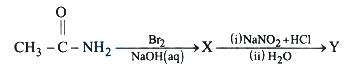 TS EAMCET 2023 Hard
 - The maximum number of possible electrons in a subshell with \(n=3\) and \(l=2\) isTS EAMCET 2020 Easy
More PYQs from TS EAMCET
- \(\log (9+3 \sqrt{2}(2+\sqrt{5})+4 \sqrt{5})=\)TS EAMCET 2020 Medium
- A copper ball of radius \(3.0 \mathrm{~mm}\) falls in an oil tank of viscosity \(1 \mathrm{~kg} / \mathrm{ms}\). Then, the terminal velocity of the copper ball will be (Density of oil \(=1.5 \times 10^3 \mathrm{~kg} / \mathrm{m}^3\), Density of copper \(=9 \times 10^3 \mathrm{~kg} / \mathrm{m}^3\) and \(g=10 \mathrm{~m} / \mathrm{s}^2\).)TS EAMCET 2019 Easy
- If the eccentricity of a hyperbola is \(\sqrt{3}\); then the eccentricity of its conjugate hyperbola is :TS EAMCET 2006 Easy
- If one of the lines in the pair of straight line given by \(4 x^2+6 x y+k y^2=0\) bisects the angle between the coordinate axes, then \(k \in\)TS EAMCET 2011 Medium
- If \(\hat{\mathbf{a}}, \mathbf{b}\) and \(\hat{\boldsymbol{c}}\) are non-coplanar vectors and if \(\mathbf{d}\) is such that \(\hat{\mathbf{d}}=\frac{1}{x}(\hat{\mathbf{a}}+\hat{\mathbf{b}}+\hat{\mathbf{c}})\) and \(\hat{\mathbf{d}}=\frac{1}{y}(\hat{\mathbf{b}}+\hat{\mathbf{c}}+\hat{\mathbf{d}})\) where \(x\) and \(y\) are non-zero real numbers, then \(\frac{1}{x y}(\hat{\mathbf{a}}+\hat{\mathbf{b}}+\hat{\mathbf{c}}+\hat{\mathbf{d}})\) equals toTS EAMCET 2014 Hard
- Identify \(B\) in the following reaction \(\mathrm{H}_4 \mathrm{SiO}_4 \underset{-\mathrm{H}_2 \mathrm{O}}{\stackrel{1000{ }^{\circ} \mathrm{C}}{\longrightarrow}} A \underset{\Delta}{\stackrel{\text { Carbon }}{\longrightarrow}} B+\mathrm{CO}\)TS EAMCET 2008 Hard