


TS EAMCET · Chemistry · Chemical Kinetics
The rate law for the decomposition of hydrogen iodide is \(-\frac{\mathrm{d}[\mathrm{HI}]}{\mathrm{dt}}=\mathrm{k}[\mathrm{HI}]^2\). The units of rate constant \(\mathrm{k}\) are
- A \(\mathrm{L}_{\mathrm{mol}^{-1}} \mathrm{~s}^{-1}\)
- B \(\mathrm{L}^{-1} \mathrm{~mol} \mathrm{~s}^{-1}\)
- C \(\mathrm{L}^2 \mathrm{~mol}^{-2} \mathrm{~s}^{-1}\)
- D \(\mathrm{L}^{1 / 2} \mathrm{~mol}^{-1 / 2} \mathrm{~s}^{-1}\)
Answer & Solution
Correct Answer
(A) \(\mathrm{L}_{\mathrm{mol}^{-1}} \mathrm{~s}^{-1}\)
Step-by-step Solution
Detailed explanation
From the rate law, units \(=\frac{\left(\mathrm{mol} \mathrm{L}^{-1} \mathrm{~s}^{-1}\right)}{\left(\mathrm{mol} \mathrm{L}^{-1}\right)^2}=\mathrm{L} \mathrm{mol}^{-1} \mathrm{~s}^{-1}\)
See the Complete Solution
Get step-by-step explanations for this and 2.5 Lakh+ more JEE, NEET & CET questions.
- Unlock all solutions
- Practice the full chapter
- Track accuracy across PYQs
4.8 rated on Google Play · 14,000+ reviews
More questions from Chemistry
- The oxide of a metal contains \(40 \%\) of oxygen. The valency of metal is 2 . What is the atomic weight of metal?TS EAMCET 2014 Easy
- 200 mL of an aqueous solution of \(\mathrm{HCl}(\mathrm{pH}=2)\) is mixed with 300 mL of aqueous solution of \(\mathrm{NaOH}(\mathrm{pH}=12)\) and is diluted to 1.0 L. The pH of the resulting solution isTS EAMCET 2025 Easy
- The number of chlorine \((\mathrm{Cl})\) atoms in the structure of DDT molecule isTS EAMCET 2025 Easy
- The wavelength (in \(Å\) ) of a photon having energy \(3 \mathrm{eV}\) is approximately. \[ \begin{aligned} & {\left[1 \mathrm{eV}=1.6 \times 10^{12} \mathrm{erg}\right]} \ & {\left[h=6.626 \times 10^{27} \mathrm{erg} \mathrm{s}\right]} \end{aligned} \]TS EAMCET 2018 Easy
- Which intermediate is formed in the Reimer-Tiemann reaction?TS EAMCET 2015 Easy
- The monomer which is present in both Bakelite and Melamine polymers isTS EAMCET 2024 Medium
More PYQs from TS EAMCET
- If \(\alpha_1, \beta_1, \gamma_1, \delta_1\) are the roots of the equation \(a x^4+b x^3+c x^2+d x+e=0\) and \(\alpha_2, \beta_2, \gamma_2, \delta_2\) are the roots of the equation \(e x^4+d x^3+c x^2+b x+a=0\) such that \(0 < \alpha_1 < \beta_1 < \gamma_1 < \delta_1, 0 < \alpha_2 < \beta_2 < \gamma_2 < \delta_2\) \(\alpha_1-\delta_2=2=\beta_1-\gamma_2 ; \gamma_1-\beta_2=\delta_1-\alpha_2=4\), then \(a+b+c+d+e=\)TS EAMCET 2020 Hard
- The standard electrode potentials \(\mathrm{E}^{\circ}(\mathrm{V})\) for \(\mathrm{Li}^{+} / \mathrm{Li}, \mathrm{Na}^{+} /\) Na respectively areTS EAMCET 2024 Easy
- Which of the curve \((Z v s p)\) will be followed by a real gas?
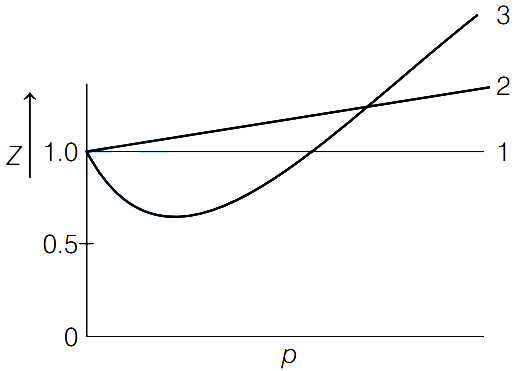 TS EAMCET 2020 Medium
 - In which of the following options, the IUPAC name is not correctly matched with the structure of the compound?TS EAMCET 2024 Easy
- If \((1, a),(b, 2)\) are conjugate points with respect to the circle \(x^2+y^2=25\), then \(4 a+2 b\) is equal toTS EAMCET 2004 Easy
- A small ball is thrown at an angle \(45^{\circ}\) to the horizontal with an initial velocity of \(2 \sqrt{2} \mathrm{~m} / \mathrm{s}\). The magnitude of mean velocity averaged over the first \(2 \mathrm{~s}\) is [talse, acceleration due to gravity, \(g=10 \mathrm{~m} / \mathrm{s}^2\) ]TS EAMCET 2018 Easy