


TS EAMCET · Chemistry · Haloalkanes and Haloarenes
The organic halide, which does not undergo hydrolysis by \(\mathrm{S}_{\mathrm{N}} 1\) mechanism is
- B \(\mathrm{CH}_2=\mathrm{CH}-\mathrm{CF}_2 \mathrm{Cl}\)
- C \(\left(\mathrm{CH}_3\right)_3 \mathrm{C}-\mathrm{Cl}\)
- D \(\mathrm{CH}_3-\mathrm{CH}=\mathrm{CH}-\mathrm{Cl}\)
Answer & Solution
Correct Answer
(D) \(\mathrm{CH}_3-\mathrm{CH}=\mathrm{CH}-\mathrm{Cl}\)
Step-by-step Solution
Detailed explanation
\(\mathrm{S}_{\mathrm{N}} 1\) mechanism proceeds by the formation of carbocation intermediate. Stable carbocation undergo hydrolysis by \(\mathrm{S}_{\mathrm{N}} 1\) mechanism.
See the Complete Solution
Get step-by-step explanations for this and 2.5 Lakh+ more JEE, NEET & CET questions.
- Unlock all solutions
- Practice the full chapter
- Track accuracy across PYQs
4.8 rated on Google Play · 14,000+ reviews
More questions from Chemistry
- Which one of the following functional groups undergoes hydrolysis with alkali to yield an acid group?TS EAMCET 2004 Medium
- The change in enthalpy in for the reaction is Given: of of ofTS EAMCET 2022 Medium
- In group 13 of the long form of periodic table an element \(\mathrm{X}\) has a boiling point of \(\mathrm{T}_2(\mathrm{~K})\) and melting point of \(\mathrm{T}_1(\mathrm{~K})\). Identify the element \(\mathrm{X}\) for which \(\mathrm{T}_2-\mathrm{T}_1(\mathrm{~K})\) is maximumTS EAMCET 2023 Medium
- The graph obtained between \(\ln \mathrm{k}(\mathrm{k}=\) Rate constant \()\) on \(y\)-axis \(1 / T\) on \(x\)-axis is a straight line. The slope of it is \(-4 \times 10^4 \mathrm{k}\). The activation energy of the reaction (in \(\mathrm{kJ} \mathrm{mol}^{-1}\) ) is \[ \left(\mathrm{R}=8.3 \mathrm{~J} \mathrm{~K}^{-1} \mathrm{~mol}^{-1}\right) \]TS EAMCET 2023 Medium
- Which of the following are the correct representations of a zero order reaction, where \(A\) represents the reactant?
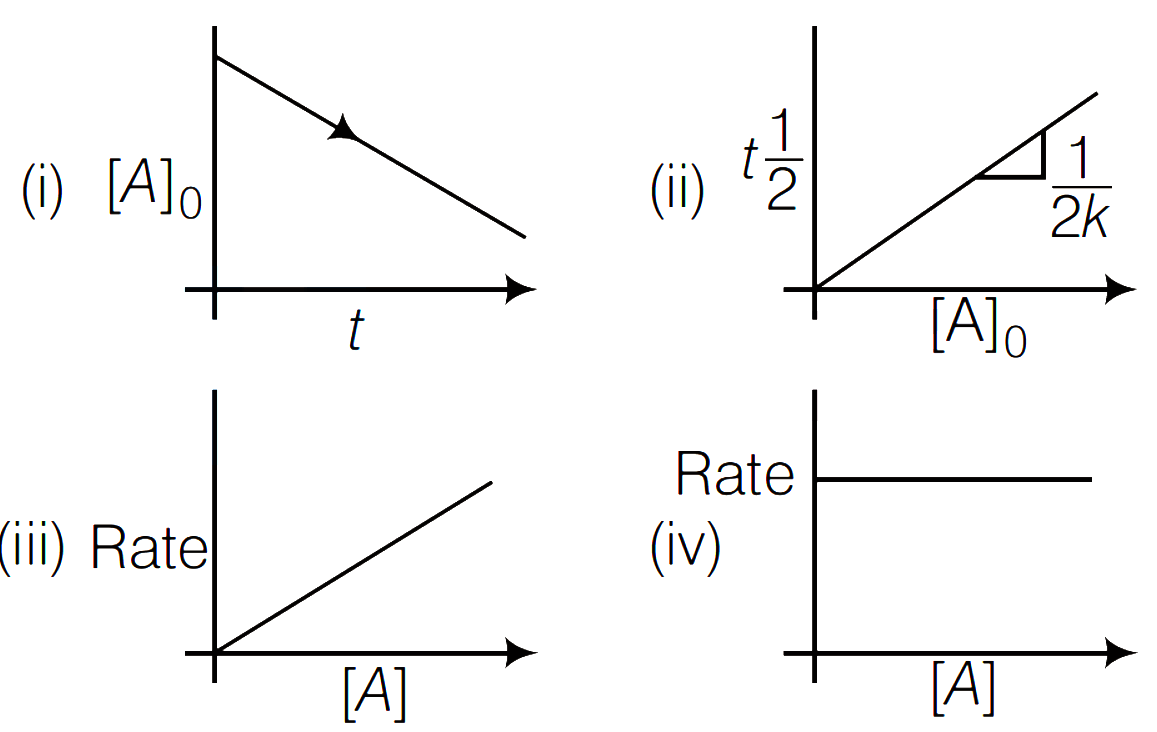 TS EAMCET 2017 Hard
 - Silver electrode acts as anode and \(E_{\text {cell }}^{\circ}\) is \(-0.34 \mathrm{~V}\)TS EAMCET 2020 Easy
More PYQs from TS EAMCET
- Consider the following reaction equilibrium: \(\mathrm{N}_2(g)+3 \mathrm{H}_2(g) \rightleftharpoons 2 \mathrm{NH}_3(g)\) Initially, 1 mole of \(\mathrm{N}_2\) and 3 moles of \(\mathrm{H}_2\) are taken in a \(2 \mathrm{~L}\) flask. At equilibrium state if, the number of moles of \(\mathrm{N}_2\) is 0.6 , what is the total number of moles of all gases present in the flask?TS EAMCET 2003 Medium
- \(\int_0^{\frac{\pi}{4}} \frac{\cos ^2 x}{\cos ^2 x+4 \sin ^2 x} d x=\)TS EAMCET 2019 Easy
- If \(\frac{x-2}{x^2(2 x-3)}=\frac{\mathrm{A}}{x}+\frac{\mathrm{B}}{x^2}+\frac{\mathrm{C}}{2 x-3}\) then \(2(\mathrm{~A}-\mathrm{C})=\)TS EAMCET 2022 Easy
- What is the formula of the product formed when \(\mathrm{F}^{-}\)reacts with enamel on teeth?TS EAMCET 2019 Medium
- If the distance from a variable point \(\mathrm{P}\) to a fixed point \(\mathrm{A}(a, 0)\) is equal to the perpendicular distance from \(\mathrm{P}\) to the line \(x+y=0\) then the equation of the locus of \(\mathrm{P}\) isTS EAMCET 2022 Hard
- A clock is designed based on the oscillations of a springblock system suspended vertically in the absense of air-resistance. Assume it shows the correct time when a spring of stiffness ' \(\mathrm{k}\) ' and block of mass ' \(\mathrm{m}\) ' are used. If the block is replaced by another block of mass \(4 \mathrm{~m}\), choose the correct option.TS EAMCET 2023 Medium