


TS EAMCET · Chemistry · Chemical Bonding and Molecular Structure
The correct order of the bond angles of the compounds \(\mathrm{SiCl}_4, \mathrm{BF}_3, \mathrm{BeCl}_2\) and \(\mathrm{SF}_6\) is
- A \(\mathrm{BF}_3>\mathrm{BeCl}_2>\mathrm{SF}_6>\mathrm{SiCl}_4\)
- B \(\mathrm{BeCl}_2>\mathrm{SF}_6>\mathrm{SiCl}_4>\mathrm{BF}_3\)
- C \(\mathrm{BeCl}_2>\mathrm{SiCl}_4>\mathrm{BF}_3>\mathrm{SF}_6\)
- D \(\mathrm{BeCl}_2>\mathrm{BF}_3>\mathrm{SiCl}_4>\mathrm{SF}_6\)
Answer & Solution
Correct Answer
(D) \(\mathrm{BeCl}_2>\mathrm{BF}_3>\mathrm{SiCl}_4>\mathrm{SF}_6\)
Step-by-step Solution
Detailed explanation
\(\mathrm{BeCl}_2\) has linear structure. So, the bond angle is \(180^{\circ}\). \(\mathrm{BF}_3\) has trigonal planar structure. So, the bond angle is \(120^{\circ}\). \(\mathrm{SiCl}_4\) has tetrahedral structure. So, the bond angle is \(109.5^{\circ}\). \(\mathrm{SF}_6\) has…
See the Complete Solution
Get step-by-step explanations for this and 2.5 Lakh+ more JEE, NEET & CET questions.
- Unlock all solutions
- Practice the full chapter
- Track accuracy across PYQs
4.8 rated on Google Play · 14,000+ reviews
More questions from Chemistry
- Which of the following is not a conjugate acid-base pair?TS EAMCET 2007 Easy
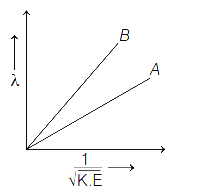
- The following plot represents the de-Broglie wavelength as a function of the kinetic energy (K.E.) of two particles \(A\) and \(B\). Identify the correct relation
 TS EAMCET 2018 Easy
 - One Debye is equal to how many coulomb meter?TS EAMCET 2021 Medium
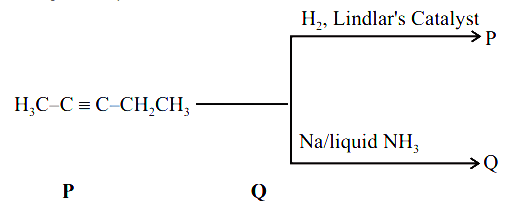
- The major products P and Q in the following reactions, respectively, are
 TS EAMCET 2022 Easy
 - If the radius of first orbit of hydrogen like ion is \(1.763 \times 10^{-2} \mathrm{~nm}\), the energy associated with that orbit (in \(J\) ) isTS EAMCET 2024 Easy
- In \(\operatorname{Sr}(\mathrm{Z}=38)\), the number of electrons with \(l=0\) is \(x\), number of electrons with \(l=2\) is \(y .(x-y)\) is equal to
( \(l=\) Azimuthal quantum number)TS EAMCET 2025 Medium
More PYQs from TS EAMCET
- Infinite number of spheres, each of mass \(m\) are placed on the \(X\)-axis at distances \(1,2,4,8\), 16 ...... metres from origin. The magnitude of the gravitational field at the origin isTS EAMCET 2015 Easy
- Correct order of osmotic pressure of the following solutions is (i) \(30 \mathrm{~g} \mathrm{~L}^{-1}\) of glucose (ii) \(60 \mathrm{~g} \mathrm{~L}^{-1}\) of \(\mathrm{NH}_2 \mathrm{CONH}_2\) (iii) \(80 \mathrm{~g} \mathrm{~L}^{-1}\) of glucose (iv) \(58.5 \mathrm{~g} \mathrm{~L}^{-1}\) of \(\mathrm{NaCl}\)TS EAMCET 2020 Medium
- If \(m\) and \(M\) are respectively the absolute minimum and absolute maximum values of a function \(f(x)=2 x^3+9 x^2+12 x+1\) defined on \([-3,0]\), then \(m+M=\)TS EAMCET 2024 Medium
- An alpha particle and a proton are accelerated from rest in a uniform electric field. The ratio of the times taken by proton and alpha particle to attain equal displacements isTS EAMCET 2025 Medium
- A thin uniform rod of mass and length is hanged at one end to the ground floor. It originally stands vertically and is allowed to fall to the ground. If the rod hits the ground with angular speed then the correct statement is (AssumeTS EAMCET 2021 Hard
- If for \(|x|>1, \tanh ^{-1}\left(\frac{1}{x}\right)+\operatorname{coth}^{-1}(x)=\log _e(f(x))\), then \(f(-5)=\)TS EAMCET 2020 Hard