


TS EAMCET · Chemistry · p Block Elements (Group 15, 16, 17 & 18)
In reaction (1), \(\mathrm{XeF}_6\) hydrolysis to form \(\mathrm{HF}\) and \(X\). In reaction (2), \(\mathrm{XeF}_6\) on partial hydrolysis form HF, \(Y\) and \(Z\). The products \(X, Y, Z\) respectively, are
- A \(\mathrm{XeO}_3, \mathrm{Xe}_1, \mathrm{XeO}_2 \mathrm{~F}_2\)
- B \(\mathrm{XeO}_3, \mathrm{XeOF}_4, \mathrm{XeO}_2 \mathrm{~F}_2\)
- C \(\mathrm{Xe}, \mathrm{XeOF}_4, \mathrm{XeO}_2 \mathrm{~F}_2\)
- D \(\mathrm{XeO}_3, \mathrm{O}_2, \mathrm{XeO}_2 \mathrm{~F}_2\)
Answer & Solution
Correct Answer
(B) \(\mathrm{XeO}_3, \mathrm{XeOF}_4, \mathrm{XeO}_2 \mathrm{~F}_2\)
Step-by-step Solution
Detailed explanation
Complete hydrolysis of \(\mathrm{XeF}_6\) produces xenon trioxide. \[ \mathrm{XeF}_6+3 \mathrm{H}_2 \mathrm{O} \longrightarrow \mathrm{KeO}_3+6 \mathrm{HF} \] Whereas partial hydrolysis of \(\mathrm{XeF}_6\) form different products.…
See the Complete Solution
Get step-by-step explanations for this and 2.5 Lakh+ more JEE, NEET & CET questions.
- Unlock all solutions
- Practice the full chapter
- Track accuracy across PYQs
4.8 rated on Google Play · 14,000+ reviews
More questions from Chemistry
- The intramolecular hydrogen bonding is present inTS EAMCET 2022 Easy
- Which one of the following is a secondary alcohol?TS EAMCET 2002 Easy
- \(138 \mathrm{~g}\) of ethyl alcohol is mixed with \(72 \mathrm{~g}\) of water. The ratio of mole fraction of alcohol to water isTS EAMCET 2007 Easy
- Henry's law is valid for A) Ammonia gas dissolution in water B) gas dissolution in unsaturated blood C) dissolution in water D) dissolution in waterTS EAMCET 2022 Medium
- At \(\mathrm{T}(\mathrm{K}), \mathrm{K}_{\mathrm{p}}\) value for the reaction, \(2 \mathrm{AO}_2(g)+\mathrm{O}_2(g) \rightleftharpoons 2 \mathrm{AO}_3(g)\) is \(4 \times 10^{10}\). What is the \(\mathrm{K}_{\mathrm{p}}^{\prime}\) value for \(3 \mathrm{AO}_2(g)+\frac{3}{2} \mathrm{O}_2(g) \rightleftharpoons 3 \mathrm{AO}_3(g)\) at \(\mathrm{T}(\mathrm{K})\) ?TS EAMCET 2025 Medium
- A plot of the compressibility factor (z) vs \(\mathrm{P}\) is shown below for \(\mathrm{H}_2, \mathrm{He}, \mathrm{N}_2, \mathrm{CO}_2\) and \(\mathrm{SO}_2\). Identify the plot for \(\mathrm{CO}_2\) gas.
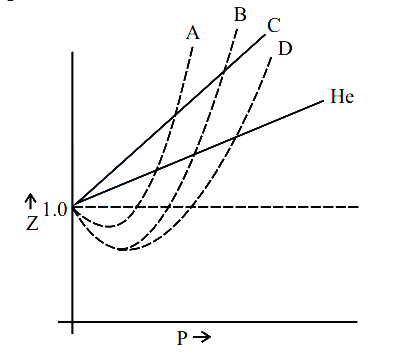 TS EAMCET 2022 Medium
More PYQs from TS EAMCET
- \(\lim _{x \rightarrow 0} \frac{\left(1-e^x\right) \sin x}{x^2+x^3}\) is equal toTS EAMCET 2008 Medium
- If \(f(x)=\frac{x-1}{e^x}\), then \(f^{\prime}(0)+f^{\prime \prime}(0)=\)TS EAMCET 2020 Medium
- \(\int_2^3 \frac{d x}{x^2-x}\) is equal toTS EAMCET 2002 Medium
- Which of the following molecules is present in photochemical smog?TS EAMCET 2020 Easy
- The ratio of specific heats of a gas is \(\gamma\). The change in internal energy of one mole of the gas, when the volume changes from \(V\) to \(2 V\) at constant pressure \(p\) isTS EAMCET 2005 Medium
- Assertion (A) The moment of inertia of a steel sphere is larger than the moment of inertia of a wooden sphere of same radius. Reason (R) Moment of inertia is independent of mass of the body. The correct one isTS EAMCET 2012 Easy