


TS EAMCET · Chemistry · Chemical Bonding and Molecular Structure
Group the molecules/ions according to bond order.
- A \(\left(\mathrm{O}_2^{2-}, \mathrm{Li}_2, \mathrm{O}_2^{2+}\right)\left(\mathrm{F}_2, \mathrm{~N}_2, \mathrm{He}_2^{2+}\right)\)
- B \(\left(\mathrm{F}_2, \mathrm{O}_2^{2+}, \mathrm{N}_2\right)\left(\mathrm{O}_2^{2-}, \mathrm{He}_2^{2+}, \mathrm{Li}_2\right)\)
- C \(\left(\mathrm{O}_2^{-}, \mathrm{Li}_2, \mathrm{~F}_2, \mathrm{He}_2^{2+}\right)\left(\mathrm{N}_2, \mathrm{O}_2^{2+}\right)\)
- D \(\left(\mathrm{Li}_2, \mathrm{~F}_2, \mathrm{O}_2^{2+}\right)\left(\mathrm{N}_2, \mathrm{O}_2^{2-}, \mathrm{He}_2^{2+}\right)\)
Answer & Solution
Correct Answer
(C) \(\left(\mathrm{O}_2^{-}, \mathrm{Li}_2, \mathrm{~F}_2, \mathrm{He}_2^{2+}\right)\left(\mathrm{N}_2, \mathrm{O}_2^{2+}\right)\)
Step-by-step Solution
Detailed explanation
Bond order of the group \[ \begin{aligned} & \mathrm{O}_2^{-} \text {has }=1, \quad \mathrm{Li}_2 \text { has }=1 \\ & \mathrm{~F}_2 \text { has }=1, \quad \mathrm{He}_2^{2+} \text { has }=1 \\ & \end{aligned} \] Similarly, \(\mathrm{N}_2\) has B. \(\mathrm{O}=3\) and…
See the Complete Solution
Get step-by-step explanations for this and 2.5 Lakh+ more JEE, NEET & CET questions.
- Unlock all solutions
- Practice the full chapter
- Track accuracy across PYQs
4.8 rated on Google Play · 14,000+ reviews
More questions from Chemistry
- Identify the major product ( P ) in the following reaction sequence. \(\left(\mathrm{CH}_3\right)_3 \mathrm{CBr} \xrightarrow{\text { Alcoholic }} \mathrm{KOH} \Delta \xrightarrow{\mathrm{HBr}} \mathrm{P}\)TS EAMCET 2024 Easy
- Match the following
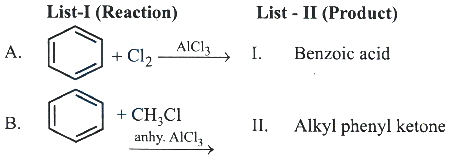
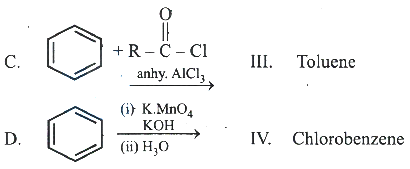 TS EAMCET 2023 Medium
 - The incorrect rule regarding the determination of significant figures isTS EAMCET 2024 Easy
- The Haworth projection shown below represents
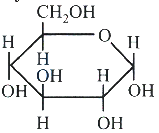 TS EAMCET 2023 Easy
 - At \(298 \mathrm{~K}\) the molar conductivities at infinite dilution \(\left(\Lambda_m^{\circ}\right)\) of \(\mathrm{NH}_4 \mathrm{Cl}, \mathrm{KOH}\) and \(\mathrm{KCl}\) are 152.8, 272.6 and \(149.8 \mathrm{~S} \mathrm{~cm} \mathrm{cmol}^{-1}\) respectively. The \(\Lambda_m^{\circ}\) of \(\mathrm{NH}_4 \mathrm{OH}\) in \(\mathrm{S} \mathrm{cm}^2 \mathrm{~mol}^{-1}\) and \(\%\) dissociation of \(0.01 \mathrm{M} \mathrm{NH}_4 \mathrm{OH}\) with \(\Lambda_m=25.1 \mathrm{~S} \mathrm{~cm}^2 \mathrm{~mol}^{-1}\) at the same temperature areTS EAMCET 2014 Easy
- Rate constants in the following reaction are Reaction 1: \(\mathrm{A} \stackrel{\text { catalyst } 1}{\longrightarrow} \mathrm{P}_1, \mathrm{k}_1=1 \mathrm{~s}^{-1}\) Reaction 2: A \(\stackrel{\text { catalyst } 2}{\longrightarrow} \mathrm{P}_2, \mathrm{k}_2=0.1 \mathrm{~L} \mathrm{~mol}^{-1} \mathrm{~s}^{-1}\) Reaction 3: A \(\stackrel{\text { catalyst } 3}{\longrightarrow} \mathrm{P}_3, \mathrm{k}_3=0.01 \mathrm{~L}^2 \mathrm{~mol}^{-2} \mathrm{~s}^{-1}\) The correct relations between the rate of the reactions at \(1 \mathrm{M}\) of \(\mathrm{A}\) areTS EAMCET 2022 Medium
More PYQs from TS EAMCET
- A conducting wire of cross-sectional area \(1 \mathrm{~cm}^2\) has \(3 \times 10^{23}\) charge carriers per \(\mathrm{m}^3\). If wire carries a current of \(24 \mathrm{~mA}\), then drift velocity of carriers isTS EAMCET 2020 Easy
- If \(\mathbf{b}, \mathbf{c}\) are non collinear vectors, \(|\mathbf{c}| \neq 0\), \(\mathbf{a} \times(\mathbf{b} \times \mathbf{c})+(\mathbf{a} \cdot \mathbf{b}) \mathbf{b}=(4-2 \beta-\sin \alpha) \mathbf{b}+\left(\beta^2-1\right) \mathbf{c}\) and \((\mathbf{c} \cdot \mathbf{c}) \mathbf{a}=\mathbf{c}\), then the scalars \(\alpha\) and \(\beta\) areTS EAMCET 2020 Easy
- If \(\alpha, \beta, \gamma\) are the roots of the equation \(x^3+p x^2+q x+r=0\), then \((\alpha+\beta)(\beta+\gamma)(\gamma+\alpha)=\)TS EAMCET 2019 Easy
- \(S \equiv y^2-4 a x=0, S^{\prime} \equiv y^2+a x=0\) are two parabolas and \(P(t)\) is a point on the parabola \(\mathrm{S}^{\prime}=0\). If A and B are the feet of the perpendiculars from P on to coordinate axes and AB is a tangent to the parabola \(\mathrm{S}=0\) at the point \(\mathrm{Q}\left(t_1\right)\), then \(t_1=\)TS EAMCET 2024 Medium
- The relation between the displacement ' \(x\) ' (in metre) and the time ' \(t\) ' (in second) of a particle is \(\mathrm{t}=2 x^2+3 x\). If the displacement of the particle is 25 cm from the origin \((x=0)\), then the acceleration of the particle isTS EAMCET 2025 Medium
- Which one of the following gives sooty flame on combustion?TS EAMCET 2014 Easy