


TS EAMCET · Chemistry · Electrochemistry
During the electrolysis of copper sulphate aqueous solution using copper electrode, the reaction takine place at the cathode is
- A \(\mathrm{Cu} \longrightarrow \mathrm{Cu}^{2+}(\mathrm{aq})+2 e^{-}\)
- B \(\mathrm{Cu}^{2+}(\mathrm{aq})+2 e^{-} \longrightarrow \mathrm{Cu}(\mathrm{s})\)
- C \(\mathrm{H}^{+}(\mathrm{aq})+\mathrm{e}^{-} \longrightarrow \frac{1}{2} \mathrm{H}_2(g)\)
- D \(\mathrm{SO}_4^{2-}(\mathrm{aq}) \longrightarrow \mathrm{SO}_3(g)+\frac{1}{2} \mathrm{O}_2(g)+2 e^{-}\)
Answer & Solution
Correct Answer
(B) \(\mathrm{Cu}^{2+}(\mathrm{aq})+2 e^{-} \longrightarrow \mathrm{Cu}(\mathrm{s})\)
Step-by-step Solution
Detailed explanation
During the electrolysis of an aqueous solution of copper sulphate using copper electrodes, both \(\mathrm{Cu}^{2+}\) and \(\mathrm{H}^{+}\)ions move towards cathode, but the discharge potential of \(\mathrm{Cu}^{2+}\) ions is lower than that of \(\mathrm{H}^{+}\)ions, therefore…
See the Complete Solution
Get step-by-step explanations for this and 2.5 Lakh+ more JEE, NEET & CET questions.
- Unlock all solutions
- Practice the full chapter
- Track accuracy across PYQs
4.8 rated on Google Play · 14,000+ reviews
More questions from Chemistry
- For the gaseous reaction, \(\mathrm{N}_2 \mathrm{O}_5 \rightarrow 2 \mathrm{NO}_2+\frac{1}{2} \mathrm{O}_2\) the rate can be expressed as
\( -\frac{\mathrm{d}\left[\mathrm{N}_2 \mathrm{O}_5\right]}{\mathrm{dt}}=\mathrm{K}_1\left[\mathrm{~N}_2 \mathrm{O}_5\right] \ +\frac{\mathrm{d}\left[\mathrm{NO}_2\right]}{\mathrm{dt}}=\mathrm{K}_2\left[\mathrm{~N}_2 \mathrm{O}_5\right] \ +\frac{\mathrm{d}\left[\mathrm{O}_2\right]}{\mathrm{dt}}=\mathrm{K}_3\left[\mathrm{~N}_2 \mathrm{O}_5\right]\) The correct relation between \(\mathrm{K}_1, \mathrm{~K}_2\) and \(\mathrm{K}_3\) isTS EAMCET 2024 Easy - Which of the following is/are correct for Boyle's law?
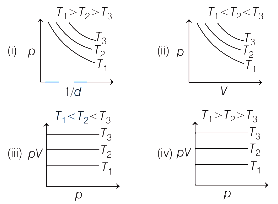 TS EAMCET 2019 Easy
 - What is the catalyst used in the conversion of acetaldehyde to acetic acid?TS EAMCET 2002 Hard
- Assertion (A): Both Glucose and Fructose have the same D-configuration.
Reason (R): Both Glucose and Fructose are dextrorotatory. The correct option among the following is:TS EAMCET 2022 Easy - In which of the following the s-block elements are arranged in the correct order of their melting points?TS EAMCET 2025 Medium
- Identify and respectively, in the following reaction sequence are
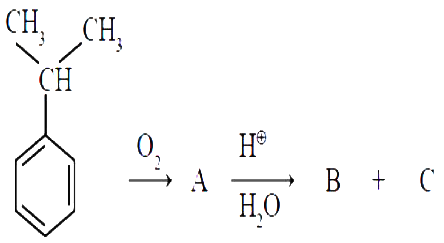 TS EAMCET 2021 Hard
More PYQs from TS EAMCET
- If the system of equations has a solution other than thenTS EAMCET 2021 Easy
- An air bubble rises from the bottom of a water tank of height . If the initial volume of the bubble is . What will be its volume as it reaches the surface. Assume that its temperature does not change. [, density of water ]TS EAMCET 2018 Medium
- Area of the region (in square units) bounded by the curve \(y=x^2+4\) and the line \(y=5 x-2\) isTS EAMCET 2019 Easy
- Two numbers \(b\) and \(c\) are chosen at random in succession without replacement from the set \(\{1,2,3, \ldots, 9\}\). Then the probability that \(\mathrm{x}^2+\mathrm{bx}+\mathrm{c}>0, \forall \mathrm{x} \in \mathbb{R}\) isTS EAMCET 2023 Hard
- One end each of a resistance \(r\) capacitor \(C\) and resistance \(2 r\) are connected together. The other ends are respectively connected to the positive terminals of batteries, \(P, Q, R\) having respectively emf's \(E, E\) and \(2 E\). The negative terminals of the batteries are then connected together. In this circuit, with steady current the potential drop across the capacitor is :TS EAMCET 2006 Medium
- \(\cos \alpha \sin (\beta-\gamma)+\cos \beta \sin (\gamma-\alpha)\) \(+\cos \gamma \sin (\alpha-\beta)\) is equal toTS EAMCET 2003 Medium