


TS EAMCET · Chemistry · Coordination Compounds
Consider the complexes. (i) \(\left[\mathrm{Pd}\left(\mathrm{NH}_3\right)_2 \mathrm{ClBr}\right]\) (ii) \(\left[\mathrm{Pd}\left(\mathrm{NH}_3\right)_2 \mathrm{Cl}_2\right]\) (iii) \(\left[\mathrm{Pd}(\mathrm{en}) \mathrm{Cl}_2\right]\) (iv) [Pd(en) \(\mathrm{ClBr}]\) (v) \(\left[\mathrm{Pd}(\mathrm{en})_2\right] \mathrm{Cl}_2 \quad\) (en = ethylenediamine) The total number of geometrical isomers of (A) is same as the total number of geometrical isomers of
- A (ii)
- B (iii)
- C (iv)
- D (v)
Answer & Solution
Correct Answer
(A) (ii)
Step-by-step Solution
Detailed explanation
(i) \(\left[\mathrm{Pd}\left(\mathrm{NH}_3\right)_2 \mathrm{ClBr}\right]\) (ii) \(\left[\mathrm{Pd}\left(\mathrm{NH}_3\right)_2 \mathrm{Cl}_2\right]\) \(M a_2 b c\) \(M a_2 b_2\) G.I \(=2\) G.I \(=2\) cis and trans cis and trans (iii)…
See the Complete Solution
Get step-by-step explanations for this and 2.5 Lakh+ more JEE, NEET & CET questions.
- Unlock all solutions
- Practice the full chapter
- Track accuracy across PYQs
4.8 rated on Google Play · 14,000+ reviews
More questions from Chemistry
- Among the options, the element with highest electron gain enthalpy isTS EAMCET 2021 Easy
- In group 13 of the long form of periodic table an element \(\mathrm{X}\) has a boiling point of \(\mathrm{T}_2(\mathrm{~K})\) and melting point of \(\mathrm{T}_1(\mathrm{~K})\). Identify the element \(\mathrm{X}\) for which \(\mathrm{T}_2-\mathrm{T}_1(\mathrm{~K})\) is maximumTS EAMCET 2023 Medium
- For a reaction the set of all correct statements are a) is independent of . b) is dependent on partial pressure of at a given temperature. c) will be independent of temperature. d) is independent of the catalyst addition.TS EAMCET 2022 Medium
- \(\mathrm{NH}_2 \mathrm{CONH}_2+2 \mathrm{H}_2 \mathrm{O} \rightarrow[\mathrm{X}] \rightleftharpoons 2 \mathrm{NH}_3+\mathrm{H}_2 \mathrm{O}+[\mathrm{Y}]\)
The hybridization of carbon in X and Y respectively areTS EAMCET 2024 Hard - Find the value of the equilibrium constant \((K)\) of a reaction at \(300 \mathrm{~K}\), when standard Gibbs free energy change is \(-25 \mathrm{~kJ} \mathrm{~mol}^{-1}\) ? (Consider \(R=8.33 \mathrm{Jmol}^{-1} \mathrm{~K}^{-1}\) )TS EAMCET 2020 Medium
- In molecule, the hybridizations of carbon and oxygen atoms are respectivelyTS EAMCET 2020 Easy
More PYQs from TS EAMCET
- The parametric equations of the parabola areTS EAMCET 2021 Easy
- Which of the following vitamin is also called pyridoxine?TS EAMCET 2024 Easy
- \[ \begin{aligned} & \mathrm{H}_3 \mathrm{CCONH}_2+\mathrm{Br}_2+4 \mathrm{NaOH} \longrightarrow \ & Y+\mathrm{Na}_2 \mathrm{CO}_3+2 \mathrm{NaBr}+2 \mathrm{H}_2 \mathrm{O} \end{aligned} \] What is \(Y\) in the above reaction?TS EAMCET 2015 Easy
- The current through the ammeter (neglecting internal resistance) in the following circuit is
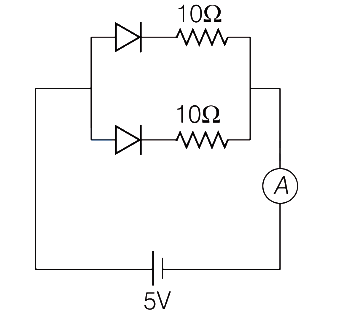 TS EAMCET 2021 Easy
 - In the following, the oxoacid with a peroxy bond isTS EAMCET 2022 Easy
- If , thenTS EAMCET 2021 Hard