


TS EAMCET · Chemistry · Amines
\[ \begin{aligned} & \mathrm{H}_3 \mathrm{CCONH}_2+\mathrm{Br}_2+4 \mathrm{NaOH} \longrightarrow \ & Y+\mathrm{Na}_2 \mathrm{CO}_3+2 \mathrm{NaBr}+2 \mathrm{H}_2 \mathrm{O} \end{aligned} \] What is \(Y\) in the above reaction?
- A \(\mathrm{H}_3 \mathrm{CCH}_2 \mathrm{NH}_2\)
- B \(\mathrm{H}_3 \mathrm{CNH}_2\)
- C \(\mathrm{H}_3 \mathrm{CCOBr}\)
- D \(\mathrm{HCONH}_2\)
Answer & Solution
Correct Answer
(B) \(\mathrm{H}_3 \mathrm{CNH}_2\)
Step-by-step Solution
Detailed explanation
\(\mathrm{H}_3 \mathrm{CCONH}_2+\mathrm{Br}_2+4 \mathrm{NaOH} \longrightarrow\) \[ \mathrm{CH}_3 \mathrm{NH}_2+\mathrm{Na}_2 \mathrm{CO}_3+2 \mathrm{NaBr}+2 \mathrm{H}_2 \mathrm{O} \] (Y) It is Hofmann degradation of primary amides.
See the Complete Solution
Get step-by-step explanations for this and 2.5 Lakh+ more JEE, NEET & CET questions.
- Unlock all solutions
- Practice the full chapter
- Track accuracy across PYQs
4.8 rated on Google Play · 14,000+ reviews
More questions from Chemistry
- Arrange the following in decreasing order of their boiling points
(A) 2 -Methylbutane
(B) 2,2 - Dimethylpropane
(C) Pentane
(D) HexaneTS EAMCET 2025 Medium - Observe the following reaction \(2 A+B \longrightarrow C\) The rate of formation of \(\mathrm{C}\) is \(2.2 \times 10^{-3} \mathrm{~mol}\) \(\mathrm{L}^{-1} \min ^{-1}\). What is the value of \(-\frac{d[A]}{d t}\) (in mol \(\left.\mathrm{L}^{-1} \min ^{-1}\right) ?\)TS EAMCET 2005 Easy
- A nitrogen oxide that forms "in situ" when dilute \(\mathrm{FeSO}_4\) is treated with aqueous solution of nitrate ion and then careful addition of conc. \(\mathrm{H}_2 \mathrm{SO}_4\) along the sides of test tube, isTS EAMCET 2022 Easy
- For the given equilibrium reaction \(\mathrm{H}_2(g)+\mathrm{I}_2(g) \rightleftharpoons 2 \mathrm{HI}(g)\) Choose the correct equation to calculate \(K_p\).TS EAMCET 2020 Medium
- \(\mathrm{CH}_3 \mathrm{CH}_2 \mathrm{OH} \underset{\text { step-1 }}{\stackrel{\mathrm{Cl}_2}{\longrightarrow}} \mathrm{CH}_3 \mathrm{CHO}\) \(\underset{\text { step-2 }}{\stackrel{3 \mathrm{Cl}_2}{\longrightarrow}} \mathrm{Cl}_3 \mathrm{CCHO}\) In above reactions the role of \(\mathrm{Cl}_2\) in step- 1 and step-2 respectively is :TS EAMCET 2006 Hard
- Liquid \(X\) is used in bubble chamber to detect neutral mesons and gamma photons. Then, \(X\) isTS EAMCET 2013 Easy
More PYQs from TS EAMCET
- Match the following.
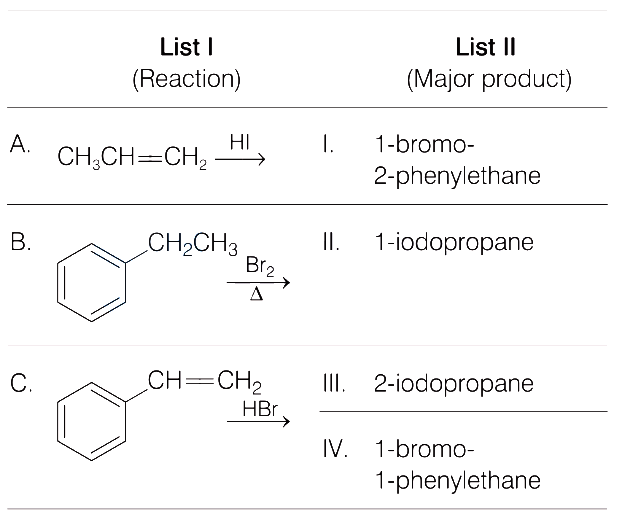
The correct match is \(\text { A } \quad B \quad C\)qTS EAMCET 2021 Hard - A generator with a circular coil of 100 turns of area \(2 \times 10^{-2} \mathrm{~m}^2\) is immersed in a \(0.01 \mathrm{~T}\) magnetic field and rotated at a frequency of \(50 \mathrm{~Hz}\). The maximum emf which is produced dwing a cycle isTS EAMCET 2017 Medium
- A block of mass \(m\) placed on a rough horizontal plane is pulled by a constant power \(P\). The coefficient of friction between the block and the surface is \(\mu\). The maximum velocity of the block will beTS EAMCET 2020 Medium
- \(z_1, z_2\) are two fixed points on the Argand plane. If \(z\) is a complex number such that \(\left|z-z_1\right|+\left|z-z_2\right|=\lambda\), then the locus of \(z\) isTS EAMCET 2020 Easy
- An iron rod of length \(1.5 \mathrm{~m}\) lying on a horizontal table is pulled up form one end along a vertical line so as to move it with a constant velocity \(3 \mathrm{~m} / \mathrm{s}\), while the other end of the rod slides along the floor. After how much time the speed of the end sliding on the floor equals to the speed of the end being pulled up.TS EAMCET 2019 Medium
- If \(f: \mathbb{R} \rightarrow \mathbb{R}\) is defined by \(f(\mathrm{x})=2 \mathrm{x}+\sin \mathrm{x}, \mathrm{x} \in \mathrm{R}\), then \(f\) isTS EAMCET 2023 Medium