


TS EAMCET · Chemistry · p Block Elements (Group 15, 16, 17 & 18)
Assertion (A) The boiling points of noble gases increases from He to Xe. Reason (R) The interatomic van der Waals' attractive forces increases from \(\mathrm{He}\) to \(\mathrm{Xe}\). The correct answer is
- A Both (A) and (R) are true, and (R) is the correct explanation of (A)
- B Both \((\mathrm{A})\) and \((\mathrm{R})\) are true, and \((\mathrm{R})\) is not the correct explanation of (A)
- C (A) is true but (R) is not true
- D (A) is not true but (R) is true
Answer & Solution
Correct Answer
(A) Both (A) and (R) are true, and (R) is the correct explanation of (A)
Step-by-step Solution
Detailed explanation
As the size of noble gases increases from He to Xe, van der Waals' forces increases and due to which boiling point increases.
See the Complete Solution
Get step-by-step explanations for this and 2.5 Lakh+ more JEE, NEET & CET questions.
- Unlock all solutions
- Practice the full chapter
- Track accuracy across PYQs
4.8 rated on Google Play · 14,000+ reviews
More questions from Chemistry
- Average \(\mathrm{C}-\mathrm{H}\) bond energy is \(416 \mathrm{~kJ} \mathrm{~mol}^{-1}\). Which of the following is correct?TS EAMCET 2004 Easy
- The mass percentage composition of dry air at the sea level is approximately \(\mathrm{N}_2: 63 \%\), \(\mathrm{O}_2: 16 \%, \mathrm{Kr}: 21 \%\). If the total pressure is \(p\) atm, calculate the partial pressure of each component respectively are (Molecular weights \(\mathrm{N}_2: 28, \mathrm{O}_2: 32, \mathrm{Kr}: 84\) )TS EAMCET 2020 Medium
- The decomposition of \(\mathrm{O}_3(g)\) follows first order kinetics and is given by \[ \mathrm{O}_3(9) \longrightarrow \mathrm{O}_2(9)+\mathrm{O}(9) \] The rate constant for this reaction is \(1.0 \times 10^{-3} \mathrm{~s}^{-1}\). The initial pressure of \(\mathrm{O}_3(g)\) is \(100 \mathrm{~atm}\). What will be the partial pressure (in atm) of \(\mathrm{O}_3, \mathrm{O}_2, \mathrm{O}\) respectively after 38.38 minutes?TS EAMCET 2019 Medium
- In which of the following reactions, \(t\)-butyl benzene is formed 1. Benzene \(+t\)-butyl chloride \(\stackrel{\mathrm{AlCl}_3}{\longrightarrow}\) 2. Benzene \(+\left(\mathrm{CH}_3\right)_2 \mathrm{C}=\mathrm{CH}_2 \stackrel{\mathrm{BF}_3}{\stackrel{\mathrm{HF}}{\longrightarrow}}\) 3. Benzene \(+t\)-butyl alcohol \(\stackrel{\mathrm{H}_2 \mathrm{SO}_4}{\longrightarrow}\) 4. Benzene + butanoyl chloride \(\underset{\mathrm{Zn} / \mathrm{HCl}}{\stackrel{\mathrm{AlCl}_3}{\longrightarrow}}\)TS EAMCET 2021 Hard
- 3-hydroxybutanal is formed when \((X)\) reacts with \((Y)\) in dilute \((Z)\) solution. What are \(X, Y\) and \(Z\) ? \(\begin{array}{lll}X & Y & Y\end{array}\)TS EAMCET 2005 Medium
- Match the following:
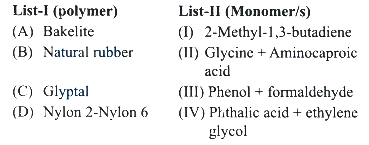
The correct answer isTS EAMCET 2023 Easy
More PYQs from TS EAMCET
- Identify the increasing order of the angular velocities of the following 1. earth rotating about its own axis 2. hour's hand of a clock 3. second's hand of a clock 4. flywheel of radius \(2 \mathrm{~m}\) making \(300\mathrm{rpm}\)TS EAMCET 2005 Medium
- Young's modulus is proportionality constant that relates the force per unit area applied perpendicularly at the surface of an object toTS EAMCET 2020 Easy
- If \(P M\) is the perpendicular from \(P(2,3)\) onto the line \(x+y=3\), then the coordinates of \(M\) areTS EAMCET 2005 Easy
- A charge \(Q\) is divided into two charges \(q\) and \(Q-q\). The value of \(q\) such that the force between them is maximum, isTS EAMCET 2014 Easy
- Match the following Reactants (A) \(\mathrm{C}_2 \mathrm{H}_5 \mathrm{Cl}\), moist \(\mathrm{Ag}_2 \mathrm{O}\) (B) \(\mathrm{C}_2 \mathrm{H}_5 \mathrm{Cl}\), aqueous ethanolic \(\mathrm{AgCN}\) Products (i) \(\mathrm{CH}_3 \mathrm{CH}_2 \mathrm{ONO}\) (ii) \(\mathrm{C}_2 \mathrm{H}_4\) aqueous (iii) \(\mathrm{CH}_3 \mathrm{CH}_2 \mathrm{OH}\) ethanolic \(\mathrm{AgNO}_2\) (D) \(\mathrm{C}_2 \mathrm{H}_5 \mathrm{Cl}\), ethanolic (iv) \(\mathrm{CH}_3 \mathrm{CH}_2 \mathrm{NC}\) \(\mathrm{KOH}\) (v) \(\mathrm{C}_2 \mathrm{H}_6\) The correct match isTS EAMCET 2007 Medium
- Arrange the following in increasing order of their crystal field splitting energy I. \(\left[\mathrm{Co}\left(\mathrm{H}_2 \mathrm{O}\right)_6\right]^{3+}\) II. \(\left[\mathrm{Co}\left(\mathrm{NH}_3\right)_6\right]^{3+}\) III. \(\left[\mathrm{Co}(\mathrm{CN})_6\right]^{3-}\)
IV: \(\left[\mathrm{CoF}_6\right]^{3-}\)TS EAMCET 2024 Medium