


TS EAMCET · Chemistry · Solutions
\(15 \%\) aqueous solution of glucose (molecular weight \(=180 \mathrm{~g} / \mathrm{mol}\) ) is isotonic with \(8 \%\) aqueous solution containing an unknown non-dissociable solute. What is the molecular weight of the unknown solute?
- A 108
- B 96
- C 84
- D 9.6
Answer & Solution
Correct Answer
(B) 96
Step-by-step Solution
Detailed explanation
Given, Molecular weight of \(15 \%\) aqueous solution of glucose \(=180 \mathrm{~g} / \mathrm{mol}\) Molecular weight of solute \(=\) ? \(\pi_1(\) glucose \()=\pi_2(\) unknown solute \()\) \(C_1(\) urea \()=C_2(\) unknown solute \()\) Now,…
See the Complete Solution
Get step-by-step explanations for this and 2.5 Lakh+ more JEE, NEET & CET questions.
- Unlock all solutions
- Practice the full chapter
- Track accuracy across PYQs
4.8 rated on Google Play · 14,000+ reviews
More questions from Chemistry
- What is \(Z\) in the following reactions?
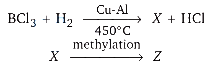 TS EAMCET 2012 Hard
 - Which of the following is not an intensive property?TS EAMCET 2021 Easy
- \(A\) and \(B\) are formed when borax is dissolved in water. \(C\) and \(B\) are formed when borax is reacted with aqueous \(\mathrm{HCl}\) solution. What are \(A\) and \(C\) respectively?TS EAMCET 2019 Medium
- In which of the following reactions, \(t\)-butyl benzene is formed 1. Benzene \(+t\)-butyl chloride \(\stackrel{\mathrm{AlCl}_3}{\longrightarrow}\) 2. Benzene \(+\left(\mathrm{CH}_3\right)_2 \mathrm{C}=\mathrm{CH}_2 \stackrel{\mathrm{BF}_3}{\stackrel{\mathrm{HF}}{\longrightarrow}}\) 3. Benzene \(+t\)-butyl alcohol \(\stackrel{\mathrm{H}_2 \mathrm{SO}_4}{\longrightarrow}\) 4. Benzene + butanoyl chloride \(\underset{\mathrm{Zn} / \mathrm{HCl}}{\stackrel{\mathrm{AlCl}_3}{\longrightarrow}}\)TS EAMCET 2021 Hard
-
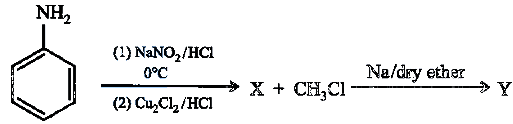
Conversion of X to Y in the above reaction isTS EAMCET 2024 Easy - If the kinetic energy in \(\mathrm{J}\), of \(\mathrm{CH}_4\) (molar mass \(=16 \mathrm{~g} \mathrm{~mol}^{-1}\) ) at \(T(\mathrm{~K})\) is \(X\), the kinetic energy in \(\mathrm{J}\), of \(\mathrm{O}_2\) (molar mass \(=32 \mathrm{~g} \mathrm{~mol}^{-1}\) ) at the same temperature isTS EAMCET 2016 Easy
More PYQs from TS EAMCET
- Consider the following statements : I. If \(P\left(x_1, y_1\right)\) and \(Q\left(x_2, y_2\right)\) are conjugate points with respect to the circle \(x^2+y^2+2 g x+2 f y+c=0\), then \(x_1 x_2+y_1 y_2+g\left(x_1+x_2\right)+f\left(y_1+y_2\right)+c=0\) II. The pole of the line \(x+y+1=0\) with respect to the circle \(x^2+y^2=9\) is \((9,9)\). Then, which one of the following is true?TS EAMCET 2019 Easy
- For a given unbalanced reaction, \(\mathrm{MnO}_2+\mathrm{HCl} \longrightarrow \mathrm{MnCl}_2+\mathrm{H}_2 \mathrm{O}\), which is the limiting reagent, if the initial amount for each of the reactant is 100 grams? [Molar masses : \(\mathrm{MnO}_2=86.9 ; \mathrm{HCl}=36.5\); \(\left.\mathrm{MnCl}_2=125.8 ; \mathrm{Cl}_2=70.9 ; \mathrm{H}_2 \mathrm{O}=18\right]\)TS EAMCET 2020 Easy
- \(\mathrm{P}(5,2)\) is a point on the curve \(y=f(x)\) and \(\frac{7}{2}\) is the slope of the tangent to the curve at P. The area of the triangle (in sq. units) formed by the tangent and the normal to the curve at P with \(x\)-axis isTS EAMCET 2025 Medium
- The heat required to convert 8 g of ice at a temperature of \(-20^{\circ} \mathrm{C}\) to steam at \(100^{\circ} \mathrm{C}\) is [Specific heat capacity of ice \(=2100 \mathrm{~J} \mathrm{~kg}^{-1} \mathrm{~K}^{-1}\), specific heat capacity of water \(=4200 \mathrm{~J} \mathrm{~kg}^{-1} \mathrm{~K}^{-1}\), latent heat of fusion of ice \(=336 \times 10^3 \mathrm{~J} \mathrm{~kg}^{-1}\) and latent heat of steam \(\left.=2.268 \times 10^6 \mathrm{Jkg}^{-1}\right]\)TS EAMCET 2025 Medium
- Let \(\mathbf{a}=\sin ^2 x \hat{\mathbf{i}}+\cos ^2 x \hat{\mathbf{j}}+\hat{\mathbf{k}},(x \in R)\). If the pairs of vectors \(\mathbf{a}, \hat{\mathbf{i}} ; \mathbf{a}, \hat{\mathbf{j}}\) and \(\mathbf{a}, \hat{\mathbf{k}}\) are adjacent sides of 3 distinct parallelograms and \(A\) is the sum of the squares of areas of these parallelograms, then \(A\) lies in the intervalTS EAMCET 2018 Medium
- If \(x=\log \left(y+\sqrt{y^2+1}\right)\) then \(y=\)TS EAMCET 2023 Medium