


KCET · Physics · Electrostatics
Two tiny spheres carrying charges \(1.8 \mu \mathrm{C}\) and \(2.8 \mu \mathrm{C}\) arc located at \(40 \mathrm{~cm}\) apart. The potential at the mid - point of the line joining the two charges is
- A \(2.1 \times 10^5 \mathrm{~V}\)
- B \(1.3 \times 10^4 \mathrm{~V}\)
- C \(3.6 \times 10^5 \mathrm{~V}\)
- D \(3.8 \times 10^4 \mathrm{~V}\)
Answer & Solution
Correct Answer
(A) \(2.1 \times 10^5 \mathrm{~V}\)
Step-by-step Solution
Detailed explanation
Charge on first sphere, \(q_1=1.8 \mu \mathrm{C}=1.8 \times 10^{-6} \mathrm{C}\)
Charge on second sphere, \(q_2=2.8 \mu \mathrm{C}=2.8 \times 10^{-6} \mathrm{C}\)
Distance between the two spheres, \(r=40 \mathrm{~cm}\)
Distance between mid-point and each sphere \(r_1=r_2=20 \mathrm{~cm}=0.2 \mathrm{~m}\)
\(\therefore\) Electric potential at mid-point due to both charged sphere
\(\begin{aligned}V & =V_1+V_2=\frac{1}{4 \pi \varepsilon_0} \cdot \frac{q_1}{r_1}+\frac{1}{4 \pi \varepsilon_0} \cdot \frac{q_2}{r_2} \\& =9 \times 10^9 \times \frac{1.8 \times 10^{-6}}{0.2}+9 \times 10^9 \times \frac{2.8 \times 10^{-6}}{0.2} \\& =9 \times 10^3(9+14)=2.07 \times 10^5 \mathrm{~V} \approx 2.1 \times 10^5 \mathrm{~V}\end{aligned}\)
Charge on second sphere, \(q_2=2.8 \mu \mathrm{C}=2.8 \times 10^{-6} \mathrm{C}\)
Distance between the two spheres, \(r=40 \mathrm{~cm}\)
Distance between mid-point and each sphere \(r_1=r_2=20 \mathrm{~cm}=0.2 \mathrm{~m}\)
\(\therefore\) Electric potential at mid-point due to both charged sphere
\(\begin{aligned}V & =V_1+V_2=\frac{1}{4 \pi \varepsilon_0} \cdot \frac{q_1}{r_1}+\frac{1}{4 \pi \varepsilon_0} \cdot \frac{q_2}{r_2} \\& =9 \times 10^9 \times \frac{1.8 \times 10^{-6}}{0.2}+9 \times 10^9 \times \frac{2.8 \times 10^{-6}}{0.2} \\& =9 \times 10^3(9+14)=2.07 \times 10^5 \mathrm{~V} \approx 2.1 \times 10^5 \mathrm{~V}\end{aligned}\)
See the Complete Solution
Get step-by-step explanations for this and 2.5 Lakh+ more JEE, NEET & CET questions.
- Unlock all solutions
- Practice the full chapter
- Track accuracy across PYQs
4.8 rated on Google Play · 14,000+ reviews
More questions from Physics
- Dimensional formula for activity of radioactive substance isKCET 2024 Easy
- The power dissipated in \( 3 \Omega \) resistance in the following circuit is
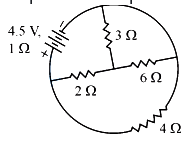 KCET 2017 Easy
 - The electric current flowing through a given conductor varies with time as shown in the graph below. The number of free electrons which flow through a given cross-section of the conductor in the time interval \(0 \leq t \leq 20 \mathrm{~s}\) is
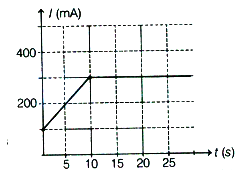 KCET 2024 Easy
 - A train is moving slowly on a straight track with a constant speed of \(2 \mathrm{~ms}^{-1}\). A passenger in that train starts walking at a steady speed of \(2 \mathrm{~ms}^{-1}\) to the back of the train in the opposite direction of the motion of the train. So to an observer standing on the platform directly in front of that passenger, the velocity of the passenger appears to beKCET 2010 Hard
- An electric heater rated \(220 \mathrm{~V}\) and \(550 \mathrm{~W}\) is connected to AC mains. The current drawn by it isKCET 2009 Easy
- The pressure at the bottom of a liquid tank is not proportional to theKCET 2018 Medium
More PYQs from KCET
- At \(300 \mathrm{~K}\), a gaseous reaction \(\mathrm{A} \longrightarrow \mathrm{B}+\mathrm{C}\) was found to follow first order kinetics. Starting with pure \(A\), the total pressure at the end of \(20 \mathrm{~min}\) was \(100 \mathrm{~mm}\) of \(\mathrm{Hg}\). The total pressure after the completion of the reaction is \(180 \mathrm{~mm}\) of \(\mathrm{Hg}\). The partial pressure of \(A\) (in \(\mathrm{mm}\) of \(\mathrm{Hg}\) ) isKCET 2012 Medium
- If \( \tan ^{-1} x+\tan ^{-1} y=\frac{4 \pi}{5} \), then \( \cot ^{-1} x+\cot ^{-1} y \) is equal toKCET 2017 Medium
- Corpus callosum connects theKCET 2022 Medium
- The "spin only" magnetic moment of \(\mathrm{Ni}^{2+}\) in aqueous solution would be [At. no. of \(\mathrm{Ni}=28\) ]KCET 2012 Easy
- The average length of hnRNA in humans isKCET 2017 Medium
- For the reaction, \(A \rightleftharpoons B, E_a=50 \mathrm{~kJ} \mathrm{~mol}^{-1}\) and \(\Delta H=-20 \mathrm{~kJ} \mathrm{~mol}^{-1}\). When a catalyst is added \(E_a\) decreases by \(10 \mathrm{~kJ} \mathrm{~mol}^{-1}\). What is the \(E_a\) for the backward reaction in the presence of catalyst?KCET 2024 Medium