


KCET · Physics · Dual Nature of Matter
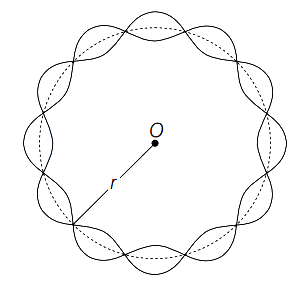
The figure shows standing de-Broglie waves due to the revolution of electron in a certain orbit of hydrogen atom. Then, the expression for the orbit radius is (All notations have their usual meanings )
- A \(\frac{h^{2} \varepsilon_{0}}{\pi m e^{2}}\)
- B \(\frac{4 h^{2} \varepsilon_{0}}{\pi m e^{2}}\)
- C \(\frac{9 h^{2} \varepsilon_{0}}{\pi m e^{2}}\)
- D \(\frac{36 h^{2} \varepsilon_{0}}{\pi m e^{2}}\)
Answer & Solution
Correct Answer
(D) \(\frac{36 h^{2} \varepsilon_{0}}{\pi m e^{2}}\)
Step-by-step Solution
Detailed explanation
According to de-Broglie, the circumference of a stationary orbit must be an integral number of wavelengths.
\(\begin{aligned}
&\qquad n \lambda=2 \pi r_{n} \\
&\text { Also, angular momentum, } m v_{n} r_{n}=\frac{n h}{2 \pi} \\
&\Rightarrow \quad m \frac{e^{2}}{2 n h \varepsilon_{0}} r_{n}=\frac{n h}{2 \pi} \quad\left[\because v_{n}=\frac{e^{2}}{2 n h \varepsilon_{0}}\right] \\
&\Rightarrow \quad r_{n}=\frac{n^{2} h^{2} \varepsilon_{0}}{m e^{2} \pi}=\frac{n^{2} h^{2} \varepsilon_{0}}{\pi m e^{2}}
\end{aligned}\)
Here, number of standing waves, \(n=6\) \(\therefore\)
\(r_{n}=\frac{(6)^{2} h^{2} \varepsilon_{0}}{\pi m e^{2}}=\frac{36 h^{2} \varepsilon_{0}}{\pi m e^{2}}\)
\(\begin{aligned}
&\qquad n \lambda=2 \pi r_{n} \\
&\text { Also, angular momentum, } m v_{n} r_{n}=\frac{n h}{2 \pi} \\
&\Rightarrow \quad m \frac{e^{2}}{2 n h \varepsilon_{0}} r_{n}=\frac{n h}{2 \pi} \quad\left[\because v_{n}=\frac{e^{2}}{2 n h \varepsilon_{0}}\right] \\
&\Rightarrow \quad r_{n}=\frac{n^{2} h^{2} \varepsilon_{0}}{m e^{2} \pi}=\frac{n^{2} h^{2} \varepsilon_{0}}{\pi m e^{2}}
\end{aligned}\)
Here, number of standing waves, \(n=6\) \(\therefore\)
\(r_{n}=\frac{(6)^{2} h^{2} \varepsilon_{0}}{\pi m e^{2}}=\frac{36 h^{2} \varepsilon_{0}}{\pi m e^{2}}\)
See the Complete Solution
Get step-by-step explanations for this and 2.5 Lakh+ more JEE, NEET & CET questions.
- Unlock all solutions
- Practice the full chapter
- Track accuracy across PYQs
4.8 rated on Google Play · 14,000+ reviews
More questions from Physics
- Two luminous point sources separated by a certain distance are at \(10 \mathrm{~km}\) from an observer. If the aperture of his eye is \(2.5 \times 10^{-3} \mathrm{~m}\) and the wavelength of light used is \(500 \mathrm{~nm}\), the distance of separation between the point sources just seen to be resolved isKCET 2009 Hard
- In a radioactive disintegration, the ratio of initial number of atoms to the number of atoms present at an instant of time equal to its mean life isKCET 2009 Medium
- A nucleus at rest splits into two nuclear parts having radii in the ratio \( 1: 2 \). Their velocities are
in the ratioKCET 2015 Easy - Two stars \(A\) and \(B\) radiate maximum energy at the wavelength of \(360 \mathrm{~nm}\) and \(480 \mathrm{~nm}\) respectively. Then the ratio of the surface temperatures of \(A\) and \(B\) isKCET 2013 Medium
- Which of the following statements is not true?KCET 2025 Easy
- A \(1 \mathrm{~kg}\) ball moving at \(12 \mathrm{~ms}^{-1}\) collides with a \(2 \mathrm{~kg}\) ball moving in opposite direction at \(24 \mathrm{~ms}^{-1}\). If the coefficient of restitution is \(2 / 3\), then their velocities after the collision areKCET 2021 Hard
More PYQs from KCET
- Which of the following radiations is deflected by electric field ?KCET 2022 Easy
- If \(x-y=1\) is a tangent to the hyperbola \(\frac{x^{2}}{4}-\frac{y^{2}}{3}=1\), then the point of contact isKCET 2012 Medium
- Choose the correct statement.KCET 2021 Easy
- The magnetic dipole moment of a current loop is independent ofKCET 2009 Easy
- The rate of the reaction, \(\mathrm{CH}_3 \mathrm{COOC}_2 \mathrm{H}_5+\mathrm{NaOH} \longrightarrow \mathrm{CH}_3 \mathrm{COONa}+\mathrm{C}_2 \mathrm{H}_5 \mathrm{OH}\) is given by the equation, rate \(=k\left[\mathrm{CH}_3 \mathrm{COOC}_2 \mathrm{H}_5\right][\mathrm{NaOH}]\). If concentration is expressed in \(\mathrm{mol}^{-1}\), the unit of \(k\) isKCET 2022 Easy
- If \(\Delta=\left|\begin{array}{lll}1 & a & a^2 \\ 1 & b & b^2 \\ 1 & c & c^2\end{array}\right|\) and \(\Delta_1=\left|\begin{array}{ccc}1 & 1 & 1 \\ b c & c a & a b \\ a & b & c\end{array}\right|\), thenKCET 2023 Hard