


KCET · Physics · Current Electricity
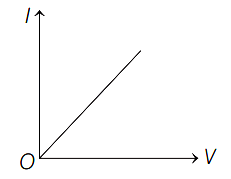
\(I-V\) characteristic of a copper wire of length \(L\) and area of cross-section \(A\) is shown in figure. The slope of the curve becomes
- A More if experiment is performed at higher temperature
- B More if a wire of steel of same dimension is used
- C Less if the area of the wire is increased
- D Less if the length of the wire is increased
Answer & Solution
Correct Answer
(D) Less if the length of the wire is increased
Step-by-step Solution
Detailed explanation
\(I-V\) characteristics of copper wire of length \(L\) and area of cross-section \(A\) is shown in the figure.
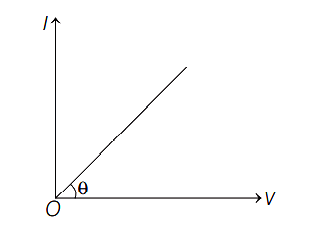
Since, \(I-V\) characteristic is a straight line, hence it obeys \(\mathrm{Ohm}^{\prime}\) s law. According to which resistance of copper wire,
\(R =\frac{V}{I}=\cot \theta \)
\(\Rightarrow R =\cot \theta \)
\(\Rightarrow \rho \cdot \frac{l}{A} =\cot \theta\)
or \(\quad \tan \theta \propto\left(\frac{A}{\rho l}\right)\)
Hence, slope \((\tan \theta)\) of the curve becomes
(i) less if the length of the wire is increased.
(ii) more if the area of the wire is increased.
(iii) less if a wire of steel of same dimensions is used as \(\rho_{\text {steel }}>\rho_{\text {copper }}\).
(iv) less if experiment is performed at higher temperature.
Since, \(I-V\) characteristic is a straight line, hence it obeys \(\mathrm{Ohm}^{\prime}\) s law. According to which resistance of copper wire,
\(R =\frac{V}{I}=\cot \theta \)
\(\Rightarrow R =\cot \theta \)
\(\Rightarrow \rho \cdot \frac{l}{A} =\cot \theta\)
or \(\quad \tan \theta \propto\left(\frac{A}{\rho l}\right)\)
Hence, slope \((\tan \theta)\) of the curve becomes
(i) less if the length of the wire is increased.
(ii) more if the area of the wire is increased.
(iii) less if a wire of steel of same dimensions is used as \(\rho_{\text {steel }}>\rho_{\text {copper }}\).
(iv) less if experiment is performed at higher temperature.
See the Complete Solution
Get step-by-step explanations for this and 2.5 Lakh+ more JEE, NEET & CET questions.
- Unlock all solutions
- Practice the full chapter
- Track accuracy across PYQs
4.8 rated on Google Play · 14,000+ reviews
More questions from Physics
- A ball rests upon a flat piece of paper on a table top. The paper is pulled horizontally but quickly towards right as shown relative to its initial position with respect to the table, the ball
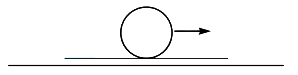
(1) remains stationary if there is no friction between the paper and the ball.
(2) moves to the left and starts rolling backwards, ie, to the left if there is a friction between the paper and the ball.
(3) moves forward, ie, in the direction in which the paper is pulled.
Here, the correct statement/s is/areKCET 2010 Medium - The de-Broglie wavelength associated with electron of hydrogen atom in this ground state isKCET 2020 Hard
- An object is placed at the principle focus of a convex mirror. The image will be atKCET 2018 Easy
- The S.I. unit of specific heat capacity isKCET 2017 Medium
- A straight wire of length \( 50 \mathrm{~cm} \) carrying a current of \( 2.5 \mathrm{~A} \) is suspended in mid-air by a uniform magnetic field of \( 0.5 \mathrm{~T} \) (as shown in figure). The mass of the wire is \( \left(\mathrm{g}=10 \mathrm{~m} \mathrm{~s}^{-2}\right) \)KCET 2017 Hard
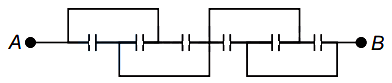
- All capacitors used in the diagram are identical and each is of capacitance C. Then the effective capacitance between the point \(A\) and \(B\) is
 KCET 2010 Medium
More PYQs from KCET
- Based on the first law of thermodynamics, which one of the following is correct?KCET 2010 Easy
- The value of \( \lim _{x \rightarrow 0} \frac{[x]}{x} \) isKCET 2018 Easy
- Match the type of immunity listed in column-I with the examples listed in column-II. Choose the answer that gives the correct combination of alphabets of the two columns:
Column-I
(Types of immunity)Column-II
(Example)A. Natural active p. Immunity developed by heredity B. Artificial passive q. From mother to foetus through placenta C. Artificial active r. Injection of antiserum to travellers D. Natural passive s. Fighting infections naturally t. Induced by vaccination KCET 2010 Easy -

\(a\) and \(y\) respectively areKCET 2023 Medium - A bag contains \(2 n+1\) coins. It is known that \(n\) of these coins have head on both sides whereas, the other \(n+1\) coins are fair. One coin is selected at random and tossed. If the probability that toss results in heads is \(\frac{31}{42}\), then the value of \(n\) isKCET 2023 Easy
- Which of the following element forms \( p \Pi-p_{\Pi} \) bond with itself ?KCET 2017 Easy