


KCET · Physics · Atomic Physics
Bohr's second postulate implies quantisation of
- A Charge of an electron
- B Energy of an electron
- C Angular momentum of electron
- D Radiated energy by an electron
Answer & Solution
Correct Answer
(C) Angular momentum of electron
Step-by-step Solution
Detailed explanation
According to Bohr's second postulate, an electron can revolve only in those circular orbits where its angular momentum is an integral multiple of \(\dfrac{h}{2\pi}\).
Mathematically, \(L = mvr = \dfrac{nh}{2\pi}\), where \(n = 1, 2, 3, \dots\)
This postulate directly implies the quantisation of the angular momentum of an electron.
Answer: Angular momentum of electron
Mathematically, \(L = mvr = \dfrac{nh}{2\pi}\), where \(n = 1, 2, 3, \dots\)
This postulate directly implies the quantisation of the angular momentum of an electron.
Answer: Angular momentum of electron
See the Complete Solution
Get step-by-step explanations for this and 2.5 Lakh+ more JEE, NEET & CET questions.
- Unlock all solutions
- Practice the full chapter
- Track accuracy across PYQs
4.8 rated on Google Play · 14,000+ reviews
More questions from Physics
- A uniform electric field \(E=3 \times 10^5 \mathrm{NC}^{-1}\) is acting along the positive \(Y\)-axis. The electric flux through a rectangle of area \(10 \mathrm{~cm} \times 30 \mathrm{~cm}\) whose plane is parallel to the ZX -plane isKCET 2024 Easy
- A uniform electric field in the plane of the paper as shown. Here \(A, B, C\) and \(D\) are the ponits on the circle. \(V_{1}, V_{2}, V_{3}\) and \(V_{4}\) are the potentials at those points respectively. Then
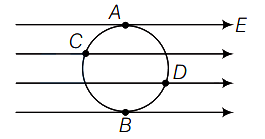 KCET 2013 Easy
 - A piston is performing S.H.M. in the vertical direction with a frequency of \( 0.5 \mathrm{~Hz} \). A block of \( 10 \)
\( \mathrm{kg} \) is placed on the piston. The maximum amplitude of the system such that the block remains
in contact with the piston isKCET 2019 Easy - What is a period of revolution of earth satellite ? Ignore the height of satellite above the surface of earth.
Given :
(1) The value of gravitational acceleration \( g=10 \mathrm{~ms}^{-2} \).
(2) Radius of earth \( R_{E}=6400 \mathrm{~km} \). Take \( \Pi=3.14 \).KCET 2014 Medium - Horizontal tube of non-uniform corss-section has radii of \(0.1 \mathrm{~m}\) and \(0.05 \mathrm{~m}\) respectively at \(\mathrm{M}\) and N. For a streamline flow of liquid the rate of liquid flow is
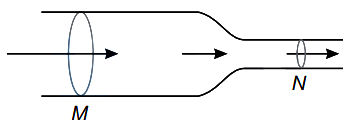 KCET 2009 Easy
 - Consider the following statements regarding the network shown in the figure.
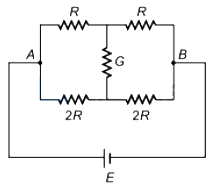
(1) The equivalent resistance of the network between points \(A\) and \(B\) is independent of value of \(G\).
(2) The equivalent resistance of the network between points \(A\) and \(B\) is \(\frac{4}{3} R\)
(3) The current through \(G\) is zero.
Which of the above statements is/are true?KCET 2011 Medium
More PYQs from KCET
- Two fly wheels are connected by a non-slipping belt as shown in the figure. \(I_1=4 \mathrm{~kg} \mathrm{~m}^2, r_1=20 \mathrm{~cm}\), \(\mathrm{I}_2=20 \mathrm{kgm}^2\) and \(\mathrm{r}_2=30 \mathrm{~cm}\). A torque of 10 Nm is applied on the smaller wheel. Then match the entries of column I with appropriate entries of column II.
Quantities Their numerical Values (in SI units) a. Angular acceleration of smaller wheel 1. \(\frac{5}{3}\) b. Torque on the larger wheel 2. \(\frac{100}{3}\) c. Angular acceleration of larger wheel 3. \(\frac{5}{2}\) 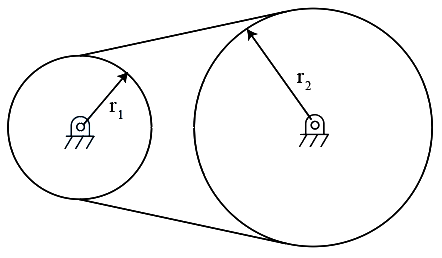 KCET 2025 Medium
 - The electromagnetic theory of light failed to explainKCET 2007 Medium
-
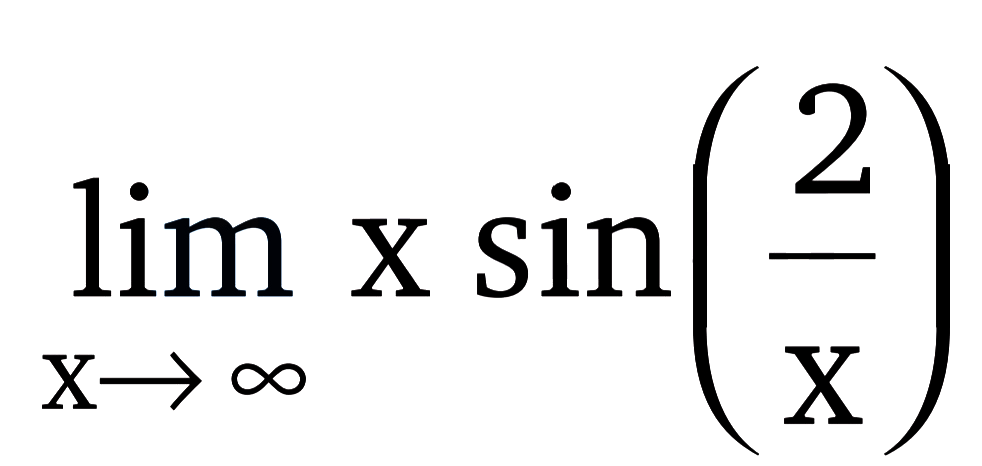
is equal toKCET 2008 Easy - In the given sequence of reactions, identify \({ }^{\prime} P^{\prime}, ' Q{ }^{\prime}, R^{\prime}\) and ' \(S\) respectively.
\(\mathrm{CH}_2= \underset{\underset{}{\Large | ~~~~} \atop \huge \mathrm{Br}}{\mathrm{CH}_2}-\underset{\underset{}{\Large | ~~~~} \atop \huge \mathrm{Br}}{\mathrm{CH}_2} \xrightarrow{Q}\)
\(\mathrm{CH}_2=\mathrm{CH}-\mathrm{Br} \xrightarrow{R} \mathrm{CH} \equiv \mathrm{CH} \xrightarrow{s} \mathrm{C}_6 \mathrm{H}_6\)KCET 2024 Easy - Though the electron drift velocity is small and electron charge is very small, a conductor can
carry an appreciably large current becauseKCET 2019 Easy - The probability distribution of \( x \) is
\(\begin{array}{|l|l|l|l|l|}
\hline \mathbf{x} & 0 & 1 & 2 & 3 \\
\hline \mathbf{P}(\mathbf{x}) & 0.2 & k & k & 2 k \\
\hline
\end{array}\)
find the value of \( k \)KCET 2015 Hard