


KCET · Physics · Ray Optics
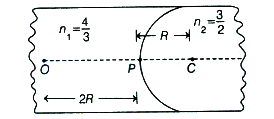
A luminous point object \(O\) is placed at a distance \(2 R\) from the spherical boundary separating two transparent media of refractive indices \(n_1\) and \(n_2\) as shown, where \(R\) is the radius of curvature of the spherical surface. If \(n_1=\frac{4}{3}, n_2=\frac{3}{2}\) and \(R=10 \mathrm{~cm}\), the image is obtained at a distance from \(P\) equal to
- A 30 cm in the rarer medium
- B 30 cm in the denser medium
- C 18 cm in the rarer medium
- D 18 cm in the denser medium
Answer & Solution
Correct Answer
(A) 30 cm in the rarer medium
Step-by-step Solution
Detailed explanation
From the given diagram in question,
\(n_1=\frac{4}{3} n_2=\frac{3}{2}\)
\(u=-2 R\)
\(\therefore\) Using refraction formula through convex spherical surface.
\(\frac{n_2}{v}-\frac{n_1}{\mu}=\frac{n_2-n_1}{R}\)
\(\Rightarrow \quad \frac{\frac{3}{2}}{v}-\frac{4}{3(-2 R)}=\frac{\frac{3}{2}-\frac{4}{3}}{R} \Rightarrow v=-3 R\)
\(=-3 \times 10 \quad[\because R=10 \mathrm{~cm}]\)
\(=-30 \mathrm{~cm}\)
Since, \(v\) is negative, thus image is obtained at a distance from \(P\) equal to 30 cm in the rarer medium.
\(n_1=\frac{4}{3} n_2=\frac{3}{2}\)
\(u=-2 R\)
\(\therefore\) Using refraction formula through convex spherical surface.
\(\frac{n_2}{v}-\frac{n_1}{\mu}=\frac{n_2-n_1}{R}\)
\(\Rightarrow \quad \frac{\frac{3}{2}}{v}-\frac{4}{3(-2 R)}=\frac{\frac{3}{2}-\frac{4}{3}}{R} \Rightarrow v=-3 R\)
\(=-3 \times 10 \quad[\because R=10 \mathrm{~cm}]\)
\(=-30 \mathrm{~cm}\)
Since, \(v\) is negative, thus image is obtained at a distance from \(P\) equal to 30 cm in the rarer medium.
See the Complete Solution
Get step-by-step explanations for this and 2.5 Lakh+ more JEE, NEET & CET questions.
- Unlock all solutions
- Practice the full chapter
- Track accuracy across PYQs
4.8 rated on Google Play · 14,000+ reviews
More questions from Physics
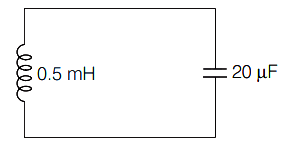
- In the given circuit, the resonant frequency is
 KCET 2020 Medium
 - A long solenoid with \( 40 \) turns per cm carries a current of \( 1 \mathrm{~A} \). The magnetic energy stored per unit volume is \( J m^{-3} \).KCET 2016 Medium
- The amount of heat energy radiated by a metal at temperature \(\mathrm{T}\) is \(\mathrm{E}\). When the temperature is increased to 3T, energy radiated isKCET 2009 Easy
- According to Huygens' principle, during refraction of light from air to a denser mediumKCET 2017 Easy
- For what distance is ray optics is good approximation when the aperture is \( 4 \mathrm{~mm} \) and the
wavelength of light is \( 400 \mathrm{~nm} \) ?KCET 2016 Medium - A prism having refractive index \(1.414\) and refracting angle \(30^{\circ}\) has one of the refracting surfaces silvered. A beam of light incident on the other refracting surface will retrace its path, if the angle of incidence isKCET 2011 Hard
More PYQs from KCET
- Copper is extracted from Copper pyrites by heating in a Bessemer converter. The method is
based on the principle thatKCET 2015 Hard - Gametophyte is the dominant phase in the life cycle ofKCET 2011 Easy
- Energy of an electron in the second orbit of hydrogen atom is \(E_{2}\). The energy of electron in the third orbit of \(\mathrm{He}^{+}\)will beKCET 2021 Easy
- If \(A=\left[\begin{array}{cc}2-k & 2 \\ 1 & 3-k\end{array}\right]\) is singular matrix, then the value of \(5 k-k^2\) is equal toKCET 2023 Easy
- If \(2 \mathbf{i}+3 \mathbf{j}, \mathbf{i}+\mathbf{j}+\mathbf{k}\) and \(\lambda \mathbf{i}+4 \mathbf{j}+2 \mathbf{k}\) taken in an order are coterminous edges of a parallelopiped of volume \(2 \mathrm{cu}\) units, then value of \(\lambda\) isKCET 2011 Medium
- If the bond energies of \( \mathrm{H}-\mathrm{H}, \mathrm{Br}-\mathrm{Br} \) and \( \mathrm{H}-\mathrm{Br} \) are \( 433,192 \) and \( 364 \mathrm{~kJ} \mathrm{~mol}^{-1} \) respectively, then
\( \Delta \mathrm{H}^{\circ} \) for the reaction :
\( \mathrm{H}_{2}(g)+\mathrm{Br}_{2}(g) \rightarrow 2 \mathrm{HBr}(g) \)KCET 2016 Hard