


KCET · Maths · Vector Algebra
If \(\hat{\mathbf{i}}, \hat{\mathbf{j}}, \hat{\mathbf{k}}\) are unit vectors along the positive direction of \(\mathrm{x}, \mathrm{y}\) and \(\mathrm{z}\)-axes, then a false statement in the following is
- A \(\sum \hat{\mathbf{i}} \times(\hat{\mathbf{j}}+\hat{\mathbf{k}})=\overrightarrow{\mathbf{0}}\)
- B \(\sum \hat{\mathbf{i}} \times(\hat{\mathbf{j}} \times \hat{\mathbf{k}})=\overrightarrow{\mathbf{0}}\)
- C \(\Sigma \hat{\mathbf{i}} \cdot(\hat{\mathbf{j}} \times \hat{\mathbf{k}})=\overrightarrow{\mathbf{0}}\)
- D \(\Sigma \hat{\mathbf{i}} \cdot(\hat{\mathbf{j}}+\hat{\mathbf{k}})=\overrightarrow{\mathbf{0}}\)
Answer & Solution
Correct Answer
(C) \(\Sigma \hat{\mathbf{i}} \cdot(\hat{\mathbf{j}} \times \hat{\mathbf{k}})=\overrightarrow{\mathbf{0}}\)
Step-by-step Solution
Detailed explanation
Given, \(\hat{\mathbf{i}}, \hat{\mathbf{j}}, \hat{\mathbf{k}}\) are unit vectors along the positive direction of \(x, y\) and \(z\)-axes, then
(a) \(\Sigma \hat{\mathbf{i}} \times(\hat{\mathbf{j}}+\hat{\mathbf{k}})\)
\[
\begin{aligned}
&=\hat{\mathbf{i}} \times(\hat{\mathbf{j}}+\hat{\mathbf{k}})+\hat{\mathbf{j}} \times(\hat{\mathbf{k}}+\hat{\mathbf{i}})+\hat{\mathbf{k}} \times(\hat{\mathbf{i}}+\hat{\mathbf{j}}) \\
&=\hat{\mathbf{k}}-\hat{\mathbf{j}}+\hat{\mathbf{i}}-\hat{\mathbf{k}}+\hat{\mathbf{j}}-\hat{\mathbf{i}} \\
&=0
\end{aligned}
\]
(b) \(\Sigma \hat{\mathbf{i}} \times(\hat{\mathbf{j}} \times \hat{\mathbf{k}})=\hat{\mathbf{i}} \times(\hat{\mathbf{j}} \times \hat{\mathbf{k}})+\hat{\mathbf{j}} \times(\hat{\mathbf{k}} \times \hat{\mathbf{i}})\)
\[
\begin{aligned}
&+\hat{\mathbf{k}} \times(\hat{\mathbf{i}} \times \hat{\mathbf{j}}) \\
&\times \hat{\mathbf{k}})
\end{aligned}
\]
\[
\begin{aligned}
&=(\hat{\mathbf{i}} \times \hat{\mathbf{i}})+(\hat{\mathbf{j}} \times \hat{\mathbf{j}})+(\hat{\mathbf{k}} \times \hat{\mathbf{k}}) \\
&=0+0+0 \\
&=0
\end{aligned}
\]
(c) \(\Sigma \hat{\mathbf{i}} \cdot(\hat{\mathbf{j}} \times \hat{\mathbf{k}})=\Sigma(\hat{\mathbf{i}} \cdot \hat{\mathbf{i}})=\Sigma(1)\)
\[
=1+1+1=3
\]
(d) \(\Sigma \hat{\mathbf{i}} \cdot(\hat{\mathbf{j}}+\hat{\mathbf{k}})=\Sigma(\hat{\mathbf{i}} \cdot \hat{\mathbf{j}}+\hat{\mathbf{i}} \cdot \hat{\mathbf{k}})\)
\[
=\Sigma(0+0)=0
\]
(a) \(\Sigma \hat{\mathbf{i}} \times(\hat{\mathbf{j}}+\hat{\mathbf{k}})\)
\[
\begin{aligned}
&=\hat{\mathbf{i}} \times(\hat{\mathbf{j}}+\hat{\mathbf{k}})+\hat{\mathbf{j}} \times(\hat{\mathbf{k}}+\hat{\mathbf{i}})+\hat{\mathbf{k}} \times(\hat{\mathbf{i}}+\hat{\mathbf{j}}) \\
&=\hat{\mathbf{k}}-\hat{\mathbf{j}}+\hat{\mathbf{i}}-\hat{\mathbf{k}}+\hat{\mathbf{j}}-\hat{\mathbf{i}} \\
&=0
\end{aligned}
\]
(b) \(\Sigma \hat{\mathbf{i}} \times(\hat{\mathbf{j}} \times \hat{\mathbf{k}})=\hat{\mathbf{i}} \times(\hat{\mathbf{j}} \times \hat{\mathbf{k}})+\hat{\mathbf{j}} \times(\hat{\mathbf{k}} \times \hat{\mathbf{i}})\)
\[
\begin{aligned}
&+\hat{\mathbf{k}} \times(\hat{\mathbf{i}} \times \hat{\mathbf{j}}) \\
&\times \hat{\mathbf{k}})
\end{aligned}
\]
\[
\begin{aligned}
&=(\hat{\mathbf{i}} \times \hat{\mathbf{i}})+(\hat{\mathbf{j}} \times \hat{\mathbf{j}})+(\hat{\mathbf{k}} \times \hat{\mathbf{k}}) \\
&=0+0+0 \\
&=0
\end{aligned}
\]
(c) \(\Sigma \hat{\mathbf{i}} \cdot(\hat{\mathbf{j}} \times \hat{\mathbf{k}})=\Sigma(\hat{\mathbf{i}} \cdot \hat{\mathbf{i}})=\Sigma(1)\)
\[
=1+1+1=3
\]
(d) \(\Sigma \hat{\mathbf{i}} \cdot(\hat{\mathbf{j}}+\hat{\mathbf{k}})=\Sigma(\hat{\mathbf{i}} \cdot \hat{\mathbf{j}}+\hat{\mathbf{i}} \cdot \hat{\mathbf{k}})\)
\[
=\Sigma(0+0)=0
\]
See the Complete Solution
Get step-by-step explanations for this and 2.5 Lakh+ more JEE, NEET & CET questions.
- Unlock all solutions
- Practice the full chapter
- Track accuracy across PYQs
4.8 rated on Google Play · 14,000+ reviews
More questions from Maths
- If \(y=\tan ^{-1} \sqrt{\mathrm{x}^{2}-1}\), then the ratio \(\frac{\mathrm{d}^{2} \mathrm{y}}{\mathrm{dx} \mathrm{x}^{2}}: \frac{\mathrm{dy}}{\mathrm{dx}}\) isKCET 2010 Medium
- \(n\)th term of the series \(1+\frac{3}{7}+\frac{5}{7^2}+\frac{1}{7^2}+\ldots\) isKCET 2023 Easy
- If \(\overrightarrow{\mathbf{a}}, \overrightarrow{\mathbf{b}}\) and \(\overrightarrow{\mathbf{c}}\) are non-zero coplanar vectors, then \([2 \overrightarrow{\mathbf{a}}-\overrightarrow{\mathbf{b}} 3 \overrightarrow{\mathbf{b}}-\overrightarrow{\mathbf{c}} 4 \overrightarrow{\mathbf{c}}-\overrightarrow{\mathbf{a}}]\) isKCET 2010 Medium
- The range of the function \(f(x)=\sin [x],-\frac{\pi}{4} < x < \frac{\pi}{4}\), where \([x]\) denotes the greatest integer \(\leq x\), isKCET 2013 Easy
- The value of
\(e^{\log _{10} \tan 1^{\circ}+\log _{10} \tan 2^{\circ}+\log _{10} \tan 3^{\circ}+\ldots+\log _{10} \tan 89^{\circ}}\)
isKCET 2023 Medium - The differential coefficient of \( \log _{10} x \) with respect to \( \log _{x} 10 \) isKCET 2016 Easy
More PYQs from KCET
- In the following reaction

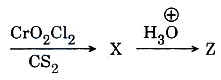
the compound \( Z \) isKCET 2018 Hard - \( \sum_{r=1}^{n}(2 r-1)=x \) then
\( \lim _{n \rightarrow \infty}\left[\frac{1^{3}}{x^{2}}+\frac{2^{3}}{x^{2}}+\frac{3^{3}}{\chi^{2}}+\ldots+\frac{n^{3}}{\chi^{2}}\right]= \)KCET 2019 Hard - Which one of the following is not correct?KCET 2013 Easy
- The digit in the unit's place of \(7^{171}+(177) !\) isKCET 2011 Easy
- If \( f(x)=x^{3} \) and \( g(x)=x^{3}-4 x \) in \( -2 \leq x \leq 2 \), then consider the statements:
(a) \( f(x) \) and \( g(x) \) satisfy mean value theorem.
(b) \( f(x) \) and \( g(x) \) both satisfy Rolle's theorem.
(c) Only \( g(x) \) satisfies Rolle's theorem.
Of these statementsKCET 2014 Medium - The compound which forms acetaldehyde when heated with dilute \(\mathrm{NaOH}\), isKCET 2009 Medium