


KCET · Maths · Inverse Trigonometric Functions
The number of real solutions of the equation \(\tan ^{-1} \sqrt{x(x+1)}+\sin ^{-1} \sqrt{x^{2}+x+1}=\frac{\pi}{2}\) is
- A one
- B four
- C two
- D infinitely many
Answer & Solution
Correct Answer
(C) two
Step-by-step Solution
Detailed explanation
Given,
\(\tan ^{-1} \sqrt{x(x+1)}+\sin ^{-1} \sqrt{x^{2}+x+1}=\frac{\pi}{2}\)
\(\Rightarrow \quad \cos ^{-1} \frac{1}{\sqrt{\left(x^{2}+x\right)^{2}+1}}\)
\(=\frac{\pi}{2}-\sin ^{-1} \sqrt{\mathrm{x}^{2}+\mathrm{x}+1}\)
\(\Rightarrow \cos ^{-1} \frac{1}{\sqrt{\left(x^{2}+x\right)^{2}+1}}=\cos ^{-1} \sqrt{x^{2}+x+1}\)
\(\Rightarrow \quad \frac{1}{\sqrt{\left(x^{2}+x\right)^{2}+1}}=\sqrt{x^{2}+x+1}\)
\(\Rightarrow \quad 1=\left(x^{2}+x+1\right)\left[\left(x^{2}+x\right)^{2}+1\right]\)
\(\Rightarrow \quad\left(\mathrm{x}^{2}+\mathrm{x}\right)^{3}+\left(\mathrm{x}^{2}+\mathrm{x}\right)^{2}+\left(\mathrm{x}^{2}+\mathrm{x}\right)+1=1\)
\(\Rightarrow \quad\left(x^{2}+x\right)\left[\left(x^{2}+x\right)^{2}+\left(x^{2}+x\right)+1\right]=0\)
\(\Rightarrow \quad x^{2}+x=0\)
\[
\Rightarrow \quad \mathrm{x}=0,-1
\]
Hence, both values of \(\mathrm{x}\) satisfies the given equation.
\(\tan ^{-1} \sqrt{x(x+1)}+\sin ^{-1} \sqrt{x^{2}+x+1}=\frac{\pi}{2}\)
\(\Rightarrow \quad \cos ^{-1} \frac{1}{\sqrt{\left(x^{2}+x\right)^{2}+1}}\)
\(=\frac{\pi}{2}-\sin ^{-1} \sqrt{\mathrm{x}^{2}+\mathrm{x}+1}\)
\(\Rightarrow \cos ^{-1} \frac{1}{\sqrt{\left(x^{2}+x\right)^{2}+1}}=\cos ^{-1} \sqrt{x^{2}+x+1}\)
\(\Rightarrow \quad \frac{1}{\sqrt{\left(x^{2}+x\right)^{2}+1}}=\sqrt{x^{2}+x+1}\)
\(\Rightarrow \quad 1=\left(x^{2}+x+1\right)\left[\left(x^{2}+x\right)^{2}+1\right]\)
\(\Rightarrow \quad\left(\mathrm{x}^{2}+\mathrm{x}\right)^{3}+\left(\mathrm{x}^{2}+\mathrm{x}\right)^{2}+\left(\mathrm{x}^{2}+\mathrm{x}\right)+1=1\)
\(\Rightarrow \quad\left(x^{2}+x\right)\left[\left(x^{2}+x\right)^{2}+\left(x^{2}+x\right)+1\right]=0\)
\(\Rightarrow \quad x^{2}+x=0\)
\[
\Rightarrow \quad \mathrm{x}=0,-1
\]
Hence, both values of \(\mathrm{x}\) satisfies the given equation.
See the Complete Solution
Get step-by-step explanations for this and 2.5 Lakh+ more JEE, NEET & CET questions.
- Unlock all solutions
- Practice the full chapter
- Track accuracy across PYQs
4.8 rated on Google Play · 14,000+ reviews
More questions from Maths
- If \( A=\left[\begin{array}{cc}\cos 2 \theta & -\sin 2 \theta \\ \sin 2 \theta & \cos 2 \theta\end{array}\right] \) and \( A+A^{T}=I \),
where \( \mathrm{I} \) is the unit matrix of \( 2 \times 2 \& \mathrm{~A}^{\mathrm{T}} \) is the transpose of \( \mathrm{A} \), then the value of \( \theta \) is equal toKCET 2016 Hard - The maximum area of a rectangle inscribed in the circle \( (x+1)^{2}+(y-3)^{2}=64 \) isKCET 2018 Hard
- If \( A \) and \( B \) are finite sets and \( A \subset B \), thenKCET 2017 Easy
- The length of the subtangent to the curve \(x^{2} y^{2}=a^{4}\) at \((-a, a)\) isKCET 2007 Hard
- If \(P\) is any point on the ellipse \(\frac{x^{2}}{36}+\frac{y^{2}}{16}=1\) and \(S\) and \(S^{\prime}\) are the foci, then \(P S+P S^{\prime}\) is equal toKCET 2007 Easy
- If \(x=e^\theta \sin \theta, y=e^\theta \cos \theta\) where \(\theta\) is a parameter, then \(\frac{d y}{d x}\) at \((1,1)\) is equal toKCET 2022 Hard
More PYQs from KCET
- Match the microbial products listed under Column-I with the related microbes given under Column - II.
Choose the appropriate option from the given choices.Column-I Column-II A. Citric acid p. Methano-bacterium B. Cyclosporin A q. Monascus purpureus C. Statin r. Aspergillus niger D. Gobar gas s. Trichoderma polysporum t. Clostridium butylicum KCET 2014 Hard - Which of the following monomers can undergo condensation polymerisation?KCET 2020 Easy
- \(\mathrm{H}_{2} \mathrm{~S}\) is passed into one \(\mathrm{nm}^{3}\) of a solution containing \(0.1\) mole of \(\mathrm{Zn}^{2+}\) and \(0.01\) mole of \(\mathrm{Cu}^{2+}\) till the sulphide ion concentration reaches to \(8.1 \times 10^{-19}\) moles. Which one of the following statements is true?
\(\left[K_{\mathrm{sp}}\right.\) of \(\mathrm{ZnS}\) and CuS are \(3 \times 10^{-22}\) and \(8 \times 10^{-36}\) respectively.]KCET 2011 Medium - Identify the option showing the correct labeling for p, q, r and s with refernce to the conducting system of the human heart.
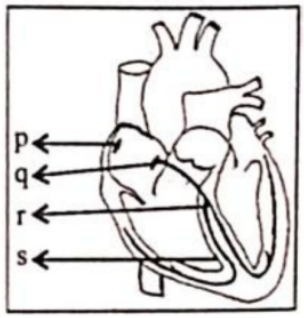 KCET 2023 Hard
 - The characteristic that is shared by urea, uric acid and ammonia is/are
(A) They are nitrogenous wastes.
(B) They all need very large amount of water is excretion.
(C) They all are equally toxic.
(D) They are produced in the kidneys.KCET 2009 Medium - In Prokaryotes the glycocalyx when it is thick is calledKCET 2015 Hard