


KCET · Maths · Functions
On the set of integers \(Z\), define \(f: Z \rightarrow Z\) as \(f(n)=\left\{\begin{array}{ll}\frac{\mathrm{n}}{2}, & \mathrm{n} \text { is even } \\ 0, & \mathrm{n} \text { is odd }\end{array}\right.\) then \(f\) is
- A injective but not surjective
- B neither injective nor surjective
- C surjective but not injective
- D bijective
Answer & Solution
Correct Answer
(C) surjective but not injective
Step-by-step Solution
Detailed explanation
Given, \(f(n)= \begin{cases}\frac{n}{2}, & n \text { is even } \\ 0, & n \text { is odd }\end{cases}\)
Here, we see that for every odd values of \(z\), it will give zero. It means that it is a many one function.
For every even values of \(z\), we will get a set of integers \((-\infty, \infty)\). So, it is onto. Hence, it is surjective but not injective.
Here, we see that for every odd values of \(z\), it will give zero. It means that it is a many one function.
For every even values of \(z\), we will get a set of integers \((-\infty, \infty)\). So, it is onto. Hence, it is surjective but not injective.
See the Complete Solution
Get step-by-step explanations for this and 2.5 Lakh+ more JEE, NEET & CET questions.
- Unlock all solutions
- Practice the full chapter
- Track accuracy across PYQs
4.8 rated on Google Play · 14,000+ reviews
More questions from Maths
- If \(\frac{x^{2}}{36}-\frac{y^{2}}{k^{2}}=1\) is a hyperbola, then which of the following statements can be true?KCET 2007 Easy
- \( \int \sqrt{x^{2}+2 x+5} d x \) is equal toKCET 2017 Medium
- If \(\frac{\log x}{b-c}=\frac{\log y}{c-a}=\frac{\log z}{a-b}\), then the value of \(x^{b+c} \cdot y^{c+a} \cdot z^{a+b}\) isKCET 2011 Easy
- The length of the chord of the circle \(x^{2}+y^{2}+3 x+2 y-8=0\) intercepted by the \(y\)-axis isKCET 2013 Easy
- The sum of the squares of the eccentricities of the conics \(\frac{x^{2}}{4}+\frac{y^{2}}{3}=1\) and \(\frac{x^{2}}{4}-\frac{y^{2}}{3}=1\) isKCET 2013 Medium
- The number of terms in the expansion of \( \left(x^{2}+y^{2}\right)^{25}-\left(x^{2}-y^{2}\right)^{25} \) after simplification isKCET 2019 Medium
More PYQs from KCET
- A gas deviates from ideal behaviour at a high pressure because its moleculesKCET 2008 Medium
- In the three parts of a transistor, 'Emitter' is ofKCET 2017 Medium
- The glycosidic linkage involved in linking the glucose units in amylose part of starch isKCET 2018 Easy
- The power dissipated in \( 3 \Omega \) resistance in the following circuit is
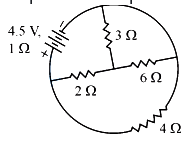 KCET 2017 Easy
 - The property of halogens which is not correctly matched isKCET 2022 Easy
- The kinetic energy of a body of mass \( 4 \mathrm{~kg} \) and momentum \( 6 \mathrm{Ns} \) will beKCET 2015 Easy