


KCET · Maths · Limits
Let the function satisfy the equation \(f(x+y)=f(x) f(y)\) for all \(x, y \in R\), where \(f(0) \neq 0\). If \(f(5)=3\) and \(f^{\prime}(0)=2\), then \(f^{\prime}(5)\) is
- A \(6\)
- B \(0\)
- C \(3\)
- D \(-6\)
Answer & Solution
Correct Answer
(A) \(6\)
Step-by-step Solution
Detailed explanation
\(\because f(x+y)=f(x) \cdot f(y)\)
Put \(x=0, y=5\), we get
\(f(0+5)=f(0) f(5)\)
\(\Rightarrow \quad f(5)[f(0)-1]=0\)
\(\Rightarrow \quad f(0)=1\)
Consider \(f^{\prime}(5)=\lim _{h \rightarrow 0} \frac{f(5+h)-f(5)}{h}\)
\(=\lim _{h \rightarrow 0} \frac{f(5) f(h)-f(5)}{h}\)
\(=\lim _{h \rightarrow 0} \frac{f(5)[f(h)-1]}{h}=f(5) \lim _{h \rightarrow 0} \frac{f(h)-f(0)}{h}\)
\(=f(5) f^{\prime}(0)=2 \times 3=6\)
Put \(x=0, y=5\), we get
\(f(0+5)=f(0) f(5)\)
\(\Rightarrow \quad f(5)[f(0)-1]=0\)
\(\Rightarrow \quad f(0)=1\)
Consider \(f^{\prime}(5)=\lim _{h \rightarrow 0} \frac{f(5+h)-f(5)}{h}\)
\(=\lim _{h \rightarrow 0} \frac{f(5) f(h)-f(5)}{h}\)
\(=\lim _{h \rightarrow 0} \frac{f(5)[f(h)-1]}{h}=f(5) \lim _{h \rightarrow 0} \frac{f(h)-f(0)}{h}\)
\(=f(5) f^{\prime}(0)=2 \times 3=6\)
See the Complete Solution
Get step-by-step explanations for this and 2.5 Lakh+ more JEE, NEET & CET questions.
- Unlock all solutions
- Practice the full chapter
- Track accuracy across PYQs
4.8 rated on Google Play · 14,000+ reviews
More questions from Maths
- Area of the region bounded by the curve \( y=\cos x, x=0 \) and \( x=\pi \) isKCET 2017 Easy
- \[
\text { If } f(x)=\left\{\begin{array}{cc}
\frac{3 \sin \pi x}{5 x} ; & x \neq 0 \\
2 K ; & x=0
\end{array}\right.
\]
is continuous at \( x=0 \), then the value of \( K \) isKCET 2014 Easy - If \(p\left(\frac{1}{q}+\frac{1}{r}\right), q\left(\frac{1}{r}+\frac{1}{p}\right), r\left(\frac{1}{p}+\frac{1}{q}\right)\) are in \(\mathrm{AP}\), then \(p, q, r\)KCET 2023 Hard
- A car manufacturing factory has two plants \(X\) and \(Y\). Plant \(X\) manufactures \(70 \%\) of cars and plant \(Y\) manufactures \(30 \%\) of cars. \(80 \%\) of cars at plant \(X\) and \(90 \%\) of cars at plant \(Y\) are rated as standard quality. A car is chosen at random and is found to be standard quality. The probability that it has come from plant \(X\) isKCET 2021 Medium
- The value of the integral \(\int_{-\frac{\pi}{4}}^{\frac{\pi}{4}} \log (\sec \theta-\tan \theta) \mathrm{d} \theta\) isKCET 2014 Easy
- If \(e_{1}\) and \(e_{2}\) are the eccentricities of a hyperbola \(3 x^{2}-3 y^{2}=25\) and its conjugate, thenKCET 2008 Medium
More PYQs from KCET
- Identifying the cells representing P, Q, R and S in the given schematic representation of spermatogenesis
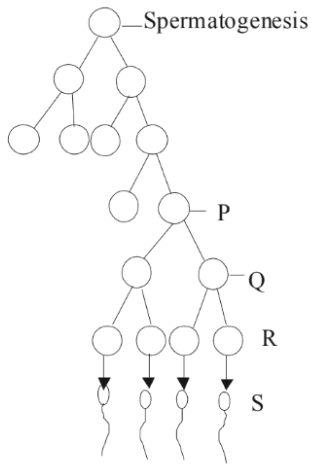 KCET 2019 Easy
 - A luminous point object \(O\) is placed at a distance \(2 R\) from the spherical boundary separating two transparent media of refractive indices \(n_1\) and \(n_2\) as shown, where \(R\) is the radius of curvature of the spherical surface. If \(n_1=\frac{4}{3}, n_2=\frac{3}{2}\) and \(R=10 \mathrm{~cm}\), the image is obtained at a distance from \(P\) equal to
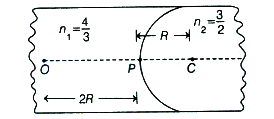 KCET 2024 Medium
 - A solenoid of inductance \( 2 \mathrm{H} \) carries a current of \( 1 \mathrm{~A} \). What is the magnetic energy stored in a solenoid?KCET 2014 Medium
- Column-I contains larval stages and column-II contains the groups to which the belong. Match them correctly and choose the right answer.
Column-I Column-II A. Planula 1. Annelida B. Tornaria 2. Mollusca C. Trochophore 3. Arthropoda D. Bipinnaria 4. Chordata E. Glochidium 5. Echinodermata 5. Echinodermata KCET 2006 Hard - A transformer works on the principle ofKCET 2011 Easy
- \(A B C\) is a triangle with \(\angle A=30^{\circ}, B C=10 \mathrm{~cm}\). The area of the circumcircle of the triangle isKCET 2007 Medium