


KCET · Maths · Differential Equations
Integrating factor of the differential equation \((1 + x^2)\dfrac{dy}{dx} + xy = 1\) is
- A \(1 + x^2\)
- B \(\dfrac{1}{2}\log(1 + x^2)\)
- C \(\dfrac{x}{1 + x^2}\)
- D \(\sqrt{1 + x^2}\)
Answer & Solution
Correct Answer
(D) \(\sqrt{1 + x^2}\)
Step-by-step Solution
Detailed explanation
The given differential equation is \((1 + x^2)\dfrac{dy}{dx} + xy = 1\)
Dividing the entire equation by \((1 + x^2)\), we get:
\(\dfrac{dy}{dx} + \dfrac{x}{1 + x^2}y = \dfrac{1}{1 + x^2}\)
This is a linear differential equation of the form \(\dfrac{dy}{dx} + P(x)y = Q(x)\), where \(P(x) = \dfrac{x}{1 + x^2}\) and \(Q(x) = \dfrac{1}{1 + x^2}\)
The integrating factor (IF) is given by \(e^{\int P(x) dx}\)
\(\int P(x) dx = \int \dfrac{x}{1 + x^2} dx\)
Let \(1 + x^2 = t\), then \(2x dx = dt \Rightarrow x dx = \dfrac{dt}{2}\)
\(\int \dfrac{x}{1 + x^2} dx = \dfrac{1}{2} \int \dfrac{dt}{t} = \dfrac{1}{2} \log t = \dfrac{1}{2} \log(1 + x^2) = \log(\sqrt{1 + x^2})\)
Therefore, the integrating factor is \(e^{\log(\sqrt{1 + x^2})} = \sqrt{1 + x^2}\)
Answer: \(\sqrt{1 + x^2}\)
Dividing the entire equation by \((1 + x^2)\), we get:
\(\dfrac{dy}{dx} + \dfrac{x}{1 + x^2}y = \dfrac{1}{1 + x^2}\)
This is a linear differential equation of the form \(\dfrac{dy}{dx} + P(x)y = Q(x)\), where \(P(x) = \dfrac{x}{1 + x^2}\) and \(Q(x) = \dfrac{1}{1 + x^2}\)
The integrating factor (IF) is given by \(e^{\int P(x) dx}\)
\(\int P(x) dx = \int \dfrac{x}{1 + x^2} dx\)
Let \(1 + x^2 = t\), then \(2x dx = dt \Rightarrow x dx = \dfrac{dt}{2}\)
\(\int \dfrac{x}{1 + x^2} dx = \dfrac{1}{2} \int \dfrac{dt}{t} = \dfrac{1}{2} \log t = \dfrac{1}{2} \log(1 + x^2) = \log(\sqrt{1 + x^2})\)
Therefore, the integrating factor is \(e^{\log(\sqrt{1 + x^2})} = \sqrt{1 + x^2}\)
Answer: \(\sqrt{1 + x^2}\)
See the Complete Solution
Get step-by-step explanations for this and 2.5 Lakh+ more JEE, NEET & CET questions.
- Unlock all solutions
- Practice the full chapter
- Track accuracy across PYQs
4.8 rated on Google Play · 14,000+ reviews
More questions from Maths
- The simplified form of \( \tan ^{-1}\left(\frac{x}{y}\right)-\tan ^{-1}\left(\frac{x-y}{x+y}\right) \) is equal toKCET 2016 Medium
- If \(y=2^{\log x}\), then \(\frac{d y}{d x}\) isKCET 2007 Easy
- The distance of the point \( P(a, b, c) \) from the \( x \)-axis isKCET 2014 Easy
- If \(A\) and \(B\) are two matrices, such that \(A B=B\) and \(B A=A\), then \(A^2+B^2\) equals toKCET 2023 Easy
- If a relation \(R\) on the set \(\{1,2,3\}\) be defined by \(R=\{(1,1)\}\), then \(R\) isKCET 2020 Easy
- The shaded region in the figure is the solution set of the inequations
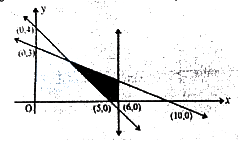 KCET 2019 Easy
More PYQs from KCET
- Out of the given two compounds, the vapour pressure of \(B\) at a particular temperature is
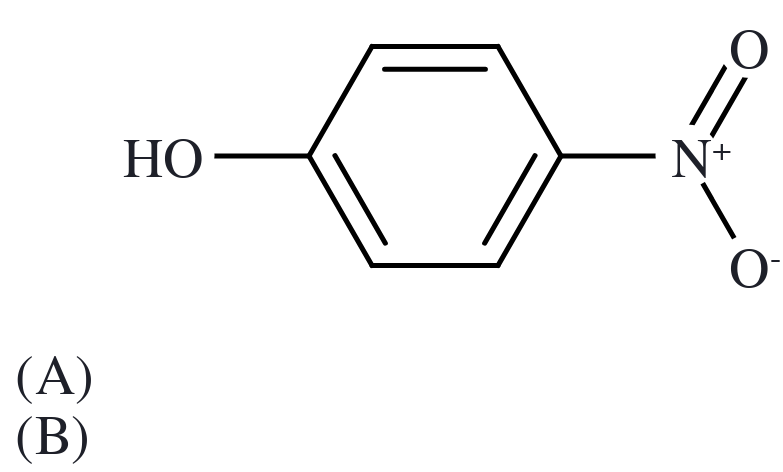 KCET 2011 Hard
 - A sphere, a cube and a thin circular plate all of same material and same mass initially heated to same high temperature are allowed to cool down under similar conditions. Then, theKCET 2020 Medium
- Consider the following statements in case of Young's double slit experiment.
(1) A slit \(S\) is necessary if we use an ordinary extended source of light.
(2) A slit \(S\) is not needed if we use an ordinary but well collimated beam of light.
(3) A slit \(S\) is not needed if we use a spatially coherent source of light.
Which of the above statements are correct?KCET 2011 Easy - Which of the following does not represent property stated against it?KCET 2021 Medium
- The power of a equi-concave lens is \(-4.5 \mathrm{D}\) and is made of a material of refractive index 1.6, the radii of curvature of the lens isKCET 2022 Easy
- If \( \vec{E} \) and \( \vec{B} \) represent electric and magnetic field vectors of an electromagnetic wave, the
direction of propagation of the wave is alongKCET 2017 Easy