


KCET · Maths · Hyperbola
In the figure
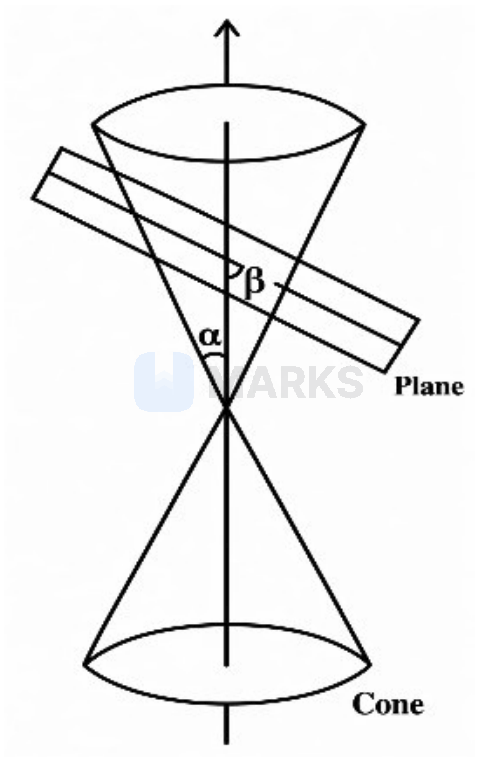
Statement-I: When \(\alpha > \beta \geq 0\), the section is hyperbola
Statement-II: When \(\beta > 90^\circ\), the section is ellipse
Which of the following is correct?
- A Statement I is true, Statement II is false
- B Statement I is false, Statement II is true
- C Both the Statements are true
- D Both the Statements are false
Answer & Solution
Correct Answer
(A) Statement I is true, Statement II is false
Step-by-step Solution
Detailed explanation
Let \(\alpha\) be the semi-vertical angle of the cone and \(\beta\) be the angle between the intersecting plane and the axis of the cone.
The conic sections formed by the intersection of a plane and a double cone are determined by the relationship between \(\alpha\) and \(\beta\):
1. If \(0 \le \beta < \alpha\), the plane intersects both nappes of the cone, forming a hyperbola.
2. If \(\beta = \alpha\), the plane is parallel to a generator of the cone, forming a parabola.
3. If \(\alpha < \beta < 90^\circ\), the plane intersects only one nappe, forming an ellipse.
4. If \(\beta = 90^\circ\), the plane is perpendicular to the axis, forming a circle.
From the above conditions, when \(\alpha > \beta \ge 0\), the section is a hyperbola. Hence, Statement-I is true.
The angle \(\beta\) is defined as the angle between the plane and the axis, which is taken in the range \(0^\circ \le \beta \le 90^\circ\). Statement-II claims that for \(\beta > 90^\circ\) the section is an ellipse, which is incorrect. Thus, Statement-II is false.
Therefore, Statement I is true and Statement II is false.
Answer: Statement I is true, Statement II is false
The conic sections formed by the intersection of a plane and a double cone are determined by the relationship between \(\alpha\) and \(\beta\):
1. If \(0 \le \beta < \alpha\), the plane intersects both nappes of the cone, forming a hyperbola.
2. If \(\beta = \alpha\), the plane is parallel to a generator of the cone, forming a parabola.
3. If \(\alpha < \beta < 90^\circ\), the plane intersects only one nappe, forming an ellipse.
4. If \(\beta = 90^\circ\), the plane is perpendicular to the axis, forming a circle.
From the above conditions, when \(\alpha > \beta \ge 0\), the section is a hyperbola. Hence, Statement-I is true.
The angle \(\beta\) is defined as the angle between the plane and the axis, which is taken in the range \(0^\circ \le \beta \le 90^\circ\). Statement-II claims that for \(\beta > 90^\circ\) the section is an ellipse, which is incorrect. Thus, Statement-II is false.
Therefore, Statement I is true and Statement II is false.
Answer: Statement I is true, Statement II is false
See the Complete Solution
Get step-by-step explanations for this and 2.5 Lakh+ more JEE, NEET & CET questions.
- Unlock all solutions
- Practice the full chapter
- Track accuracy across PYQs
4.8 rated on Google Play · 14,000+ reviews
More questions from Maths
- Let \(f: R \rightarrow R\) be given \(f(x)=\tan x\). Then, \(f^{-1}(1)\) isKCET 2024 Easy
- \( \int \sqrt{x^{2}+2 x+5} d x \) is equal toKCET 2017 Medium
- The locus of the mid point of the line joining the focus and any point on the parabola \(y^{2}=4 a x\) is a parabola with the equation of directrix asKCET 2008 Hard
- Suppose \( f(x)=(x+1)^{2} \) for \( x \geq-1 \). If \( g(x) \) is a function whose graph is the reflection of the
graph of \( f(x) \) in the line \( y=x \), then \( g(x)= \)KCET 2014 Medium - Let \(M\) be \(2 \times 2\) symmetric matrix with integer entries, then \(M\) is invertible ifKCET 2021 Easy
- Which one of the following observations is correct for the features of logarithm function to any base \(b\gt1\) ?KCET 2024 Easy
More PYQs from KCET
- Which class of algae reproduces asexually by non-motile spores and sexually by non-motile gamates?KCET 2017 Hard
- Which of the following statements is true in case of alkyl halides?KCET 2018 Easy
- Which of the following bases is not present in DNA?KCET 2018 Easy
- The value of \( \sin ^{-1}\left(\frac{2 \sqrt{2}}{3}\right)+\sin ^{-1}\left(\frac{1}{3}\right) \) is equal toKCET 2015 Easy
- Identify the incorrect statement from the following.KCET 2016 Hard
- \(\int e^{x}\left[\frac{\sin x+\cos x}{1-\sin ^{2} x}\right] d x\) isKCET 2011 Medium