


KCET · Maths · Differentiation
If \(f(x)=1+n x+\frac{n(n-1)}{2} x^2+\frac{n(n-1)(n-2)}{6}\) \(x^3+\ldots+x^n\), then \(f^n(1)\) is equal to
- A \(n(n-1) 2^{n-2}\)
- B \(n(n-1) 2^n\)
- C \(2^{n-1}\)
- D \((n-1) 2^{n-1}\)
Answer & Solution
Correct Answer
(A) \(n(n-1) 2^{n-2}\)
Step-by-step Solution
Detailed explanation
Given,
\(\begin{aligned} f(x)=1+n x+\frac{n(n-1)}{2} x^2+\frac{n(n-1)(n-2)}{6} x^3 & \\ & +\ldots+x^n .\end{aligned}\)
The given equation can be written as \(f(x)=(1+x)^n\)
\(\because(1+x)^n=1+n x+\frac{n(n-1)}{2 !}\)
\(x^2+\frac{n(n-1)(n-2)}{3 !} x^3+\ldots x^n\)
Now, \(f^{\prime}(x)=n(1+x)^{n-1}\)
and, \(f^{\prime \prime}(x)=n(n-1)(1+x)^{n-2}\)
put \(x=1\)
\(\therefore f^{\prime \prime}(1)=n(n-1) 2^{n-2}\)
\(\begin{aligned} f(x)=1+n x+\frac{n(n-1)}{2} x^2+\frac{n(n-1)(n-2)}{6} x^3 & \\ & +\ldots+x^n .\end{aligned}\)
The given equation can be written as \(f(x)=(1+x)^n\)
\(\because(1+x)^n=1+n x+\frac{n(n-1)}{2 !}\)
\(x^2+\frac{n(n-1)(n-2)}{3 !} x^3+\ldots x^n\)
Now, \(f^{\prime}(x)=n(1+x)^{n-1}\)
and, \(f^{\prime \prime}(x)=n(n-1)(1+x)^{n-2}\)
put \(x=1\)
\(\therefore f^{\prime \prime}(1)=n(n-1) 2^{n-2}\)
See the Complete Solution
Get step-by-step explanations for this and 2.5 Lakh+ more JEE, NEET & CET questions.
- Unlock all solutions
- Practice the full chapter
- Track accuracy across PYQs
4.8 rated on Google Play · 14,000+ reviews
More questions from Maths
- \(\int \frac{\cos 2 x-\cos 2 \alpha}{\cos x-\cos \alpha} d x\) is equal toKCET 2022 Medium
- The shaded region in the figure given is the solution of which of the inequations?
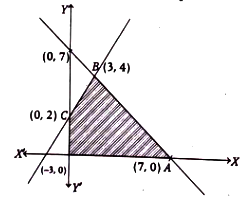 KCET 2023 Easy
 - If \( \frac{(x+1)^{2}}{x^{3}+x}=\frac{A}{x}+\frac{B x+C}{x^{2}+1} \), then \( \operatorname{cosec}^{-1}\left(\frac{1}{A}\right)+\cot ^{-1}\left(\frac{1}{B}\right)+\sec ^{-1} C= \)KCET 2015 Easy
- The maximum value of \( \left(\frac{1}{x}\right)^{x} \) isKCET 2016 Hard
- On the set \(Z\), of all integers \(*\) is defined by \(a * b=a+b-5\). If \(2 *(x * 3)=5\), then \(x\) is equal toKCET 2008 Hard
- The range in which \(y=-x^{2}+6 x-3\) is increasing isKCET 2007 Easy
More PYQs from KCET
- Entropy of the universe isKCET 2007 Medium
- A particle of specific charge \(q / m=\pi \mathrm{C} \mathrm{kg}^{-1}\) is projected the origin towards positive \(X\)-axis with the velocity \(10 \mathrm{~ms}^{-1}\) in a uniform magnetic field \(\mathbf{B}=-2 \hat{\mathbf{k}}\) T. The velocity \(\mathbf{v}\) of particle after time \(t=\frac{1}{12} \mathrm{~s}\) will be (in \(\mathrm{ms}^{-1}\) )KCET 2024 Hard
- The potential difference between and in the following figure is
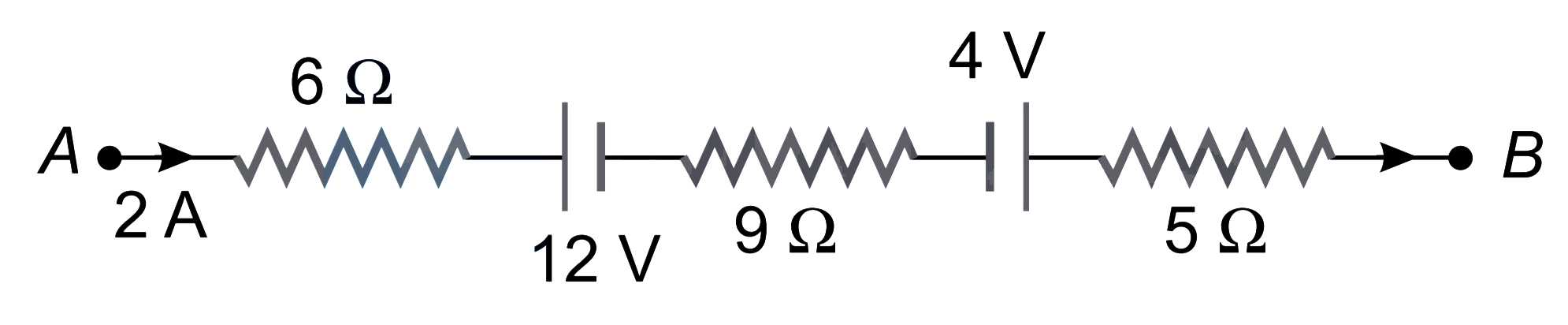 KCET 2008 Hard
 - When the chromosome number of a given orgainism has one additional chromosome in one of the homologus pairs, the condition is known as __________KCET 2005 Easy
- The points \(A(1,2), B(2,4)\) and \(C(4,8)\) form a/anKCET 2011 Easy
- E is the electric field inside a conductor whose material has conductivity \(\sigma\) and resistivity \(\rho\). The current density inside the conductor is \(\mathbf{J}\). The correct form of Ohm's law isKCET 2024 Easy